
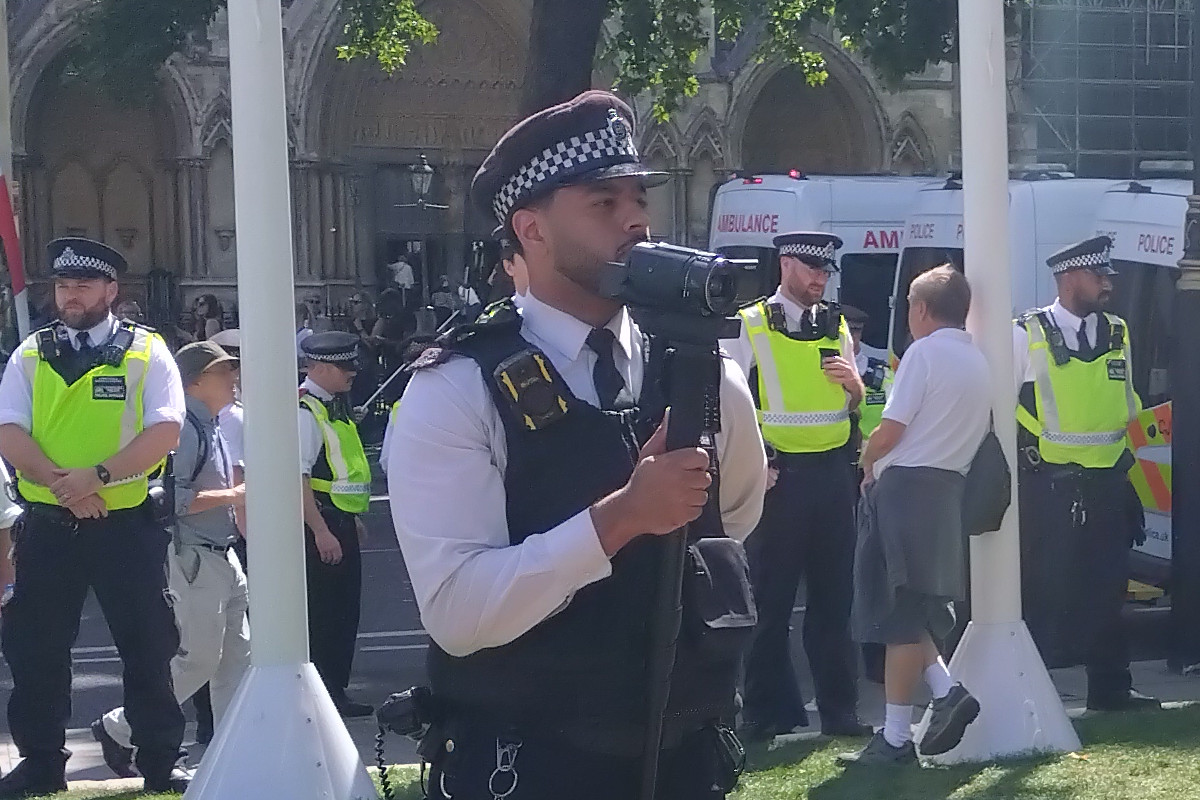
Filming protests and facial recognition
While British police have photographed and filmed protests for many years, advances in facial and object recognition technology now make it feasible to use the footage in ways that would seriously undermine basic civil liberties.
Liberty Investigates warned in 2023 that “retrospective facial recognition technology” could be used on thousands of photos of innocent people held in the police “custody image” database.
The same technology could also be applied to footage taken from protests – or, indeed, anywhere – and used to identify individuals, their friendship and political groups, and their movements and associations over time.
In August 2021, the Metropolitan Police (London’s police force, also known as the Met) signed a four-year contract for retrospective facial recognition technology with a subsidiary of NEC Corporation.
The procurement notice (pdf) said it would enable:
…effective use of images and image frames from video data across all types of investigations. Technical advancements made over recent years would, if seized, now allow the MPS opportunities that were not previously available to support the detection and matching of faces.
NEC is itself a major supplier of facial recognition technologies, and has contracts with police forces including Europol.
In April this year, the company was one of the winners of a £20 million contract for “the provision of Live Facial Recognition (LFR) Software,” which is being deployed by a growing number of police forces around the country.
“Common law right” to film protesters
The Metropolitan Police state that “a common law right exists to take and retain photographs,” as affirmed by a 2009 court case brought by a Campaign Against Arms Trade employee who was photographed by the police.
The Court of Appeal ruled, according to the freedom of information (FOI) response received by Statewatch (pdf), that the “taking and retention of photographs must be for a clearly defined policing purpose(s) and be necessary and proportionate to the circumstances.”
However, the judgement also notes that when the case was brought, the Metropolitan Police had “a balanced and reasonable published policy.”
Various versions of a Metropolitan Police policy on overt filming are publicly available (see documentation below). These were released in response to previous FOI requests, but it is not clear if they still apply.
As part of the FOI request, Statewatch asked for a copy of relevant policies or guidance, and the Met confirmed that “there is an Overt Filming Standard Operating Procedure (SOP).” They did not provide a copy, despite repeated follow-up requests.
Retention periods
Asked how long video footage is held after a protest, the Met said it was “generally retained for 31 days.”
However, “footage taken to record the character of a public order event without targeted individuals, may be retained for a period of up to 6 years,” and where “significant criminal activity” takes place, up to 50 years.
Footage “considered to be of potential evidential value… may be retained as part of the prosecution case or other investigation.”
Intelligence purposes
Of more interest to those concerned with political policing will be the retention of footage for intelligence purposes.
Decisions to film protests lie with “the Silver Commander for the event,” meaning that it falls under the responsibility of “MO6 Public Order Command and not MO2 Met Intelligence,” says the Met’s FOI response. MO is the prefix for a division within the Met.
“Footage containing intelligence may be retained if this is justifiable, in accordance with management of police information (MoPI) Guidance (s7 Review, Retention and Disposal),” says the response.
The MoPI Guidance includes three categories of information, the highest grade of which is “serious offences and public protection matters.”
This includes information on people who have committed or who may commit serious violent or sexual offences, or any offence that carries a sentence of 10 years or more.
Alongside this, “Group 1” also includes “intelligence reports of any grade.”
Data can be retained until the 100th birthday of the individual in question, though it should be reviewed every 10 years.
The police have a significant interest in gathering “intelligence” on protesters and protest groups, as made clear by the spycops scandal.
Combined with the intrusive potential of facial recognition technologies, this is one reason why the Network for Police Monitoring has called for people to cover their faces at protests.
Use of the footage
Asked what the footage can be used for, the Met said:
The purpose for filming needs to be a legitimate Policing purpose, such as protecting life and property; preserving order; preventing the commission of offences; bringing offenders to justice; and any duty or responsibility arising from common or statute law.
The request also asked whether video footage was cross-referenced with other types of information, such as information gathered from mobile phone networks.
The response says that if footage is used for investigation or prosecution, “it may be that it is cross-referenced with other types of data or Information [sic].”
Documentation
- Metropolitan Police, Freedom of Information Request Reference No: 01/FOI/25/047237/I, 15 September 2025 (pdf)
- Mayor of London Office for Policing and Crime, Retrospective Facial Recognition System, 18 August 2021 (pdf)
- Metropolitan Police, Draft Standard Operating Procedures for Overt Filming/Photography (originalFOI request)
- 7 December 2004 (pdf)
- 12 January 2005 (pdf)
- Metropolitan Police, Territorial Policing: Visual Evidence Policy, undated, released February 2010 (pdf)


