

Please note: this observatory is no longer updated.
In the wake of the attacks in the US on 11 September 2001 and 11 March in Madrid a whole series of new measures have been introduced which affect fundamental rights. This “Observatory” tracks measures by providing both anaylsis and documentation so that civil society can find out what is being planned and make its views known.
EU: Tony Bunyan’s “View from the EU” column in the Guardian looks at: Europe’s race to the right: The results of the European elections look certain to cement the centre right and far right’s sway over politics in Europe (link): “EU institutions and governments regularly repeat the mantra that we all “share common values”, as if the project has unchanging standards and principles, but do we?”
* UN: Report of the Special Rapporteur on the promotion and protection of human rights and fundamental freedoms while countering terrorism, by Martin Scheinin (pdf): The collection and sharing of “signal” intelligence has led to several violations of the right to privacy and the principle of non-discrimination, while “human intelligence” – the gathering of intelligence by means of interpersonal contact – has even led to violations of jus cogens norms such as the prohibition against torture and other inhuman treatment. Evidence suggests that the lack of oversight and political and legal accountability has facilitated illegal activities by intelligence agencies.”
* EU: Statewatch analysis: The “digital tsunami” and the EU surveillance state (pdf) by Tony Bunyan
* EU: SPECIAL STATEWATCH REPORT: The Shape of Things to Come by Tony Bunyan
The EU is currently developing a new five year strategy for justice and home affairs and security policy for 2009-2014. The proposals set out by the shadowy “Future Group” set up by the Council of the European Union include a range of highly controversial measures including new technologies of surveillance, enhanced cooperation with the United States and harnessing the “digital tsunami”. In the words of the EU Council presidency: “Every object the individual uses, every transaction they make and almost everywhere they go will create a detailed digital record. This will generate a wealth of information for public security organisations, and create huge opportunities for more effective and productive public security efforts.”
Seven years on from 11 September 2001 and the launch of the “war on terorism” this major new report The Shape of Things to come (60 pages) examines the proposals of the Future Group and their effect on civil liberties. It shows how European governments and EU policy-makers are pursuing unfettered powers to access and gather masses of personal data on the everyday life of everyone – on the grounds that we can all be safe and secure from perceived “threats”.
The Statewatch report calls for a “meaningful and wide-ranging debate” before it is “too late” for privacy and civil liberties.
Press release:
Eight page Conclusions
The Shape of Things to Come: Full report (pdf)
* USA: RENDITION-TORTURE-US ASSURANCES: Report from the UK House of Commons foreign Affairs Committee: Human Rights Annual Report 2007 (pdf). It includes the following Conclusions:
“We conclude that, given the clear differences in definition, the UK can no longer rely on US assurances that it does not use torture, and we recommend that the Government does not rely on such assurances in the future.”
“We conclude that it is extremely important that the veracity of allegations that the Government has “outsourced” interrogation techniques involving the torture of British nationals by Pakistani author authorities should be ities investigated.”
“We conclude that the Government has a moral and legal obligation to ensure that flights that enter UK airspace or land at UK airports are not pa part of the “rendition rt circuit”, even if they do not have a detainee on board during the time they are in UK territory. We recommend that the Government should immediately raise questions about such flights with the US authorities in order to ascertain the full scale of the rendition problem, and inform the Committee of the replies it rece receives in its response ives to this Report.”
* USA: Amnesty International USA (AIUSA), the Center for Constitutional Rights (CCR), and the International Human Rights Clinic at NYU School of Law (NYU IHRC): Rights groups challenge CIA for failure to release more than 7,000 documents relating to secret detention, rendition and torture program (pdf): “The Central Intelligence Agency (CIA) must no longer be allowed to use classification arguments in its attempts to prevent the disclosure of illegal or embarrassing conduct in its secret detention, torture, and rendition programs, three prominent human rights groups said today. The statement came just hours after they collectively filed a motion to require the CIA to make certain information public and to provide more details about all the documents withheld.”
* Statewatch’s observatory on the “terrorist lists” has been updated with the following items:
– Pakistan launches fresh offensive in Baluchistan, Britain accused of Baluchi “prisoner swap”;
– Denmark: Seven activists facing prison for symbolic support of PLFP and FARC;
– UK: POAC rules proscription of the People’s Mojahedin Organisation of Iran (PMOI) unlawful;
– Procedures for blacklisting individuals suspected of terrorist links are unworthy of the UN Security Council and EU, says COE
– European Court of Justice strikes down Commission’s decision to grant anti-terrorism assistance to the Philippines government;
– Four new challenges against EU ‘terrorist’ lists lodged at Court of First Instance;
– European Court of Justice rules that it is illegal to sell property to people whose assets have been frozen under Community law.
* CIA RENDITION-IRISH HUMAN RIGHTS COMMISSION report: “Extraordinary rendition” inspection and monitoring regime must be established as a matter of urgency: Diplomatic assurances not enough says Irish Human Rights Commission (Press release, 11 December 2007, pdf). The full text of the IHRC Report (20 MB, link)
“The report concludes that diplomatic assurances received from the US Government are not sufficient for Ireland to satisfy its human rights obligations with regard to the issue of ‘extraordinary rendition’ flights passing through Irish territory.
The Commission recommends that an effective inspection regime be put in place to ensure that no foreign aircraft which might be suspected of involvement in the illegal practice of ‘extraordinary rendition’ may land and refuel in Ireland. An effective inspection regime will ensure that no prisoners are transited through the State en route to a situation of torture or inhuman or degrading treatment or punishment.”
* COUNCIL OF EUROPE: Procedures for blacklisting individuals suspected of terrorist links are unworthy of the UN Security Council and EU (12 November 2007, full-text of report, pdf) says PACE. The Legal Affairs Committee of the Council of Europe Parliamentary Assembly (PACE), which today approved a report by Dick Marty (Switzerland, ALDE). These procedures, which are “unworthy” of the UN and EU, must urgently be overhauled to make them fairer. Earlier report by Marty: UN Security Council black lists (March 2007, pdf)
* EU-PNR-PLAN: European Commission: PNR (passenger name record) scheme proposed to place under surveillance all travel in and out of the EU
* EU-USA Agreement on the exchange of classified information: – “carte blanche” for exchanging information on a host of issues – all documents to be exchanged by courier – no electronic exchanges. Tony Bunyan, Statewatch editor, comments: “This is another instance of secret policymaking. European and national parliaments should be consulted and the texts made public so that there can be a debate as to their content and consequences. Putting these agreements in place is not just about exchanging classified documents, it is also about the construction of a security regime for future cooperation on defence, foreign policy and justice and home affairs between the EU, non-EU states and unaccountable international organisations. It is about cementing the aims and objectives of the EU-NATO-USA politico-military axis.”
* Council of Europe’s Anti-Torture Committee denounces secret detention: “Strasbourg, 14.09.2007 – In its 17th General Report published today, the CPT denounces secret detention, an illegal practice that has been resorted to in particular in the context of the fight against terrorism. Secret detention amounts in itself to ill-treatment and – due to the removal of fundamental safeguards which it entails – inevitably heightens the risk of resort to other forms of ill-treatment. Responding to reports that certain secret detention facilities were located in European countries, the CPT invites anyone who is in possession of information concerning such facilities to bring it to the attention of the Committee. The CPT also comments on the related issue of extra-judicial transfers from one country to another, so-called “renditions”. The Committee is particularly concerned by the practice of rendition for the purposes of detention and interrogation outside the normal criminal justice system. “Operations of this kind inevitably involve a risk of ill-treatment for the person concerned that no ‘assurances’ can ever fully remove; it follows that the authorities of Parties (to the European Convention for the Prevention of Torture) should never offer assistance in the context of such operations”. (CoE, press release) Full-text of General Report (pdf)
* EU-USA: SPECIAL: US demands 10 year ban on access to PNR documents The US government has written to the Council of the European Union – seven days after it was signed – asking it to agree that all the documents regarding the negotiations leading to the controversial new EU-US PNR (passenger name record, signed on 23 July 2007) agreement be kept secret
* EU-US PNR agreement: US changes the privacy rules to exemption access to personal data USA to give exemptions for the Department of Home Security from its Privacy Act – USA to give exemptions for the “Arrival and Departure System” (ADIS) from its Privacy Act – Did the EU know that the US was planning to introduce these exemptions?
* Statewatch analysis: “Terrorist lists” still above the law (pdf) by Ben Hayes who comments: “The EU’s reform of its terrorist lists amounts to little more than window dressing. Secret intergovernmental committees continue to act as judge and executioner and those listed are denied their basic human rights. Until they are granted a fair hearing – in which the substantive allegations against them can be reviewed by a competent, impartial tribunal – the terrorist lists will continue to represent a legal vacuum and a betrayal of the EU’s commitment to the rule of law”
* CoE: CIA secret detentions in Europe: PACE urges oversight of military and foreign intelligence services (CoE, link)
* EU-USA-PNR: European Data Protection Supervisor, Peter Hustinx, letter to the German Council Presidency: Hustinx letter, 27 June 2007: full-text (pdf). The letter expresses “grave concern” at the proposals
* EU-USA-PNR (passenger name record): EU negotiators agree that PNR data will be held for 7 years, doubling the current 3.5 years, and in addition agree that data can be access for a further 8 years (so-called “dormant” data). See News Online
* Council of Europe: Clandestine CIA operations authorised through NATO including those in Poland and Romaia: Secret detentions and illegal transfers of detainees involving Council of Europe member states: Second report (link to press release). Secret detentions and illegal tranfers of detainees involving CoE members: second report by Dick Marty (full-text, pdf) and – Disguised CIA flights to Poland (link to graph); – The “secure zone” for CIA transfers and secret detentions in Romania (link); – Flight logs related to the secret “homeward rendition” of Khaled El-Masri in May 2004 (pdf); – The investigation into secret detentions in Europe: a chronology (link)
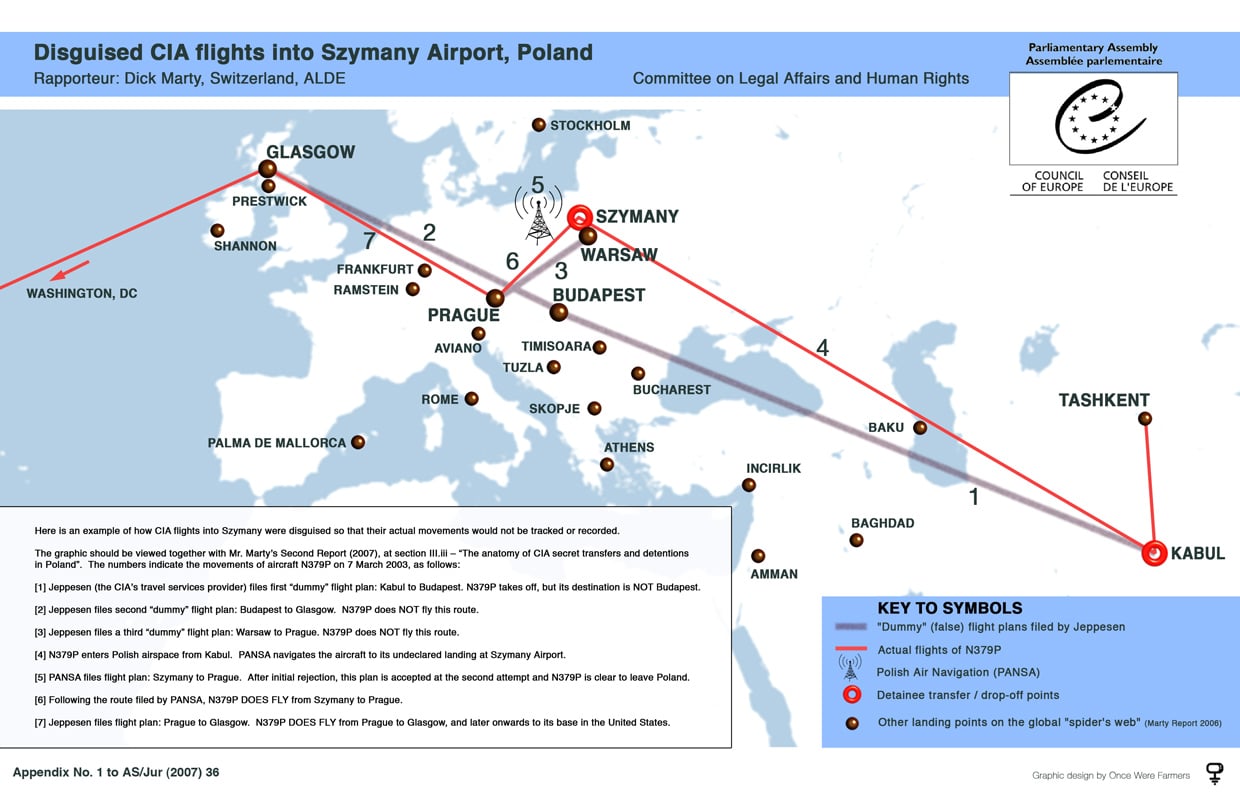
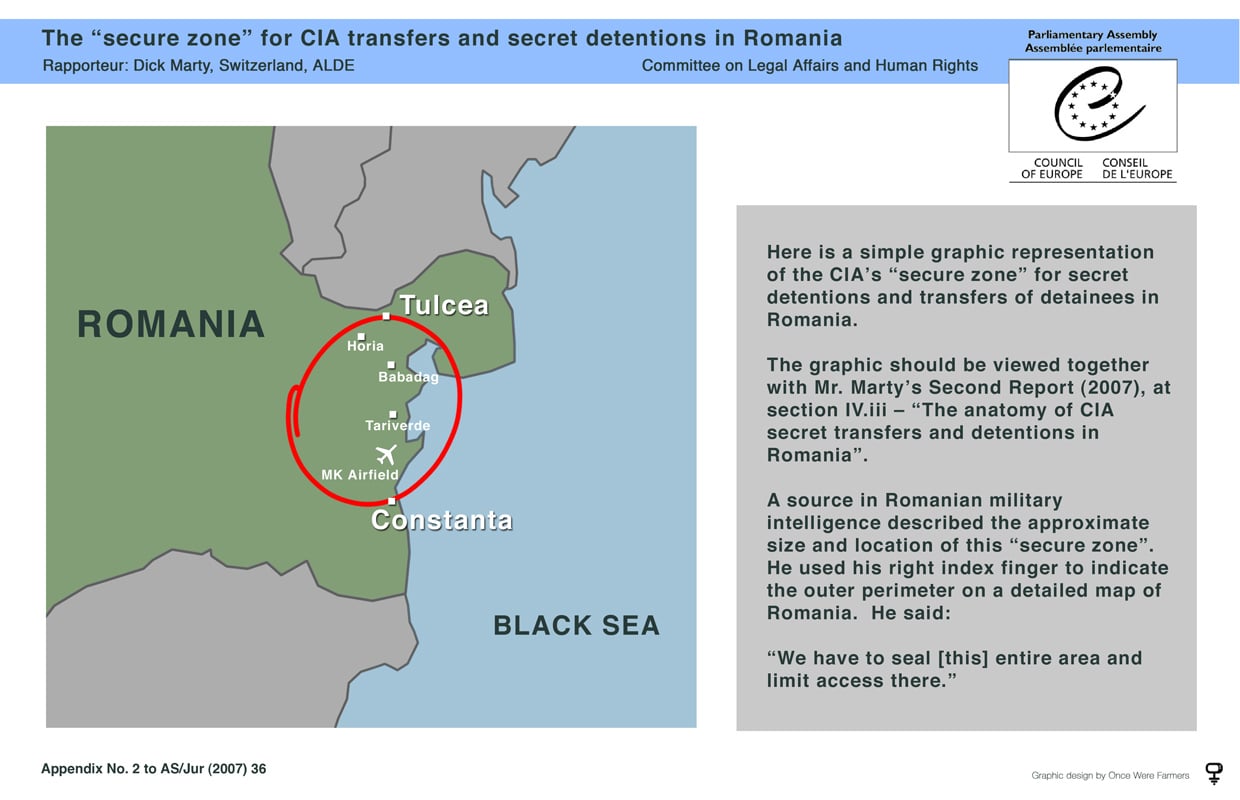
* ITALY-CIA-RENDITION: Americans and Italians are indicted in CIA kidnapping case (International Herald Tribune, link) MILAN, Italy: An Italian judge on Friday indicted 26 Americans and five Italians for what will be the first criminal trial over the CIA’s extraordinary rendition program. The judge set a trial date for June 8. Prosecutors allege that five Italian intelligence officials worked with the Americans – almost all CIA agents – to abduct terror suspect Osama Moustafa Hassan Nasr from a Milan street on Feb. 17, 2003. See: Statewatch’s Observatory on CIA Rendition – documentation
* EP: The European Parliament has adopted (14 February 2007) a highly critical report on CIA renditions and detentions and on the activities of a number of EU governments including the UK, Austria, Italy, Poland and Portugal. The report: “gives detailed evidence of investigations of illegal rendition or CIA flight cases involving Germany, Sweden, Spain, Ireland, Greece, Cyprus, Denmark, Turkey, the Former Yugoslav Republic of Macedonia (FYROM), Bosnia and Romania.” Full-text of the European Parliament Resolution adopted on 14 February 2007 on CIA rendition and detention (pdf) Press release on the CIA rendition debate and amendments agreed (pdf). Excellent summary in Working Document no 9 of the key evidence (eg: cases and flights) gathered on Italy, UK, Germany, Sweden, Austria, Spain, Portugal, Ireland, Greece, Macedonia, Bosnia Herzegovina, Romania and Poland to back up the Resolution above: Evidence gathered on key EU states – CIA rendition and detention (pdf) This should be read in conjunction with: Working Document no 7 (extraordinary renditions) and Working Document no 8: Companies working for the CIA and stop-overs in the EU. Tony Bunyan, Statewatch editor, comments: “The European Parliament’s committee of inquiry has done a great public service in gathering evidence to show not just the extent of CIA renditions through and abductions in the EU but also the collusion – by “turning a blind eye” – of EU governments. This have been achieved with little or no help from the other EU institutions (European Commission and the Council of the European Union).”
* ITALY-CIA: Italian judge issues arrest warrants for 13 CIA agents involved in the kidnapping and rendition of Abu Omar to Egypt where he was tortured: Abu Omar: Evidence as presented to the courts (pdf, 210 pages) See also Statewatch’s Observatory on CIA renditions and detention (documents) and CIA team wanted over Milan ‘kidnap’ (Guardian, link)
* European Parliament inquiry into CIA rendition and detention: Inquiry report as adopted by the Committee on Civil Liberties (pdf). The report now goes to the plenary session. Press release on committee report For full background documentation see: Statewatch’s Observatory on CIA renditions and detention
* Border Wars and Asylum Crimes by Frances Webber. When the Statewatch pamphlet “Crimes of Arrival” by the same author was written, in 1995, the title was a metaphor for the way the British government, in common with other European governments, treated migrants and especially, asylum seekers. Now, a decade on, that title describes a literal truth: Order publication (£10, 36 pages, A4)
* EU-CIA-RENDITION: What happened at dinner?
* Sweden: UN Human Rights Committee finds that Sweden broke the international prohibition against torture. The case concerned the rendition of two Egyptians from Sweden 2001 by undercover US and Egyptian agents. The UN Committee also states that the treatment of the two men on Swedish soil (Bromma Airport in Sweden) in connection with the rendition was a breach of the ban on torture and inhuman treatment. Full text of: UN Human Rights Committee Decision, 6 November 2006 Statewatch coverage: Sweden: Expulsions carried out by US agents, men tortured in Egypt and Update
* New EU-USA PNR deal:For full background documentation and history, see Statewatch’s Observatory on the exchange of data on passengers (PNR) with the USA
* EU-USA: Status of ratifications on EU-USA Agreements on extradition and mutual legal assistance and bilateral instruments (pdf) Full-text of the Agreements (pdf) Statewatch analysis The two Agreements signed by the EU and USA on 25 June 2003 still have to be ratified by both sides – the US side will not start until the procedures in the EU member states are completed. Twelve of the member states in the old EU of 15 had to go through constitutional procedures as did the ten new states. Twelve member states still have to complete constitutional procedures. And although all 25 member states have signed the accompanying bilateral instruments with the USA the majority still have to ratify these. It is interesting to note that had the agreement on extradition been in place EU government could request the extradition of suspected CIA agents operating in the EU.
* European Parliament: Transfer of financial data to USA from SWIFT: The parliament adopted a Resolution on 6 July calling on EU governments, the Commission and the European Central Bank “to explain fully the extent to which they were aware of the secret agreement” between the Belgium-based SWIFT (‘Society for Worldwide Interbank Financial Telecommunication’) and the United States. Full-text of Resolution (pdf) Text of the debate – in original languages (pdf) The Resolution was proposed by an alliance of the PSE (Socialist group), ALDE (Liberals), GUE/NGL (United Left) and Green/EFA group. It was agreed by 302 votes with 219 votes against from the PPE-DE (Conservatives) and UEN groups. See: European Digital Rights (link) and: Privacy International: complaints in 33 countries on transfer of financial data to the US by SWIFT (link)
* European Parliament: Interim report on alleged use of European countries by the CIA for the transport and illegal detention of prisoners approved in plenary session by a majority of 389 members against 137 with 55 MEPs abstaining (6 July 2006). Press release (pdf) Full-text of Interim report (pdf)
* EU: News agencies are reporting: Italian intelligence officer arrested in CIA kidnapping probe. The no 2 of the SISMI (the IT military intelligence service), Mauro Mancini, Director of the foreign “clandestine operations” section, has been arrested in connection with the CIA kidnapping of Abu Omar in Milan in 2003 – Abu Omar was flown by the CIA to Germany and then to Egypt where he was tortured. For full background see: Statewatch’s Observatory on CIA rendition and flights which includes under Documents the court documents (nos 136-143)
* Europol-USA agreement: Was it really needed? Analysis and full-text of evaluation report. The report shows that there is no record of data transfers recorded by USA. 2005 evaluation report still secret
* MEPs: CIA “directly responsible” for abduction, detention and extraordinary renditions in Europe: European Parliament inquiry adopts interim report on CIA flights and rendtion Text of the Interim report NEW: Contribution of the Rapporteur: Research on the planes used by the CIA – highly detailed 72 page report (pdf) See for full background Statewatch’s Observatory – full-text reports and 185 documents
* EU-US PNR (passenger name record) Treaty annulled by Court of Justice in case brought by the European Parliament – but is it a “pyrrhic” victory? Full-text of Judgment (pdf) Court of Justice press release (pdf)
* Statewatch launches a new “Observatory” on CIA “rendition”
* EU-USA: MEPs say Washington visit shows CIA investigation must continue – press statement 12 May 2006 from the delegation from the Committee of Inquiry into flights and detention (TDIP)
* European Parliament: ALDE (Liberal group) welcomes draft report on CIA alleged flights and secret prisons in the EU: Press statement (English) Press statement (French) Interim report from the inquiry into on the alleged use of European countries by the CIA for the transport and illegal detention of prisoners (French)
* EU: New Statewatch Report: Tuesday 25 April 2006: Arming Big Brother: new research reveals the true costs of Europe’s security-industrial complex (pdf) The European Union is preparing to spend up to €1 billion per year on new ‘research’ into surveillance and control technologies, according to Arming Big Brother, a new report by the Transnational Institute (TNI) and Statewatch. “Arms industry lobbying is leading to the creation of a powerful new internal security-industrial complex,” says Ben Hayes, author of the report. Arming Big Brother lifts the lid on the secretive committees and arms industry lobbying that led to the creation of the European Security Research Programme (ESRP). “The EU is basically funding the diversification of the ‘military-industrial complex’ into the highly profitable internal security field”, said Hayes. “The militarisation of policing and border controls will not prevent crime or terrorism, it does nothing to address ‘root causes’ while posing a massive threat to civil liberties”: Press release Five page Summary Copy of full report Hard copies of Arming Big Brother can be obtained from: The Transnational Institute, please send an e-mail to: wilbert@tni.org with your request.
* UK: “Renew for freedom” campaign launched – urging people to get a new passport now to avoid the fingerprinting ID card for 10 years. How to do it Factsheet (pdf) “Renew for freedom” website ((link)
* EU: Data Protection Commissioners calls for harmonised safeguards on the use of mandatory data retention Tony Bunyan, Statewatch editor, comments: “Time and time again EU governments are “harmonising” the powers of the state to place individuals under surveillance, when are they going to “harmonise” the right of the individuals against the misuse and abuse of state power?”
* EU-CIA: Highly detailed Working Table on alleged CIA flights/secret prisons prepared for the European Parliament’s inquiry (pdf) prepared by the ALDE/CIA team
* EU-US Informal High Level meeting on freedom, security and justice on 2-3 March in Vienna – full-text (pdf) The minutes of this high-level meeting show the US input/interest on substantial issues of EU policy-making. Of particular interest are: 1. “US side indicated that it was considering approaching each [EU] Member State to ensure that the data collected on the basis of the recently adopted Directive on data retention be accessible to them”. This is the measure which will enable the surveillance of all phone-calls, e-mails, faxes, mobile phone-calls and internet usage; 2. “US side expressed serious concern about the negative impact that the draft Framework Decision on data protection would have on its bilateral relations with Member states if it was to be adopted in its present form”. This is a reference to Article 15 of the proposed measure referring to “an adequate level of protection is ensured in the third country” – which raises yet again the fact that there is no protection for non-US citizens. The EU side at the meeting clearly sought to meet this point by saying that: “Member States were divided on the need for such a provision”.
* EU: Report from European Commission for Democracy through Law (Venice Commission) Opinion on the International legal obligations of Council of Europe Member States in respect of secret detention facilities and inter-state transport of prisoners (adopted at the Plenary session on 17-18 March 2006, pdf)
* UK: British airports handled 73 CIA flights – details
* MEPs demand that the report on EU-US PNR (passnger name records) is de-classified: Letter to US from Liberal group MEPs (pdf). For full background see Statewatch’s Observatory on the exchange of data on passengers (PNR) with USA
* EU-USA: The agreements on extradition and mutual legal assistance agreed in June 2003 still have some way to go before they come into effect. Twenty-two Member States are in the process of amending their constitutions to give effect to the agreements – a few of these have completed this process: EU doc no: 5848/06 (pdf). For full background and texts of the agreements see: Statewatch’s analysis
* Council of Europe: Damning report on secret detentions and transport of detainees by foreign agencies (full-text, pdf). The report concludes that: Europe has next to no safeguards to monitor or control foreign intelligence agents nor any way of monitoring that its airports and airspace were not used for illegal abductions. For a: Full list of the replies given by each European government to the CoE’s questions (link)
* CIA-renditions-flights: Speech by Tony Bunyan, Statewatch, to the European Parliament hearing on 23 February 2006 (pdf)
* Report from an Autistic Country by Dennis Tollborg, Sweden (pdf) Far-ranging lecture on the use and abuse of national security, the role of intelligence agencies and how the lives of people targeted can be ruined.
* USA: General Accountability Office (GAO) report on the “Secure Flight” programme which monitors domestic flights finds that the: “lack of progress indicates that the program has not been effectively managed and is at risk of failure” (p43). For example, none of the privacy and redress protections have ben put in place. International flights are to be monitored through the Customs and Border Protection’s (CBP) Advanced Passenger Information System (APIS) and Passenger Name Record (PNR) scheme.
* Council of Europe: Rendition and camps: According to Council of Europe Parliamentary Assembly investigator Dick Marty it is highly likely that European governments were aware of ‘rendition’ affecting Europe: CoE Interim Report – full-text (pdf)
* The war on terrorism: What is “Camolin”? An intelligence operation involving agencies from the USA, Germany, France, UK, Canada and Australia
* EU-USA: “Frank and non-diplomatic language” censored – Statewatch denied access to document to hide EU views on US demands
* EU-wide warrant over ‘CIA kidnap’ (BBC, link) Abu Omar was allegedly kidnapped from a Milan street An Italian court has issued Europe-wide arrest warrants for 22 suspected CIA agents accused of helping to kidnap a Muslim cleric in Milan in 2003.
* EU: “Unaccountable Europe” by Tony Bunyan (Statewatch editor) in Special issue of Index on Censorship: “Big Brother Goes Global”
* EU-USA: Rendition and removing refugees raise the same issue: Censored document reveals increased transit facilities for the USA to use EU airports to move people around the world Tony Bunyan, Statewatch editor, comments: “Whether these US transit flights are for “criminals”, “inadmissible aliens” or for rendition the same questions arise. Do EU governments know how many times their airports have been used for “transit” by US government flights? Which airports are used? How many people have been moved in this way? How many “criminals” and how many “inadmissible aliens”? If they do then why are the facts and figures not available? And if they do not know, why not? If EU governments do not know who is being moved and where by foreign agencies using their airports then they are grossly irresponsible. To “aid and abet” the movement of people in an inhuman or degrading way or to be tortured is a crime.”
* EU: European Parliament, 14 December 2005: The EP today voted in favour of “deal” on mandatory data retention agreed in secret meetings between the Council (EU governments) and the “grand coalition” of the PPE (conservative group) and the PSE (socialist group). The measure was “fast-tracked” through the parliament on 1st reading. The vote was 378 votes in favour, 197 against and 30 abstentions. The GUE, Greens and UEN groups and some members from the ALDE group voted against the directive in the final vote. The rapporteur, Alexander Nuno Alvaro (ALDE, DE) withdrew his name from the report. For documents and background please see: Statewatch analysis: “The European Parliament and data retention: Chronicle of a ‘sell-out’ foretold?” (pdf) by Professor Steve Peers, Open Letter from civil society groups to the European Parliament calling on MEPs to reject Data Retention, UK-EU: Data retention and police access in the UK – a warning for Europe and for full background, see Statewatch’s Observatory on the surveillance of telecommunications in the EU
Tony Bunyan, Statewatch editor, comments: “The European Parliament has failed on almost every count to protect fundamental rights and privacy. The two big parties in the parliament believe more in “inter-institutional loyalty” to the Council (the EU governments) than their responsibility to the people who elected them. The way this measure was passed is a democratic travesty – rushed through with deals negotiated in secret and not in open committee. When civil society and national parliaments have no chance to find out what is happening, when the proper co-decision timetable is discarded, there is little chance to intervene. Such a procedure diminishes respect for the European Parliament and lacks any legitimacy whatsoever. Mandatory data retention will place all the communications of everyone under surveillance. In 2002 the same grand coalition steam-rolled through the Directive on privacy in telecommunications opening the door to state agencies. In December 2004 the mandatory taking of finger-prints for passports was agreed and in April 2004 an EU PNR (passenger name record) for everyone flying in and out too. The asylum procedure directive – which is a disgrace to any notion of humanity and the rule of law – was formally adopted last week. The cost of the “war on terrorism” to democratic standards is mounting as each year goes by.”
* Europe: Parliamentary Assembly of the Council of Europe’s (PACE) Committee on Legal Affairs and Human Rights, Paris 13 December. The rapporteur and Chair of the Committee, Dick Marty, Council of Europe statement on detention centres (full-text). “Legal proceedings in progress in certain countries seemed to indicate that individuals had been abducted and transferred to other countries without respect for any legal standards.”
* European Commission: “Recommendation” and “Code of Conduct” for non-profit organisations. In another response to the “war on terrorism” the proposal calls for the compulsory registration of all non-profit groups in the EU: European Commission proposal calls for the compulsory registration of NGOs The proposal is being considered by the Council’s (25 EU governments) “Joint meeting of Financial Attaches and Counter-Terrorism Focal Points”, its first thoughts are in: EU doc no: 14694/05
* EU: The European Union Strategy for Combating Radicalisation and Recruitment to Terrorism” to be adopted as an “A” Point (without discussion) at the Justice and Home Affairs Council on 1-2 December
* EU: Opinion of the Advocate-General on the European Parliament’s case on EU-US PNR before the Court of Justice: Press release (pdf) Full-text of Opinion (French, 4.52MB, pdf). For background and documentation See Statewatch’s Observatory exchange of passenger data with the USA Commentary: Advocate general backs Parliament challenge on passenger records (euractiv, link) EU-US air data accord under legal threat (eupolitix, links)
* Statewatch has launched an Observatory on the surveillance of telecommunications in the EU – under mandatory data retention a record will be kept of everyone’s phone-calls, e-mails, mobile phone calls (including location) and internet usage. The Council (the 25 EU governments) are proposing the data can be accessed by law enforcement agencies for any suspected crime, however minor. The proposal is now being discussed in the European Parliament.
* UK-EU: Data retention and police access in the UK – a warning for Europe
* EU: Mandatory data retention:
- Critical Opinion of the Article 29 Working Party on Data Protection (pdf)
2. The Council’s latest draft positions on its Framework Decision and the Commission’s draft Directive (doc no: (13789/05, dated 28.10.05) – effectively the Council’s negotiating position
3. Background: Statewatch’s: Annotated Guide to the issues and documentation
4. Context: While Europe sleeps…..
* EU: Two overviews on civil liberties, security and democracy: While Europe sleeps: under the “war on terrorism” a veneer of democracy is legitimating the creation of a coercive (and surveillance) state by Tony Bunyan and There is no “balance” between security and civil liberties – just less of each by Ben Hayes
* “Essays on civil liberties and democracy in Europe”: A collection of sixteen Essays were specially written for the launch of the European Civil Liberties Network (ECLN) on 19 October. They include: “The Rules of the Game”? A. Sivanandan, Director of the Institute of Race Relations; The “War on Terror”: lessons from Ireland Paddy Hillyard, Professor of Sociology, Queens University, Belfast; Why Terror and Tolerance are the Greatest Test of Modern Journalism Aidan White, Secretary-General European Federation of Journalists; Lex Vigilatoria – Towards a control system without a state? Thomas Mathiesen, Professor of the Sociology of Law, Oslo University, Norway; Checking and balancing polity-building in the European Union Deirdre Curtin, Professor of European and International Governance, Utrecht School of Governance, Utrecht, Netherlands; Lampedusa – a test case for the subcontracting of EU border controls Lorenzo Trucco, President of A.S.G.I. (Associazione Studi Giuridici sull’Immigrazione)
* European Civil Liberties Network (ECLN) to be launched on Wednesday, 19 October 2005:
“We are living at a moment in history when civil liberties and democracy are under attack as never before and the need for a collective response to counter these threats has never been greater.
We share common objectives of seeking to create a European society based on freedom and equality, of fundamental civil liberties and personal and political freedoms, of free movement and freedom of information, and equal rights for minorities. This entails defending, extending and deepening the democratic culture – a concept not limited to political parties and elections but embracing wider values of pluralism, diversity and tolerance. And we share too a common opposition to racism, fascism, sexism and homophobia.
The defence of civil liberties and democracy also requires that positive demands are placed on the agenda. For example, respect and rights for all people, cultures and their histories, for the presumption of innocence and freedom from surveillance and the freedom to protest and demonstrate.
To these ends the European Civil Liberties Network (ECLN) has been established.”
Press launch in Brussels and Workshop for NGO’s and researchers (pdf)
ECLN website and Noticeboard (link)
* EU: Mandatory data retention: Report of the European Parliament adopted on 27 September 2005 rejecting the Council’s proposal (pdf) European Parliament press statement (link) Latest version of the Council’s proposal, 27.9.05 (pdf). The View of the Article 29 Data Protection Working Party on the Council initiative by five members states (November 2004). Text of the European Commission proposals on the mandatory retention of telecommunications data (pdf) Full-text of the Commission’s Extended Impact Assessment (pdf). The Commission’s Impact Assessment is dismissive of the strong objections from the European Data Protection Supervisor and the national Data Protection Commissioners on the Article 29 Working Party stating that it expects them to “revisit their position(s)”. Report from the European Data Protection Supervisor on the Commission’s proposal (26.9.05) on the Commission’s proposal. Civil society letter to Members of the European Parliament on data retention proposals, from 21 NGOs.The Council’s proposal, from five member states, combines the mandatory retention of traffic data by service providers and access to the data by law enforcement agencies (LEAs) – on which the European Parliament is only “consulted”. The Legal Services of the Council and Commission said the proposal should be split in two with the first measure (data retention) coming under the “first pillar” on which the parliament would have powers of co-decision with the Council. The Commission has put forward a proposal on data retention under the “first pillar” which will be followed by another on access by LEAs. Tony Bunyan, Statewatch editor comments: “The issue of the legal basis is clear, there should be two separate measures. However, on the substantive issue the Commission’s proposal on mandatory data retention presents as great a danger to privacy and civil liberties as the Council’s – which will result in the wholesale surveillance of all communications in the EU with few if any constraints.”
* UK: Protect our rights – a briefing document on the government’s anti-terrorism proposals. A joint analysis from UK’s leading civil society organisations
* EU: COSI – Standing Committee on Internal Security rescued from the debris of the EU Constitution
* UK: Draft Terrorism Bill published (pdf)
* European Commission two proposals (full-text): Data protection activities of police and judicial co-operation in criminal matters provided for by Title VI of the Treaty on European Union and Mandatory data retention in telecommunications
* Destination Cairo: human rights fears over CIA flights – Snatched suspects tell of torture, UN investigator to look at British role (Guardian, link)
* UK: Second statement by Gareth Peirce, lawyer, on the men arrested (pdf) First, Statement from the solicitors of foreign nationals today arrested by police say they do not know where their clients are being held Ten foreign nationals who the Home Office says pose a threat to national security have been detained in the UK, pending deportation. Comments by Gareth Peirce on Tony Blair’s 12 point terrorism plan (pdf) Prime Minister’s 12 point plan
* Ireland-USA: Mutual Legal Assistance Treaty signed (press statement, link) Full-text of the MLAT (pdf) Treaty gives CIA powers over Irish citizens (Irish Examiner, link) Statewatch analysis of the EU-US MLAT
* UK: Reactions to the government’s new plans to tackle terrorism (see story below): Deportation plans anger rights groups (link) Who will be deported and who decides? (link) Worse than the disease (Guardian, Leader Comment) Gareth Peirce is lawyer who has represented many terror suspects in the British courts commented on the Prime Minister’s statement: “There is nothing I can say as a lawyer that can adequately react to so terrifying an announcement.This is a statement of dangerous self-delusion, deliberately ignoring history, legality, principle and justice.”
*UK: Prime Minister’s statement on new terrorists measures including deporting and excluding people said to be encouraging terrorism: Full text of new terrorism plans Shami Chakrabarti, Director of Liberty, commented:“It seems he no longer has much truck for fundamental humn rights at all. He is talking about actively deporting people to face torture around the world – that is completely unacceptable and plays into the hands of the terrorists” and Eric Metcalfe, JUSTICE’s human rights policy director, said: “A British court would never accept a diplomatic assurance from a country that tortures its own citizens. Any attempt to amend the Human Rights Act to force courts to do otherwise is doomed to failure. A free society doesn’t fight terrorists byexportingthem to other countries. It prosecutes them here in the UK.” On the idea of returning people to third countries with whom the UK will sign a “memorandum of understanding” on their treatment, the first being with Jordan, Amnesty International UK said: Jordan assurances not worth the paper they are written on (press release). In the statement Mr Blair said that “assurances” will be sought from “around 10 such countries” including Algeria and Lebanon. See also: UK: Egyptian national “unlawfully detained” after intervention by Prime Minister (16.11.04)
* UK: Campaign Against Criminalising Communities (CAMPACC): We are all ‘terror suspects’: The ‘War on Terror’ at home (pdf)
* EU: Data retention is no solution – petition The EU is discussing proposals for the mandatory retention of traffic data for phones, faxes, e-mails, mobile phones (inc location) and internet usage for all communications by everyone. Supporting organisations: IRIS, France, BIT Internet B.V., Netherlands, Bits of Freedom, Netherlands, FIfF, Germany, Electronic Frontier Finland ry, Finland, Netzwerk Neue Medien, Germany Luna.nl, Netherlands, SIUG, Switzerland, Stop1984, Germany, CPSR-ES, Spain, Privacy International, UK, Statewatch, UK, GreenNet, UK, Digital Rights, Denmark and 6,514 individuals (29.7.05)
* UK: London police shot wrong man (link to BBC News) The man shot dead by police on Friday 22 July was Jean Charles de Menezes, a 27 year old Brazilian national who had lived in London for three years, working as an electrician – police say that he had nothing to do with the bombings on 7 July or the attempted bombings on 21 July 2005. The shooting will be investigated by the Independent Police Complaints Authority (formerly the Police Complaints Authority), see: Police Complaints Authority Review of shootings by police in England and Wales from 1998 to 2001 (January 2003, pdf) See also: Guidelines (1987) ACPO Manual of guidance on police use of firearms (January 2003, pdf) Devon and Cornwall Police Guidelines (15 July 2005, pdf)
* UK: Association of Chief Police Officers (ACPO) calls for new terrorism measures:
– extend powers to detain people for questioning from 14 days to 3 months
– new offence of “indirect incitement” will “capture the expression of sentiments which do not amount to direct incitement”
– extend provisions in the Council of Europe’s Convention on the Prevention of Terrorism which make the provision of training an offence to “receiving training” (this was discussed but rejected in the CoE negotiations)
– extend the role of MI5 (the Security Service) to enable it to operate outside of the UK and British Territories
– create a new offence of “inappropriate internet usage”
– have powers to “attack identified websites”
Full details in: ACPO proposals (pdf)
See also: Home Secretary announces new terrorism laws
* Statewatch report: The exceptional and draconian become the norm by Tony Bunyan (updated 19 July 2005). The emerging counter-terrorism regime: G8 and EU plans for “special investigative techniques”, the use of “intelligence information” in court and new “preparatory” offences
* EU: Biometrics – from visas to passports to ID cards
– The EU does not have the powers to introduce biometrics for national ID cards
– The ICAO standard only requires a “facial image”
– USA not intending to introduce biometrics on its passports – only a digitised normal passport photo
* EU: Special meeting of the Justice and Home Affairs Ministers on 13 July 2005: Press release (pdf)
* EU: UK Presidency proposes that all ID cards have biometrics – everyone to be fingerprinted
Tony Bunyan, Statewatch editor, comments:“This proposal, with others, means that everyone living in the EU is going to be finger-printed and their details held on an EU-wide database. At a time of great tragedy it is all the more important that we act with care and do not bequeath to future generations a society where every movement and every communication is under surveillance. Whether a democratic way of life could survive in such a climate is doubtful.”
* UK-EU: Call for mandatory data retention of all telecommunications The draft proposal on the table is:
1. legally flawed and open to legal challenge
2. confused as to its scope – is it to deal with terrorism or crime in general?
3. requires service providers to retain data they have never collected before
4. the cost and technical capacity of service providers is unknown
5. the value in terms of tackling terrorism is highly questionable
6. it will store data on all the communications of everyone in the EU, suspect or not
7. there are no data protection provisions nor any external supervision
* Statewatch: Terrorising the rule of law: the policy and practice of proscription Statewatch, with partner organisations the Campaign Against Criminalising Communities (CAMPACC) and the Human Rights and Social Justice Institute (HRSJ, London Metropolitan University) publish extensive research on a new website to explain and monitor the policy of “proscription” – designating groups and individuals as “terrorists” in order to criminalise their activities or impose sanctions against them. The website includes expert legal analysis on the development of the policy, the scope and effect of the current UK, US, UN and EU “terrorist” lists, the procedures used to agree them, and what listed groups and individuals can do to challenge their inclusion.
* Spain: Court dismisses terrorist charges in Basque youth association trial
* Spain: Court report on the Gabriele Kanze case – Gabriele Kanze was detained in complete isolation in Switzerland, and in provisional and preventative detention in Spain, for a total of over two years and eight months before being released.
* Denmark: Greenpeace verdict introduces collective punishment in Danish law
* UK: Damning report on human rights and civil liberties: Report by Mr Alvaro Gil-Robles, Commissioner for Human Rights on the United Kingdom, Council of Europe (pdf)
* EU: On 7 June the plenary session of the European Parliament unanimously adopted the report from the Committee on Civil Liberties calling for the rejection of the proposal from the Council of the European Union (governments) on the mandatory retention of all telecommunications traffic data: Full-text of report (pdf)
* EU: Letter to the European Parliament on mandatory retention of communications data – from European Digital Rights, Privacy International and Statewatch. Letter (French) Letter (German) Letter (Spanish)
* EU: The Civil Liberties Committee of the European Parliament has rejected a proposal on the mandatory retention of data on all telecommunications for the purposes of law enforcement (full-text of adopted report, pdf) Press release (pdf)
* EU: Updated EU Anti-terrorism Action Plan, 23 May 2005 (pdf) The Action Plan updates that of 14 December 2004, see Statewatch’s Observatory on freedom and democracy plus:
- EU Anti-terrorism implementation report, 24 May 2005
2. EU anti-terrorism clauses 11 May 2005 – declassified version with lots of deletions
3. EU: anti-terrorism external relations 11 May 2005 – declassified version with lots of deletions
4. Europol’s Plan of Action on Combating Terrorism, 23 May 2005. Contains interesting comments by Europol on the “principle of availability” of intelligence (ie: every agency has access to everything) to “avoid information “shopping” and duplication of effort” and on the Analysis Work File (AWF) “Dolphin” which seeks to cover suspected terrorist groups not covered by “Islamic Terrorism” – which covers 2,380 “entities and 6,286 “link records”.
* UK: Identity Card Bill published 25 May 2005 (full-text, pdf) Explanatory Notes (pdf)
* Europol Terrorism Report October 2003 – October 2004 (pdf)
* Denmark: Greenpeace charged under anti-terror laws
* Journalism, civil liberties and the war on terrorism (full-report/request printed copy) – Special report by the International Federation of Journalists and Statewatch. This 64 page report includes an analysis of current policy developments as well as a survey of 20 selected countries in Africa, Asia, Europe, Latin Amercia, the Middle East and the USA.
“An atmosphere of fear and uncertainty is being created and civil liberties are being torn to shreds, even in states with a reputation for tolerance and pluralism,” said Aidan White, IFJ General Secretary. “This report is an alarm call to democracies,” said Tony Bunyan, Statewatch Director. “In the name of the “politics of fear” we are in great danger of sleepwalking into a surveillance society while the democratic values we have taken for granted are being sacrificed in the ‘war on terrorism’”.
* EU: Role of new Internal Security Committee being decided by the Council – in secret – “internal security” to include crime, public order, illegal immigration and border controls
* 20 April, 2005: Global coalition launch report and international surveillance campaign: London – Statewatch, with partner organisations the American Civil Liberties Union (ACLU), Focus on the Global South, Friends Committee (US) and the International Civil Liberties Monitoring Group (Canada) today publishes an in-depth report on “The emergence of a global infrastructure for registration and surveillance”. With the support of around 100 civil liberties groups and NGOs from across the world, the report is backed by the launch of the International Campaign Against Mass Surveillance (ICAMS), calling on all national governments and intergovernmental organisations to turn away from anti-terrorism efforts that are oriented around mass surveillance:
- Press release (pdf)
2. Executive Summary (English, pdf) French (link)
3. Full report (pdf)
4. Declaration (English, pdf) French (link) Spanish (link) Dutch (link)
5. List supporting organisations
6. Endorse the Declaration – sign-up (link)
Tony Bunyan, Director of Statewatch, said: “We are very pleased to be joining with so many civil liberties groups from around the world to oppose the introduction of mass surveillance on a global basis. There is a real danger that in trying to watch everyone you are actually watching no-one”
* Statewatch announces an International project to stop “Policy Laundering” – EU liberties being undermined by the influence of secretive International fora (press release, pdf) Statewatch, which monitors civil liberties in the EU, with its partners – the American Civil Liberties Union (ACLU) and the human rights group Privacy International – today announced the formation of a new international “Policy Laundering Project” to monitor and counter the increasing policymaking influence on civil liberties issues through international organizations such as G8. The project is being launched on Wednesday, 13 April, at the annual Computers, Freedom and Privacy conference in Seattle, Washington, USA: “In more and more areas we are seeing security and law enforcement agencies pushing measures through international fora which undermine and endanger civil liberties and privacy which are then introduced through the national political process,” said Tony Bunyan Director of Statewatch. “This is the strategy we call policy laundering. The security and law enforcement agencies have “gone global” and so must the protection of civil liberties.”
* Sweden: Update: Parliamentary Ombudsman issues report criticising the role of the Security Police ( (SÄPO) in allowing inhuman treatment and the removal of two men to Egypt
* EU: Data Retention proposal partly illegal, say Council and Commission lawyers
* Statewatch special report – updated 26 March: The exceptional and draconian become the norm – G8 and EU counter-terrorism plans (pdf): “Special investigative” techniques * “intelligence information” in court * new “preparatory” terrorist offences.
* Evidence to the House of Lords Select Committee on the European Union (sub-committee F): EU counter-terrorism measures (November 2004) (25.3.05)
* EU issues updated lists of “terrorist organisations and persons” (updated 17.3.05)
* EU: Europol report on: Terrorist activity in the European Union: Situation and trends report (TE-SAT) October 2003 – 17th October 2004 (pdf) This “non-confidential” report from Europol largely reflects the perspectives of police forces and criminal investigation departments at national level. Spain devotes more space to ETA than to international terrorism. Three and a bit pages, from six countries, are devoted to “leftwing extremism” and one paragraph, from Sweden, to “rightwing extemism”. Meanwhile the report from the EU’s Counter-Terrorism Coordinator sets out the: Fight against terrorism: Programme and priorities for 2005 (pdf).
* for earlier News please see: News Archive from September 2001
* EU measures are covered below and full documentation is provided
* UK: UK page
* Reactions in EU countries, US, Canada, Australia: Reactions
* Commentaries: articles and reports: Commentaries
In defence of freedom and democracy in the European Union
The key documents in the EU:
1. Conclusions of the Justice and Home Affairs Council, 20.9.01: Full-text (pdf file) | Statewatch analysis of planned new measures: Analysis these “Conclusions” have been supplemented by points 2 and 3 below
- “Anti-terrorism roadmap” – Justice and Home Affairs Aspects: “Anti-terrorism roadmap” – Justice and Home Affairs Aspects (26.9.01): SN 4019/01 (Word 97) SN 4019/01 (pdf) and (2.10.01) SN 4019/1/01 REV 1 (Word 97) SN 4019/1/01 REV 1 (pdf)
- Coordination of implementation of the plan of action to combat terrorism: these contain details of legislative and operational measures with timetables: Plan of action to combat terrorism (16.10.01): 12800/01 (pdf) (17.10.01) 12800/1/01 REV 1 (pdf). New report, dated 24.10.01, now called “European Union Action following the attacks on the US: 13155/01 (pdf); 31.10.01: 13381/01 (pdf); 15.11.01: 13880/01 (pdf); Action Plan 7.12.01: 14925/01 (pdf) to be read in conjunction with: 14919/1/01; Action Plan (15.2.02): 5600/1/02 (English, pdf); Action Plan: (5.3.02): 6811/02 (English) 6811/02 (French, pdf), (9.4.02) 7686/02 (pdf); Action Plan on terrorism (14.5.02): 8547/02; Action Plan (“roadmap”), 17.7.02: 10773/2/02 Previous Action Plan, 14 November 2002: 13909/1/02 Action Plan, dated 11 June 2004: 10010/3/04
Latest versions: EU Plan of Action on Combating Terrorism – New Update (doc no 16090/04, dated 14.12.04).
(earlier versions of 16090/04: EU Plan of Action on Combating Terrorism (doc no 14330/04, 19.11.04) EU Plan of Action on Combating Terrorism (doc no 14330/1/04, 29.11.04)).
Updated EU Anti-terrorism Action Plan, 23 May 2005
- 4. Full text of the US-Bush letter placing demands on the EU: Full-text and analysis
EU documentation
u003cpu003eu003cstrongu003eEU anti-terrorism plans: justice and home affairs proposalsu003c/strongu003eu003c/pu003ernu003cpu003eThis page contains all the justice and home affairs legislative proposals in the EU’s action plan on terrorism. See Statewatch analysis of these measures: u003ca href=u0022http://www.statewatch.org/news/2001/oct/13analy6.htmu0022u003eAnalysis no 6u003c/au003e (html) u003ca href=u0022http://www.statewatch.org/news/2001/october/analy6.pdfu0022u003eAnalysis no 6u003c/au003e (pdf).u003c/pu003ernu003cpu003eEurojustu003c/pu003ernu003culu003ernu003cliu003eDraft Council Decision setting up Eurojust, 12727/1/01, 19.10.01: u003ca href=u0022http://www.statewatch.org/docbin/freedomobsodcs/12727-r1en1.pdfu0022u003eFull-textu003c/au003e (pdf)u003c/liu003ernu003cliu003eDecision 2000/799/JHA setting up a provisional Judicial Cooperation Unit (Eurojust), 14.12.00: u003ca href=u0022http://europa.eu.int/eur-lex/en/lif/dat/2000/en_300D0799.htmlu0022u003eFull-textu003c/au003e (html)u003c/liu003ernu003cliu003eLegislature text of Decision setting up Eurojust (18.2.02): u003ca href=u0022http://www.statewatch.org/news/2002/february/eurojust05358.pdfu0022u003eFull-textu003c/au003e (pdf)u003c/liu003ernu003cliu003eBackground report on above with Statements to be attached to the Decision (15.2.02): u003ca href=u0022http://www.statewatch.org/news/2002/february/eurojust206347.pdfu0022u003eFull-text u003c/au003e(pdf)u003c/liu003ernu003c/ulu003ernu003cpu003eEuropean arrest warrantu003c/pu003ernu003culu003ernu003cliu003eProposed Framework Decision on a European Arrest Warrant from the Commission, COM (2001) 522, 19.9.01: u003ca href=u0022http://www.statewatch.org/news/2001/september/euarrest2.pdfu0022u003eFull-textu003c/au003e (pdf)u003c/liu003ernu003cliu003eCouncil of the EU (the member states) response to the Comission proposal, 12646/01, 10.10.01: u003ca href=u0022http://www.statewatch.org/news/2001/october/ewarr12646.pdfu0022u003eFull-textu003c/au003e (pdf)u003c/liu003ernu003cliu003eStatewatch analysis of the Commission proposal with an addendum (16.10.01) on this Council response: u003ca href=u0022http://www.statewatch.org/news/2001/october/ewarrant.pdfu0022u003eAnalysisu003c/au003e (pdf)u003c/liu003ernu003cliu003eCouncil of the European Union final adopted text: u003ca href=u0022http://www.statewatch.org/news/2001/december/14867-r1.pdfu0022u003eFull-textu003c/au003e (pdf) u003ca href=u0022http://www.statewatch.org/news/2001/december/14867-r1.docu0022u003eFull-textu003c/au003e (Word 97) correction: u003ca href=u0022http://www.statewatch.org/news/2001/december/14867-cor.docu0022u003eCORu003c/au003e (Word 97)u003c/liu003ernu003cliu003eDraft text of actual u0022European arrest warrantu0022, 5327/02: u003ca href=u0022http://www.statewatch.org/news/2002/february/arrwar05327.pdfu0022u003eFull-textu003c/au003e (pdf)u003c/liu003ernu003cliu003eFramework Decision adopted 12/13 June 2002: u003ca href=u0022http://www.statewatch.org/news/2002/august/awarr07253en2.pdfu0022u003eFull-textu003c/au003e plus u003ca href=u0022http://www.statewatch.org/news/2002/august/awarr07253-c8en2.pdfu0022u003eCorrectionu003c/au003eu003c/liu003ernu003c/ulu003ernu003cpu003eDefinition of terrorismu003c/pu003ernu003culu003ernu003cliu003eProposed Framework Decision on terrorism from the Commission, COM (2001) 521, 19.9.01:u003ca href=u0022http://www.statewatch.org/news/2001/september/terrorism.pdfu0022u003e Full-text u003c/au003e(pdf)u003c/liu003ernu003cliu003eStatewatch analysis of the Commission proposal: u003ca href=u0022http://www.statewatch.org/news/2001/sep/14eulaws.htmu0022u003eAnalysisu003c/au003e(html)u003c/liu003ernu003cliu003eCouncil of the EU (the member states) response to the Comission proposal, 12647/01, 10.10.01: u003ca href=u0022http://www.statewatch.org/news/2001/october/12647en1.pdfu0022u003eFull-textu003c/au003e (pdf)u003c/liu003ernu003cliu003eStatewatch analysis of the Council response: u003ca href=u0022http://www.statewatch.org/news/2001/oct/08counterr.htmu0022u003eAnalysisu003c/au003e (html); Statewatch analysis of the latest version of the Council text (in 12647/3/01, 14.11.01 (not released to the public)): u003ca href=u0022http://www.statewatch.org/news/2001/nov/13Acounep.htmu0022u003eAnalysisu003c/au003e(html)u003c/liu003ernu003cliu003eRapid information exchange on terrorist attacks [defines u0022terrorist incidentsu0022], 10524/5/01, 17.9.01: u003ca href=u0022http://www.statewatch.org/docbin/freedomobsodcs/10524-r5en1.pdfu0022u003eFull-textu003c/au003e (pdf)u003c/liu003ernu003cliu003eCouncil of the EU draft position on definition of terrorism: u003ca href=u0022http://www.statewatch.org/news/2002/january/ter14845.pdfu0022u003e14845/01u003c/au003e and later agreed Council position: u003ca href=u0022http://www.statewatch.org/news/2001/december/ter14845-r1.pdfu0022u003e14845/1/01u003c/au003eu003c/liu003ernu003c/ulu003ernu003cpu003eFreezing of assets and evidenceu003c/pu003ernu003culu003ernu003cliu003eFrench, Swedish and Belgian proposal on the execution of orders assets and evidence 5126/01, 2.2.01: u003ca href=u0022http://www.statewatch.org/docbin/freedomobsodcs/05126en1.pdfu0022u003eFull-textu003c/au003e (pdf)u003c/liu003ernu003cliu003eArticle 36 Committee report on the proposal on the execution of orders assets and evidence 12636/01, 10.10.01: u003cbru003eu003ca href=u0022http://www.statewatch.org/docbin/freedomobsodcs/12636en1.pdfu0022u003eFull-textu003c/au003e (pdf)u003c/liu003ernu003cliu003eCommission proposal for a Council Regulation on specific restrictive measures directed against certain persons and entities with a view to combating international terrorism, COM (2001) 569, 2.10.01: u003ca href=u0022http://www.statewatch.org/news/2001/oct/03finance.htmu0022u003eReport u0026amp; documentsu003c/au003e (html)u003c/liu003ernu003cliu003eCouncil Regulation (EC) No 467/2001 of 6 March 2001 prohibiting the export of certain goods and services to Afghanistan, strengthening the flight ban and extending the freeze of funds and other financial resources in respect of the Taliban of Afghanistan; u003ca href=u0022http://europa.eu.int/smartapi/cgi/sga_doc?smartapi!celexapi!prod!CELEXnumdocu0026amp;lg=ENu0026amp;numdoc=32001R0467u0026amp;model=guichettu0022u003eFull-textu003c/au003e (html)u003c/liu003ernu003cliu003eCommission Regulation (EC) No 1996/2001 of 11 October 2001 amending Council Regulation (EC) No 467/2001: u003ca href=u0022http://europa.eu.int/smartapi/cgi/sga_doc?smartapi!celexapi!prod!CELEXnumdocu0026amp;lg=ENu0026amp;numdoc=32001R1996u0026amp;model=guichettu0022u003eFull-textu003c/au003e (html)u003c/liu003ernu003cliu003eCommission Regulation (EC) No 2062/2001 of 19 October 2001 amending Council Regulation (EC) No 467/2001: u003ca href=u0022http://europa.eu.int/smartapi/cgi/sga_doc?smartapi!celexapi!prod!CELEXnumdocu0026amp;lg=ENu0026amp;numdoc=32001R2062u0026amp;model=guichettu0022u003eFull-textu003c/au003e (html)u003c/liu003ernu003c/ulu003ernu003cpu003eEU Extradition Conventionsu003c/pu003ernu003culu003ernu003cliu003eConvention on simplified [‘consented’] extradition procedure between the Member States of the European Union, 10.3.95 (still to be ratified by Belgium, France, Ireland, Italy u0026amp; UK): u003ca href=u0022http://europa.eu.int/eur-lex/en/lif/dat/1995/en_495Y0330_01.htmlu0022u003eFull-textu003c/au003e (html)u003c/liu003ernu003cliu003eConvention relating to [‘disputed’] extradition between the Member States of the European Union, 27.9.96 (still to be ratified by France, Ireland, Italy u0026amp; UK): u003ca href=u0022http://europa.eu.int/eur-lex/en/lif/dat/1996/en_496Y1023_02.htmlu0022u003eFull-textu003c/au003e (html)u003c/liu003ernu003c/ulu003ernu003cpu003eEU Mutual Legal Assistance Conventionu003c/pu003ernu003culu003ernu003cliu003eConvention on Mutual Assistance in Criminal Matters between the Member States of the European Union, 29.5.00 (still to be ratified by all EU member states): u003ca href=u0022http://www.statewatch.org/news/2001/oct/MLAfinal.htmu0022u003eFull-textu003c/au003e (html)u003c/liu003ernu003c/ulu003ernu003cpu003eProtocol to EU Mutual Legal Assistance Conventionu003c/pu003ernu003culu003ernu003cliu003eProtocol to the Convention on Mutual Assistance in Criminal Matters between the Member States of the European Union, 12234/01, 9.10.01 (latest draft available to the public; Protocol signed on 16 October 2001): u003ca href=u0022http://www.statewatch.org/docbin/freedomobsodcs/12234en1.pdfu0022u003eFull-textu003c/au003e (pdf)u003c/liu003ernu003c/ulu003ernu003cpu003eImmigration and asylumu003c/pu003ernu003culu003ernu003cliu003eImmigration and asylum legislation is to be examined by the Commission with reference to u0022safeguarding internal securityu0022 COM (2001) 743 final, 5.12.01: u003ca href=u0022http://www.statewatch.org/news/2001/december/immcom743.pdfu0022u003eFull-textu003c/au003eu003c/liu003ernu003cliu003eCommission communication on common EU policy on illegal immigration, COM (2001) 672 final, 15.11.01: u003ca href=u0022http://jha:tango69@www.statewatch.org/news/2001/november/illimm672.pdfu0022u003eFull-textu003c/au003e (pdf)u003c/liu003ernu003c/ulu003ernu003cpu003eJoint investigation teamsu003c/pu003ernu003culu003ernu003cliu003eInitiative of the Kingdom of Belgium, the French Republic, the Kingdom of Spain and the United Kingdom for the adoption by the Council of a draft Framework Decision on joint investigation teams, 11990/01, 19.9.01: u003ca href=u0022http://www.statewatch.org/docbin/freedomobsodcs/11990en1.pdfu0022u003eFull-textu003c/au003e (pdf)u003c/liu003ernu003cliu003eBelgian, French, Spanish u0026amp; UK proposed Framework Decision on joint investigation teams, 12442/01, 9.10.01: u003ca href=u0022http://www.statewatch.org/docbin/freedomobsodcs/12442en1.pdfu0022u003eFull-textu003c/au003e (pdf)u003c/liu003ernu003cliu003eAddendum to proposal extending its scope, 11990/01 ADD 1, 16.11.01: u003ca href=u0022http://www.statewatch.org/docbin/freedomobsodcs/11990-a1en1.pdfu0022u003eFull-textu003c/au003e (pdf)u003c/liu003ernu003cliu003eStatewatch analysis on the joint teams proposals: Analysis (html)u003c/liu003ernu003c/ulu003ernu003cpu003eHacking u0026amp; computer crimeu003c/pu003ernu003culu003ernu003cliu003eCommission communication on u0022cybercrimeu0022, COM (2000) 890, 26.1.01: u003ca href=u0022http://www.statewatch.org/docbin/2000COM890.pdfu0022u003eFull-textu003c/au003e (pdf)u003c/liu003ernu003cliu003eCommission proposal for a Framework Decision on u0022attacks against information systemsu0022, Provisional text, 5.10.01 (From u0022Cryptomeu0022): u003ca href=u0022http://cryptome.org/eu-antihack.htmu0022u003eFull-textu003c/au003e (html)u003c/liu003ernu003c/ulu003ernu003cpu003eu003cstrongu003eData protection and interception of telecommunicationsu003c/strongu003eu003c/pu003ernu003cpu003eSee Statewatch Observatory on Surveillance in Europe for developments on this issue since September 2000: u003cbru003eu003ca href=u0022http://www.statewatch.org/soseurope.htmu0022u003eReports u0026amp; documentsu003c/au003eu003c/pu003ernu003cpu003eu003cstrongu003eBackgroundu003c/strongu003eu003c/pu003ernu003cpu003eCouncil of the European Unionu003cbru003eu003cbru003eFour Acts adopted by the Council of the European Union by written procedure, 27.12.01: 1) Common Position on combating terrorism; 2) Common position on the application of specific measures to combat terrorism; 3) Regulation on specific restrictive measures directed against certain persons and entities; 4) Implementating Decision establishing the list provided for in Article 2(3) of the Council Regulation: u003ca href=u0022http://www.statewatch.org/news/2002/january/27dec69068.pdfu0022u003eFull-textu003c/au003e (pdf) and the UN Security Council: Resolution 1373(2001) dated 28 December 2001 and the UN Security Council Resolution: u003ca href=u0022http://www.statewatch.org/news/2002/january/secres1373.pdfu0022u003eUN Res 1373u003c/au003e (pdf)u003cbru003eu003cbru003eEU Justice and Home Affairs Councilu003c/pu003ernu003culu003ernu003cliu003eConclusions of the Justice u0026amp; Home Affairs special Council on terrorism, 3926/6/01, 20.9.01: u003ca href=u0022https://statewatch.org/wp-content/uploads/2026/04/03926-r6.pdfu0022u003eFull-textu003c/au003e(pdf file)u003c/liu003ernu003cliu003eStatewatch analysis of JHA conclusions 20.9.01: u003ca href=u0022https://statewatch.org/wp-content/uploads/2026/04/concl.pdfu0022u003eAnalysisu003c/au003e (pdf)u003c/liu003ernu003cliu003eu0022Anti-terrorism road mapu0022 [1] – Justice and Home Affairs Aspects, 4019/01, 26.9.01: u003ca href=u0022http://www.statewatch.org/news/2001/october/sn4019.docu0022u003eFull-textu003c/au003e (Word 97) u003ca href=u0022https://statewatch.org/wp-content/uploads/2026/06/sn4019.pdfu0022u003eFull-textu003c/au003e(pdf)u003c/liu003ernu003cliu003eu0022Anti-terrorism road mapu0022 [2] – Justice and Home Affairs Aspects, 4019/1/01, 2.10.01: u003ca href=u0022http://www.statewatch.org/news/2001/october/sn4019re.docu0022u003eFull-textu003c/au003e (Word 97) u003ca href=u0022https://statewatch.org/wp-content/uploads/2026/06/sn4019-r1.pdfu0022u003eFull-textu003c/au003e(pdf)u003c/liu003ernu003c/ulu003ernu003cpu003eEU General Affairs Councilu003c/pu003ernu003culu003ernu003cliu003eCoordination of the implementation of the plan of action to combat terrorism [1], 16.10.01: u003ca href=u0022https://statewatch.org/wp-content/uploads/2026/06/roadmap12800.pdfu0022u003e12800/01u003c/au003e (pdf)u003c/liu003ernu003cliu003eCoordination of the implementation of the plan of action to combat terrorism [2], 17.10.01: u003ca href=u0022https://statewatch.org/wp-content/uploads/2026/06/12800-r1en1.pdfu0022u003e12800/1/01u003c/au003e(pdf)u003c/liu003ernu003cliu003eCoordination of the implementation of the plan of action to combat terrorism [3], 24.10.01: u003ca href=u0022https://statewatch.org/wp-content/uploads/2026/06/polgen13155.pdfu0022u003e13155/1/01u003c/au003e(pdf)u003c/liu003ernu003cliu003eCoordination of the implementation of the plan of action to combat terrorism [4], 31.10.01: u003ca href=u0022https://statewatch.org/wp-content/uploads/2026/06/13381.pdfu0022u003e13381/01u003c/au003e(pdf)u003c/liu003ernu003cliu003eCoordination of the implementation of the plan of action to combat terrorism [5], 15.11.01: u003ca href=u0022https://statewatch.org/wp-content/uploads/2026/06/rdmap13880.pdfu0022u003e13880/01u003c/au003e(pdf)u003c/liu003ernu003cliu003eCoordination of the implementation of the plan of action to combat terrorism [6], 7.12.01: u003ca href=u0022https://statewatch.org/wp-content/uploads/2026/06/roadmap14925.pdfu0022u003e14925/01u003c/au003e(pdf)u003c/liu003ernu003cliu003eCoordination of the implementation of the plan of action to combat terrorism [7], 13.12.01: u003ca href=u0022https://statewatch.org/wp-content/uploads/2026/06/roadmap14925.pdfu0022u003e14919/1/01u003c/au003e(pdf)u003c/liu003ernu003cliu003eCoordination of the implementation of the plan of action to combat terrorism [8], 15.2.02: u003ca href=u0022https://statewatch.org/wp-content/uploads/2026/06/rmap05600-r1.pdfu0022u003e5600/1/02u003c/au003e (pdf)u003c/liu003ernu003cliu003eCoordination of the implementation of the plan of action to combat terrorism [9], 5.3.02: u003ca href=u0022https://statewatch.org/wp-content/uploads/2026/06/roadmap06811.pdfu0022u003e6811/02u003c/au003e (English, pdf) u003ca href=u0022https://statewatch.org/wp-content/uploads/2026/06/action06811.pdfu0022u003e6811/02u003c/au003e(French, pdf)u003c/liu003ernu003cliu003eAction plan on terrorism [10], 9.4.02): u003ca href=u0022https://statewatch.org/wp-content/uploads/2026/06/roadmap07686.pdfu0022u003e7686/02u003c/au003e (pdf)u003c/liu003ernu003cliu003eAction Plan on terrorism [11], (14.5.02): u003ca href=u0022https://statewatch.org/wp-content/uploads/2026/06/ter08547en2.pdfu0022u003e8547/02u003c/au003e (pdf)u003c/liu003ernu003cliu003eAction Plan on terrorism [12], 17.7.02: u003ca href=u0022https://statewatch.org/wp-content/uploads/2026/06/rm10773-r2.pdfu0022u003e10773/2/02u003c/au003e (pdf)u003c/liu003ernu003c/ulu003ernu003cpu003eEuropean Commissionu003c/pu003ernu003culu003ernu003cliu003eOverview of EU action in response to the events of 11 September and assessment of their likely economic impact, COM (2001) 611, 17.10.01: u003ca href=u0022http://www.statewatch.org/docbin/freedomobsodcs/com2001_0611en01.pdfu0022u003eFull-textu003c/au003e (pdf)u003c/liu003ernu003c/ulu003e
News archive
u003cpu003e* Council of Europe: u003ca href=u0022http://www.statewatch.org/news/2005/march/coe-draft-con-terrorism-7-march.pdfu0022u003edraft Convention on terrorism, updated 7 March 2005u003c/au003e (pdf) u003ca href=u0022http://www.statewatch.org/news/2005/march/coe-draft-con-terrorism-hr-rep.pdfu0022u003eOpinion of the Commissioner for Human Rightsu003c/au003e (pdf) For background on: u0022preparatory offencesu0022 see: Statewatch special report: u003ca href=u0022https://statewatch.org/wp-content/uploads/2026/04/exceptional-and-draconian.pdfu0022u003eThe exceptional and draconian become the norm – G8 and EU counter-terrorism plansu003c/au003e (pdf)u003c/pu003ernu003cpu003e* UK: u003ca href=u0022http://www.statewatch.org/news/2005/march/uk-pta-2005.pdfu0022u003ePrevention of Terrorism Act 2005u003c/au003e as enacted on 11 March introducing u0022control ordersu0022 for terrorist u0022suspectsu0022 – full-text (pdf). After an epic parliamentary battle between the House of Commons and the House of Lords this became law. The opposition to the Bill had called for a u0022sunset clauseu0022 (ie: that the Act fell in one year) and the government said they would only accept an u0022annual renewalu0022 (whereby parliament traditionally u0022nodsu0022 though renewal without any chance to amend an Act). The government changed its mind and announced that a new Counter Terrorism Bill would be introduced in the autumn introducing u0022preparatory offencesu0022 for terrorist u0022suspectsu0022 and that this would allow the new PTA 2005 to be amended. See on u0022control ordersu0022 u003ca href=u0022http://www.statewatch.org/news/2005/march/gareth-peirce-guardian.pdfu0022u003eA stampede against injusticeu003c/au003e, article by lawyer Gareth Peirce on control orders and their effect on liberties and rights, and on u0022preparatory offencesu0022 and G8/EU counter-terrorism plans: Statewatch special report: u003ca href=u0022https://statewatch.org/wp-content/uploads/2026/04/exceptional-and-draconian.pdfu0022u003eThe exceptional and draconian become the norm – G8 and EU counter-terrorism plansu003c/au003e (pdf)u003c/pu003ernu003cpu003e* UK: u003ca href=u0022http://www.statewatch.org/news/2005/march/int-sec-comm-treatdetainees.pdfu0022u003eIntelligence and Security Committee: The Handling of Detainees by UK Intelligence Personnel in Afghanistan, Guantanamo Bay and Iraq u003c/au003e(pdf)u003c/pu003ernu003cpu003e* Statewatch special report: u003ca href=u0022https://statewatch.org/wp-content/uploads/2026/04/exceptional-and-draconian.pdfu0022u003eThe exceptional and draconian become the norm – G8 and EU counter-terrorism plansu003c/au003e (pdf) * u0022special investigativeu0022 techniques * u0022intelligence informationu0022 in court * new u0022preparatoryu0022offences. u0022In a democracy when the rights and freedoms of the few are curtailed so too are the rights and freedoms of us allu0022 (Tony Bunyan, Statewatch editor)u003c/pu003ernu003cpu003e* EU: u003ca href=u0022http://www.statewatch.org/news/2005/march/after-madrid-hol.pdfu0022u003eAfter Madrid: the EU’s response to terrorismu003c/au003e: Report from the House of lords Select Committee on the European Unionu003c/pu003ernu003cpu003e* UK: The Prevention of Terrorism Bill: u003ca href=u0022http://www.statewatch.org/news/2005/march/pt-bill-jchr-rep.pdfu0022u003eReport from the parliamentary Joint Human Rights Committeeu003c/au003e including oral evidence hearing (4 March, pdf). Among its conclusions is: u0022In our view the unprecedented scope of the powers contained in the Bill, and the potentially drastic interference with Convention rights which they contemplate, warrant a greater degree of judicial control than access to an ex post supervisory jurisdiction.u0022 (ex parte, that is, without notice to the individual who is to be made the subject of the order). Report of the parliamentary Joint Committee on Human Rights: u003ca href=u0022http://www.statewatch.org/news/2005/february/pta-bill-jt-commrep.pdfu0022u003ePrevention of Terrorism Bill – preliminary reportu003c/au003e (pdf) u003ca href=u0022http://www.statewatch.org/news/2005/february/pta-bill.pdfu0022u003ePrevention of Terrorism Bill – full-textu003c/au003e as it left the House of Commons, 28.2.05 (pdf) u003ca href=u0022http://www.publications.parliament.uk/pa/ld200405/ldbills/034/amend/ml034-i.htmu0022u003eThe Amenmdents tabled in the House of Lordsu003c/au003e (link)u003c/pu003ernu003cpu003e* u003ca href=u0022http://www.statewatch.org/news/2005/february/bindman-lecture.pdfu0022u003eu0022A War on Terror or a War on Justice? Terrorism, War and the Rule of Lawu0022u003c/au003e by Geoffrey Bindman. Presented at London South Bank University, Tuesday 8 February 2005u003c/pu003ernu003cpu003e* UK: u003ca href=u0022http://www.statewatch.org/news/2005/february/pta-bill.pdfu0022u003ePrevention of Terrorism Bill – full-textu003c/au003e (pdf) introducing u0022control ordersu0022 (including u0022house arrestu0022) on u0022suspectedu0022 people for u0022terrorist-relatedu0022 activities and u003ca href=u0022http://www.publications.parliament.uk/pa/cm200405/cmbills/061/en/05061xu002du002d.htmu0022u003eExplanatory Notesu003c/au003e (link). It is intended to rush this through parliament in just 14 days. The Home Office has also produced four short briefing papers intended to emphasise the need for this new law: Paper One: International terrorism: u003ca href=u0022http://www.statewatch.org/news/2005/february/pta-bill-paper-one.pdfu0022u003eThe threatu003c/au003e Paper Two: International terrorism: u003ca href=u0022http://www.statewatch.org/news/2005/february/pta-bill-paper-two.pdfu0022u003eThe government’s strategyu003c/au003e Paper Three: International terrorism: u003ca href=u0022http://www.statewatch.org/news/2005/february/pta-bill-paper-three.pdfu0022u003eReconciling liberty and security – the government’s strategy to reduce the threatu003c/au003e Paper Four: International terrorism: u003ca href=u0022http://www.statewatch.org/news/2005/february/pta-bill-paper-four.pdfu0022u003eProtect and prepareu003c/au003e See also: u003ca href=u0022http://www.liberty-human-rights.org.uk/press/2005/judicial-confirmation-is-not-fair-trial.shtmlu0022u003eJudicial confirmation does not constitute a fair trialu003c/au003e (Liberty, link) u003ca href=u0022http://www.statewatch.org/news/2005/february/internment-control-orders-briefing.pdfu0022u003eLiberty Briefing on control ordersu003c/au003e (pdf) u003ca href=u0022http://www.statewatch.org/news/2005/february/carlile-ptiv-feb-05.pdfu0022u003eAnti-Terrorism, Crime and Security Act 2001, Part IV, Section 28 – Review February 2004u003c/au003e by Lord Carlile (pdf)u003c/pu003ernu003cpu003e* u003ca href=u0022http://www.statewatch.org/news/2005/february/bb-dk-joint-paper.pdfu0022u003eTerrorist Designation with Regard to European and International Law:The Case of the PMOIu003c/au003e (pdf) Joint Opinion by Prof. Bill Bowring, Director of Human Rights and Social Justice Research Institute, London Metropolitan University and Prof. Douwe Korff, Professor of International Law, London Metropolitan University. u0022This Joint Opinion concerns the following questions: first, what is the significance in law of the word u0022terroristu0022; second, how is it that an organization may find itself designated as u0022terroristu0022; and third, what can the organization concerned do about it.u0022u003c/pu003ernu003cpu003e* u003ca href=u0022http://www.statewatch.org/news/2005/jan/06sitcen.htmu0022u003eEU: “Anti-terrorism” legitimises sweeping new “internal security” complexu003c/au003eu003c/pu003ernu003cpu003e* Secretary General of the Council of Europe, calls for immediate repeal of UK anti-terror law: Strasbourg, 22.12.2004 – u0022The anti-terrorism legislation in the United Kingdom must be changed as a matter of urgency. We will not win the fight against terrorism if we undermine the foundations of our democratic societies,u0022 Terry Davis, Secretary General of the Council of Europe, stressed today following last week’s judgment of the British House of Lords which found the country’s anti-terrorism law to be incompatible with the European Convention on Human Rights. u0022I welcome the judgment of the House of Lords of 16 December. However, it is not a new development. A year ago, the special committee of nine Privy Counsellors reported unanimously that the law should be urgently replaced. The committee had been specifically established by the Home Secretary, David Blunkett, and had spent more than a year taking evidence from a wide range of people, including the Home Office experts, MI5, MI6 and Special Branch. If the government had not chosen to ignore this unanimous recommendation, they would not have the current embarrassment of having lost this case in the House of Lords,u0022 said Mr Davis. See House of Lords: judgement belowu003c/pu003ernu003cpu003e* UK: The appeal court in the House of Lords (the highest in the land) has ruled that the detention of people without trial is breaks human rights laws – the House of Lords law lords ruled by an eight to one majority in favour of appeals by nine detainees. Most of the men are being held in Belmarsh prison, south London: u003ca href=u0022http://www.statewatch.org/news/2004/december/belmarsh-appeal.pdfu0022u003eFull-text of judgementu003c/au003e (pdf)u003c/pu003ernu003cpu003e* u003ca href=u0022https://statewatch.org/wp-content/uploads/2026/04/terr-action-plan-16090.pdfu0022u003eEU Plan of Action on Combating Terrorism – New Updateu003c/au003e (doc no 16090/04, dated 14.12.04).u003c/pu003ernu003cpu003e* Terrorism, anti-terrorism and people’s response: u003ca href=u0022http://www.statewatch.org/news/2004/dec/hayes-terrorism.htmu0022u003eThe u0022war on terroru0022 as a u0022war on freedom and democracyu0022u003c/au003e: speech by Ben Hayes (Statewatch) at the Asia-Europe People’s Forum (ASEM V, 7.9.04), Hanoi, Vietnam u003cbru003eu003cbru003e* EU: The European Parliament today (2.12.04) voted through its report on biometric passports with 471 votes in favour to 118 against and 6 abstentions. The parliament had decided that the recent change to the proposed Regulation by the Council (the 25 governments) to make fingerprints mandatory as well as a facial image was not a substantial change requiring reconsultation. However, the parliament did say that the only mandatory biometric should be a facial scan. The changes to the draft Regulation put forward by the parliament will be ignored by the Council – which it does routinely under the u0022consultationu0022 procedure. The Council intend to formally adopt the Regulation at the next available meeting of the Council of Ministers. The u0022detailsu0022, such as the size of the u0022chipu0022 holding the biometrics and the number of fingerprints to be taken will be decided in a Committee set up by the Commission of representatives of each member state. See background:u003ca href=u0022http://www.privacyinternational.org/issues/terrorism/ep_letter_biometrics.htmlu0022u003eu003c/au003eu003c/pu003ernu003cpu003eu003ca href=u0022http://www.privacyinternational.org/issues/terrorism/ep_letter_biometrics.htmlu0022u003eEuropean Parliament urged to reject biometric registration of all EU citizens and residentsu003cbru003eu003c/au003eu003ca href=u0022http://www.statewatch.org/news/2004/nov/12biometric-passports-blackmail.htmu0022u003eEU governments blackmail European Parliament into quick adoption of its report on biometric passportsu003c/au003eu003c/pu003ernu003cpu003eu003ca href=u0022http://www.statewatch.org/news/2004/nov/11biometric-legal-analysis.htmu0022u003eEU biometric passports and mandatory fingerprinting: Statewatch legal analysis questions the legality of the proposed Regulationu003c/au003eu003c/pu003ernu003cpu003e* UK: u003ca href=u0022http://www.statewatch.org/news/2004/november/uk-id-card-bill.pdfu0022u003eIdentity Card Bill published – full-textu003c/au003e (pdf)u003c/pu003ernu003cpu003e* u003ca href=u0022http://www.statewatch.org/news/2004/nov/12biometric-passports-blackmail.htmu0022u003eEU governments blackmail European Parliament into quick adoption of its report on biometric passportsu003c/au003eu003c/pu003ernu003cpu003e- the Council of the European Union (the 25 governments) has told the parliament it can have full powers of u0022co-decisionu0022 after it adopts its report on biometric passports – how many national parliaments were re-consulted after the decision to make fingerprinting mandatory? – the costs are completely unknown and the u0022detailsu0022 will be decided in a secret committee – the EU has no legal powers to introduce such a Regulationu003c/pu003ernu003cpu003e* u003ca href=u0022http://www.statewatch.org/news/2004/nov/11biometric-legal-analysis.htmu0022u003eEU biometric passports and mandatory fingerprinting: Statewatch legal analysis questions the legality of the proposed Regulationu003c/au003e – u0022no powers conferred upon the EC by the EC Treaty, taken separately or together, confer upon the EC the power to adopt the proposed Regulationu0022u003c/pu003ernu003cpu003e* u003ca href=u0022http://www.statewatch.org/news/2004/nov/10biometric-rush.htmu0022u003eEU governments demand that the European Parliament rushes through mandatory finger-printing and biometric passportsu003c/au003e Is an u0022urgentu0022 decision justified? Why does the European Parliament not question the legal basis of the measure? Why does the parliament’s draft report accept the need for biometric passportsu003c/pu003ernu003cpu003e* u003ca href=u0022https://statewatch.org/wp-content/uploads/2026/04/terr-action-plan-14330.pdfu0022u003eEU Plan of Action on Combating Terrorism – Updateu003c/au003e (doc no 14330/04, 19.11.04). For previous version see u003ca href=u0022http://www.statewatch.org/observatory2.htmu0022u003eStatewatch’s Observatory in defence of freedom and democracyu003c/au003e See also: Statewatch’s u0022Scoreboardu0022 finding that 27 out of 57 EU proposals have little or nothing to do with tackling terrorism – they deal with crime in general and surveillance: u003ca href=u0022http://www.statewatch.org/news/2004/march/swscoreboard.pdfu0022u003eStatewatch Scoreboardu003c/au003e (pdf) u003ca href=u0022http://www.statewatch.org/news/2004/october/jha-agenda-oct04.pdfu0022u003eStatewatch Timetable of measures updated: 29 October 2004u003c/au003e (pdf)u003c/pu003ernu003cpu003e* UN: Special Rapporteur produces damning report on how governments are using the u0022war on terrorismu0022 to undermine and ignore fundamental rights. He speicifcally refers to the use of terrorism as a pretext for justifying torture and inhuman treatment, and on the erosion of the non-refoulement principle, whereby States should not “expel, return ‘refouler’, or extradite a person to another State“ if there are “substantial” grounds for suspecting that they may be in danger of being subjected to torture or to cruel, inhuman and degrading treatment after their return: u003ca href=u0022http://www.statewatch.org/news/2004/november/un-torture.pdfu0022u003eStatewatch Report: The UN Special Rapporteur on Torture criticises the undermining of the non-refoulement principle and the use of terrorism as a pretext to justify tortureplus full documentationu003c/au003e (pdf) (23.11.04)u003c/pu003ernu003cpu003e* Statewatch Special Report: u003ca href=u0022http://www.statewatch.org/news/2004/nov/03blair.htmu0022u003eUK: Egyptian national “unlawfully detained” after intervention by Prime Ministeru003c/au003e (16.11.04)u003cbru003eu003cbru003eu0022We should use whatever assurances the Egyptians are willing to offer, to build a case to initiate the deportation procedure”, Tony Blair’s office. When the Egyptian government rejects Foreign Office request for written assurances – on the death penalty, ill-treatment, a fair and public hearing and legal representation , Tony Blair writes: u0022Why do we need all these things?u0022u003c/pu003ernu003cpu003e* u003ca href=u0022http://www.statewatch.org/news/2004/nov/02sison.htmu0022u003eEuropean Court of Justice – EU u0022terroristu0022 list: Professor Sison case on access to documents goes to courtu003c/au003eu003c/pu003ernu003cpu003e* UK: u003ca href=u0022http://www.statewatch.org/news/2004/nov/01belmarsh-mental-health.htmu0022u003eBelmarsh prisoners: report on indefinite detention and mental healthu003c/au003e (8.11.04)u003c/pu003ernu003cpu003e* EU-USA PNR: The European Court of Justice has refused to apply the accelerated procedure to the European Parliament’s complaint on the EU-USA PNR (passenger name record) agreement, so the case will not completed for two to three years – thus probably not until after the expiry of the current agreement with the US: u003ca href=u0022http://www.statewatch.org/news/2004/october/ecj-pnr-orders.pdfu0022u003eCourt judgementu003c/au003e (in French) See:Statewatch’s u003ca href=u0022http://www.statewatch.org/pnrobservatory.htmu0022u003eObservatory on the exchange of data on passengers (PNR) with USAu003c/au003e (30.10.04)u003c/pu003ernu003cpu003e* Update: :u003ca href=u0022http://www.statewatch.org/news/2004/october/jha-oct-prel.pdfu0022u003eJustice and Home Affairs Council, Luxembourg, 25-26 October: Press release – full versionu003c/au003e (pdf). As predicted by Statewatch the Council overturned the 8 June decision and agreed that fingerprints as well as a facial image will be mandatory for EU passports: See for analysis and documentation: u003ca href=u0022http://www.statewatch.org/news/2004/oct/10eu-biometrics-fp.htmu0022u003eEU: Compulsory fingerprinting for all passportsu003c/au003e This change in the draft Regulation will mean that it will have to be re-submitted to the European Parliament. (26.10.04)u003c/pu003ernu003cpu003e* u003ca href=u0022http://www.statewatch.org/news/2004/oct/10eu-biometrics-fp.htmu0022u003eEU: Compulsory fingerprinting for all passportsu003c/au003e (24.10.04)u003c/pu003ernu003cpu003e- EU to back demand by Italy, Germany, France, Greece, Spain, Malta, Lithuania, Poland and Slovenia for mandatory fingerprintingu003cbru003e- only Sweden, Finland, Estonia and Latvia oppose moveu003cbru003e- UK and Germany want to have a third biometric – u0022iris scansu0022 too in addition to facial scans and fingerprintsu003cbru003e- EU Data Protection Commissioners are: u0022fundamentallyu0022 opposed to the creation of an EU-wide databaseu003c/pu003ernu003cpu003e* Seizure of Indymedia’s webservers in London: At 5pm on 13 October Rackspace (London-based service provider of a US company) informed Indymedia that the two servers they had handed over were now back in their office. Indymedia is now examining whether they have been u0022compromisedu0022. It is still not clear who Rackspace handed the two servers to – was it directly to the FBI in compliance with a US court order? This would be unlawful for a UK-based company. Or did the Home Office agree under the UK-USA Mutual Legal Assistance Treaty? See: u003ca href=u0022http://www.theregister.co.uk/2004/10/14/indymedia_servers_back/u0022u003eThe Registeru003c/au003e and u003ca href=u0022http://www.statewatch.org/news/2004/oct/04uk-usa-indymedia.htmu0022u003eUK-USA: Was the seizure of Indymedia’s servers in London unlawful or did the UK government collude?u003c/au003e (14.10.04)u003c/pu003ernu003cpu003e* u003ca href=u0022http://www.statewatch.org/news/2004/oct/07ev50.htmu0022u003eStatewatch’s work recognised as u0022influentialu0022 in the EU:u003c/au003e Statewatch editor, Tony Bunyan, has been selected by the European Voice newspaper as one of the fifty most influential people in the EU in 2004 for working u0022to protect civil liberties, put at risk by the package of anti-terrorism measuresu0022.u003c/pu003ernu003cpu003e* u003ca href=u0022http://www.statewatch.org/news/2004/oct/05sweden-us-abduction.htmu0022u003eUpdate: Sweden: Expulsions carried out by US agents, men tortured in Egyptu003c/au003eu003c/pu003ernu003cpu003e- second Swedish TV4 transcript with more details on the US abductionu003cbru003e- Shannon airport on west of Ireland used as stop-over for US plane (from Village magazine) (11.10.04)u003c/pu003ernu003cpu003e* u003ca href=u0022http://www.statewatch.org/news/2004/oct/04uk-usa-indymedia.htmu0022u003eUK-USA: Was the seizure of Indymedia’s servers in London unlawful or did the UK government collude? u003c/au003eu003cbru003eu0022A trail that started in Switzerland and Italy has now ended fairly and squarely in the lap of the UK Home Secretary to justifyu0022 (9.10.04)u003c/pu003ernu003cpu003e* EU: Data retention proposal: Statement and press release from Forum Computer Professionals for Peace and Social Responsibility (FIfF) e.V. and German Organisation for Data Protection (DVD) e.V.and thirteen NGOs: u0022It is not to late to avert those plans which will not lead to more safety but rather to more surveillance. We urge all democratic forces to help us prevent another step into a state of surveillance.u0022 u003ca href=u0022http://www.statewatch.org/news/2004/september/prel-trafficdata-retention.pdfu0022u003eStatement and press release on EU data retention plansu003c/au003e (pdf) See also EU surveillance of telecommunications: u003ca href=u0022http://www.statewatch.org/news/2004/apr/21dataretention.htmu0022u003eStatewatch analysisu003c/au003eu003c/pu003ernu003cpu003e* US-EU: European Cooperation With the United States in the Global War on Terrorism. William P. Pope, Principal Deputy Coordinator for Counterterrorism Remarks to the House International Relations Committee, Subcommittee on Europe and on International Terrorism, Nonproliferation and Human Rights Washington, DC September 14, 2004 u003ca href=u0022http://www.scoop.co.nz/mason/stories/WO0409/S00231.htmu0022u003eText of speechu003c/au003e (link)u003c/pu003ernu003cpu003e* (15.9.04) EU-PNR Directive published in Official Journal: u003ca href=u0022http://www.statewatch.org/news/2004/september/eu-pnr-directive.pdfu0022u003eTextu003c/au003e (pdf). Published on 6 August 2004 and came into force on 5 September. All Member States has to implement by 5 September 2006. See also: Justice and Home Affairs Council agrees on the surveillance of all airline passengers: u003ca href=u0022http://www.statewatch.org/news/2004/april/8078pnr.pdfu0022u003ePNR Directive, adopted textu003c/au003e (pdf) u0026amp; JHA Council to agree the surveillance of all airline passengers: u003ca href=u0022http://www.statewatch.org/news/2004/apr/19eu-pnr-directive.htmu0022u003eReport and documentsu003c/au003e – data can be kept indefinitely by law enforcement agencies and dubious legal basis: European Commission wanted the Council to delay decision so as not to deal u0022piecemeal with law enforcement issuesu0022 (15.9.04)u003c/pu003ernu003cpu003e* EU Over 90 non-governmental organizations – including Statewatch – and 80 companies have endorsed Privacy International’s call on the European Commission to abandon on a proposed retention regime across Europe of between 1 and 3 years for all communications traffic data. In this response, PI argues that data retention is invasive, illusory in its gains, illegal in its goals, and that the policy process surrounding retention is illegimate. Invasive, Illusory, Illegal, and Illegitimate: u003ca href=u0022http://www.privacyinternational.org/article.shtml?cmd[347]=x-347-71913u0026amp;headline=Privacy+International+responds+to+the+European+Commission+on+Data+Retentionu0022u003eInvasive, illusory, illegal and illegitmateu003c/au003e (link)u003c/pu003ernu003cpu003e* u003ca href=u0022http://www.statewatch.org/news/2004/september/beyond-sept11.pdfu0022u003eBeyond September 11: Essay by by Phil Scraton in u0022Beyond September 11 – an anthology of dissentu0022u003c/au003e (Pluto Press) (pdf)u003c/pu003ernu003cpu003e* u003ca href=u0022http://www.statewatch.org/news/2004/sep/03uk-dna-database.htmu0022u003eUK: Police can keep DNA of innocent people indefinitelyu003c/au003e – the law lords have set a dangerous precedent by backing the demands of the state over individual privacy (5.9.04)u003c/pu003ernu003cpu003e* UK: u0022Sleepwalking into a surveillance society?u0022 – Information Commissioner: u003ca href=u0022http://www.statewatch.org/news/2004/aug/08uk-info-commissioner.htmu0022u003eReportu003c/au003eu003c/pu003ernu003cpu003e* Special: Composite statement: Detention in Afghanistan and Guantanamo Bay by three British citizens: Shafiq Rasul, Asif Iqbal and Rhuhel Ahmed. This statement jointly made by them constitutes an attempt to set out details of their treatment at the hands of UK and US military personnel and civilian authorities during the time of their detention in Kandahar in Afghanistan in late December 2001 and throughout their time in American custody in Guantanamo Bay Cuba: u003ca href=u0022http://www.statewatch.org/news/2004/august/guantanamo-statement.pdfu0022u003eDetention in Afghanistan and Guantanamo Bayu003c/au003e (pdf) with thanks to: u003ca href=u0022http://www.cageprisoners.com/u0022u003eCageprisonersu003c/au003e (link)u003c/pu003ernu003cpu003e* UK: Court rules that evidence gathered using torture can be used: u003ca href=u0022http://www.statewatch.org/news/2004/aug/06uk-torture.htmu0022u003eReportu003c/au003eu003c/pu003ernu003cpu003e* EU-USA PNR DEAL: Council of the European Union (the 25 governments) get notice of case in Court of Justice brought by the European Parliament over the agreement with the USA on PNR (passenger name record): u003ca href=u0022http://www.statewatch.org/news/2004/august/pnr-court.pdfu0022u003eNote from Legal Serviceu003c/au003e (pdf). The parliament is also asking the court to annul the Commission’s finding that adequate data protection is provided in the USA u0022Undertakingsu0022.u003c/pu003ernu003cpu003e* EU: European Commission DG Information Society and DG Justice and Home Affairs have launched a public consultation on the issue of traffic data retention. A public workshop is planned on 21 September 2004, in Brussels. See:u003c/pu003ernu003cblockquoteu003ernu003cpu003ei. u003ca href=u0022http://www.statewatch.org/news/2004/august/consult-data-retention.pdfu0022u003eConsultation documentu003c/au003e (pdf)u003cbru003eii. u003ca href=u0022http://www.statewatch.org/news/2004/august/data-retention.pdfu0022u003eProposal from UK, France, Ireland and Swedenu003c/au003e (pdf)u003cbru003eiii. u003ca href=u0022http://www.statewatch.org/news/2004/apr/21dataretention.htmu0022u003eStatewatch analysis of the proposalu003c/au003eu003c/pu003ernu003c/blockquoteu003ernu003cpu003e* UK: Home Affairs Committee report on: u003ca href=u0022http://www.statewatch.org/news/2004/july/uk-hoc-idcards.pdfu0022u003eIdentity Cardsu003c/au003e (full-text – pdf). See also Submission to the Committee from the Information Commissioner which is more critical than the report: u003ca href=u0022http://www.statewatch.org/news/2004/july/idcards-ic-response.pdfu0022u003eInformation Commissioneru003c/au003e (pdf)u003c/pu003ernu003cpu003e* USA: Total Information Awareness u0026amp; Beyond: Threats to Privacy in a Post 9-11 America – press release from Bill of Rights Defence Committee: u003ca href=u0022http://www.statewatch.org/news/2004/jul/14us-privacy-threats.htmu0022u003ePress releaseu003c/au003eu003c/pu003ernu003cpu003e* UK: Government publishes u0022Preparing for emergenciesu0022 leaflet (online and to be delivered to every household): a. u003ca href=u0022http://www.preparingforemergencies.gov.uk/pdfs/index.htmu0022u003eMain pageu003c/au003e (link), b. The leaflet as large pdf files: u003ca href=u0022http://www.preparingforemergencies.gov.uk/pdfs/england.pdfu0022u003eEnglandu003c/au003e, u003ca href=u0022http://www.preparingforemergencies.gov.uk/pdfs/wales.pdfu0022u003eWalesu003c/au003e, u003ca href=u0022http://www.preparingforemergencies.gov.uk/pdfs/scottish.pdfu0022u003eScotlandu003c/au003e and u003ca href=u0022http://www.preparingforemergencies.gov.uk/pdfs/nireland.pdfu0022u003eNorthern Irelandu003c/au003e (links), c. u003ca href=u0022http://www.preparingforemergencies.gov.uk/booklet/prevent.htmu0022u003eHow to spot a u0022terroristu0022u003c/au003e page (link) – which includes: u0022Are you suspicious about any tenants or guests? Have you seen anyone pay an unusual amount of attention to security measures at any location? [and] If you are a retailer, do you have any cause to be suspicious about anything being bought? d. u003ca href=u0022http://www.mi5.gov.uk/output/Page58.htmlu0022u003eMI5 advice to businessesu003c/au003e, which includes:u0022Consider random searching on entry and exit of staff in particularly sensitive areas, making allowance for the fact that this is intrusive and that staff need to appreciate the reasons for it.u0022u003c/pu003ernu003cpu003e* European Democratic Lawyers (EDL) statement on Guantanamo Bay and other detention centres: u003ca href=u0022http://www.statewatch.org/news/2004/jul/12edl-guan.htmu0022u003eStatementu003c/au003eu003c/pu003ernu003cpu003e* European Commission proposes u0022free marketu0022 for law enforcement database access: u003ca href=u0022http://www.statewatch.org/news/2004/jul/08-com-lea-access.htmu0022u003eAnalysis and documentationu003c/au003eu003c/pu003ernu003cpu003e* PNR – EU-US deal on access to passenger name records: The u0022Undertakings of the Department of Homeland Security Bureau of Customs and Border Protection (CBP)u0022 were published in the US Federal Register on 6 July. u003ca href=u0022http://www.statewatch.org/news/2004/july/pnr-federal-reg-undertakings.pdfu0022u003eFederal Register announcementu003c/au003e (pdf) The agreement will not come in force until (a) enacted by Congress, (b) properly promulgated as a regulation, under authority of Congress, by a Federal agency, or (c) ratified by the Senate as a treaty. On the same day, 6 July 2004, the Official Journal of the European Communities (OJ) published the Commission’s Decision on u0022adequacy of protectionu0022 in the US u0022Undertakingsu0022: u003ca href=u0022http://www.statewatch.org/news/2004/july/pnr-eu-usa-oj.pdfu0022u003eEU-OJu003c/au003e (pdf). On 28 June 2004 the President of the European Parliament, Pat Cox, formally initiated court action to annul the Decision of the Commission: u003ca href=u0022http://www.statewatch.org/news/2004/july/pnr-ep-court-letter.pdfu0022u003eLetter from President of the EPu003c/au003e (pdf). Full background and documentation is given on u003ca href=u0022http://www.statewatch.org/pnrobservatory.htmu0022u003eStatewatch’s Observatory on PNRu003c/au003eu003c/pu003ernu003cpu003e* 25.6.04: European Parliament to go to court over Council and Commission decisions on PNR data agreement with USA: u003ca href=u0022http://www.statewatch.org/news/2004/jun/21-ep-court-pnr.htmu0022u003ePress statement from EP President, Pat Coxu003c/au003eu003c/pu003ernu003cpu003e* PNR: TransAtlantic Consumer Dialogue’s Resolution on Passenger Name Records: civil society coalition to send resolution to EU-US Summit meeting in Dublin on 25 June: u003ca href=u0022http://www.statewatch.org/news/2004/jun/pnr-resol-action.htmu0022u003eResolution, background and signatoriesu003c/au003eu003c/pu003ernu003cpu003e* When the EU adopts anti-terrorism measures is it trying to combat terrorism or crime? u003ca href=u0022http://www.statewatch.org/news/2004/jun/08eu-terrorism-and-crime.htmu0022u003eAnalysisu003c/au003e * Commission proposal on exchange of information on terrorism could lead to hundreds of innocent people being put on u0022watch-listsu0022 for each anti-terrorist investigation * Companies, charities and all bank accounts to be targeted * European Criminal Registry to be set up including data on all those charged – whether found guilty or notu003c/pu003ernu003cpu003e* EU: Action Plan on terrorism – updated version dated 11 June:u003ca href=u0022http://www.statewatch.org/news/2004/june/eu-action-plan-terr-rev3-04.pdfu0022u003e10010/3/04u003c/au003e (pdf). This and the documents below are to be discussed at the EU Summit (a meeting of the 25 Prime Ministers) in Brussels on 17-18 June 2004.u003cbru003eu003cbru003eup* dated 15.6.04: European Commission evaluation of the implementation by member states of the Council Framework Decision of 13 June 2002 on combating terrorism: u003ca href=u0022http://www.statewatch.org/news/2004/june/com409-fd-terr.pdfu0022u003eEvaluation reportu003c/au003e (pdf) See also detailed Appendix to European Commission report on the controversial Framework Decision on combating terrorism: u003ca href=u0022http://www.statewatch.org/news/2004/june/sec688-fd-terr.pdfu0022u003eSEC (2004) 688u003c/au003e (pdf)u003c/pu003ernu003cblockquoteu003ernu003cpu003eBackground: New EU Action Plan on terrorism adopted 8 June by the Justice and Home Affairs Council meeting in Luxembourg: The Plan is an update of the Action Plan dated 14 November 2002: u003ca href=u0022https://statewatch.org/wp-content/uploads/2026/04/actpl13909-r1en2-1.pdfu0022u003e13909/1/02u003c/au003e. A fuller list of measures is set out in the Commission’s u0022Compendiumu0022. Both the Plan of Action and the Compendium should be assessed against the Statewatch u0022Scoreboardu0022 which analysed the measures agreed at the EU Summit on 25 March 2004 and found that a number had little or nothing to do with combating terrorism.u003cbru003eu003cbru003ea. EU Plan of Action on combating terrorism (dated 1 June): u003ca href=u0022http://www.statewatch.org/news/2004/june/eu-action-plan-terr-04.pdfu0022u003eFull-textu003c/au003e (pdf)u003cbru003eb. European Commission Compendium: Counter-terrorism Actions: u003ca href=u0022http://www.statewatch.org/news/2004/june/eu-com-plan-terr-04.pdfu0022u003eFull-textu003c/au003e (pdf)u003cbru003ec. Report on implementation: u003ca href=u0022http://www.statewatch.org/news/2004/june/eu-plan-terr-impl.pdfu0022u003eFull-textu003c/au003e (pdf)u003cbru003ed. Report from EU Counter-Terrorism Coordinator: two u0022peeru0022 evaluations: u003ca href=u0022http://www.statewatch.org/news/2004/june/eu-plan-terr-eval.pdfu0022u003e9876/04u003c/au003e (pdf)u003cbru003ee. Role of the Working Party on Terrorism: u003ca href=u0022http://www.statewatch.org/news/2004/june/eu-plan-terr-wparty.pdfu0022u003e8673/1/04u003c/au003e (pdf)u003cbru003ef. Working structures on terrorism – Options paper: u003ca href=u0022http://www.statewatch.org/news/2004/june/eu-plan-terr-options.pdfu0022u003e9791/04u003c/au003e (pdf)u003cbru003eg. u003ca href=u0022http://www.statewatch.org/news/2004/march/swscoreboard.pdfu0022u003eStatewatch Scoreboardu003c/au003e (pdf) u003ca href=u0022http://www.statewatch.org/news/2004/june/timetable-may2004.pdfu0022u003eStatewatch Timetable updated: 2 June 2004u003c/au003e (pdf)u003c/pu003ernu003c/blockquoteu003ernu003cpu003e* EU: Biometric documents take another step forward: u003ca href=u0022http://www.statewatch.org/news/2004/jun/09g8-bio-docs.htmu0022u003eReport on EU and G8u003c/au003eu003c/pu003ernu003cpu003e* National (in)security politics in Australia: fear and the federal election, article by Jude McCulloch: u003ca href=u0022http://www.statewatch.org/news/2004/june/jude-mccullogh.pdfu0022u003eArticleu003c/au003e (pdf)u003c/pu003ernu003cpu003e* updated 9.6.04: EU: Justice and Home Affairs Council, 8 June 2004 in Luxembourg:u003c/pu003ernu003cblockquoteu003ernu003cpu003e1. u003ca href=u0022http://www.statewatch.org/news/2004/june/jha-june-04.pdfu0022u003ePress releaseu003c/au003e (pdf).u003c/pu003ernu003cpu003e2. Statement by Mr Solana to the Council meeting: u003ca href=u0022http://www.statewatch.org/news/2004/june/solana-jha-june-04.pdfu0022u003eStatementu003c/au003e (pdf) This gives the u0022EU Sitcenu0022 (Joint Situation Centre) based in the emerging EU military capacity, a role in gathering intelligence on terrorism inside the EU. The press release says: u0022the Secretary General / High Representative to make proposals in relation to integrating, within the Council Secretariat, an intelligence capacity on all aspects of the terrorist threatu0022u003c/pu003ernu003cpu003e3. EU: New EU Action Plan on terrorism adopted 8 June by the Justice and Home Affairs Council meeting in Luxembourg: The Plan is an update of the Action Plan dated 14 November 2002: u003ca href=u0022https://statewatch.org/wp-content/uploads/2026/04/actpl13909-r1en2-1.pdfu0022u003e13909/1/02u003c/au003e. A fuller list of measures is set out in the Commission’s u0022Compendiumu0022. Both the Plan of Action and the Compendium should be assessed against the Statewatch u0022Scoreboardu0022 which analysed the measures agreed at the EU Summit on 25 March 2004 and found that a number had little or nothing to do with combating terrorism.u003cbru003eu003cbru003ea. EU Plan of Action on combating terrorism (dated 1 June): u003ca href=u0022http://www.statewatch.org/news/2004/june/eu-action-plan-terr-04.pdfu0022u003eFull-textu003c/au003e (pdf)u003cbru003eb. European Commission Compendium: Counter-terrorism Actions: u003ca href=u0022http://www.statewatch.org/news/2004/june/eu-com-plan-terr-04.pdfu0022u003eFull-textu003c/au003e (pdf)u003cbru003ec. Report on implementation: u003ca href=u0022http://www.statewatch.org/news/2004/june/eu-plan-terr-impl.pdfu0022u003eFull-textu003c/au003e (pdf)u003cbru003ed. Report from EU Counter-Terrorism Coordinator: two u0022peeru0022 evaluations: u003ca href=u0022http://www.statewatch.org/news/2004/june/eu-plan-terr-eval.pdfu0022u003e9876/04u003c/au003e (pdf)u003cbru003ee. Role of the Working Party on Terrorism: u003ca href=u0022http://www.statewatch.org/news/2004/june/eu-plan-terr-wparty.pdfu0022u003e8673/1/04u003c/au003e (pdf)u003cbru003ef. Working structures on terrorism – Options paper: u003ca href=u0022http://www.statewatch.org/news/2004/june/eu-plan-terr-options.pdfu0022u003e9791/04u003c/au003e (pdf)u003cbru003ed. u003ca href=u0022http://www.statewatch.org/news/2004/march/swscoreboard.pdfu0022u003eStatewatch Scoreboardu003c/au003e (pdf) u003ca href=u0022http://www.statewatch.org/news/2004/june/timetable-may2004.pdfu0022u003eStatewatch Timetable updated: 2 June 2004u003c/au003e (pdf)u003c/pu003ernu003c/blockquoteu003ernu003cpu003e* EU issues updated list of u0022terrorist organisations and personsu0022 (updated 3.6.04): u003ca href=u0022http://www.statewatch.org/news/2004/jun/01terrlists.htmu0022u003eUpdated listu003c/au003eu003c/pu003ernu003cpu003e* Statewatch u0022Timetableu0022 on the anti-terrorism Declaration agreed on 25 March 2004 updated: u003ca href=u0022http://www.statewatch.org/news/2004/june/timetable-may2004.pdfu0022u003eStatewatch Timetable updated: 2 June 2004u003c/au003e (pdf) Statewatch’s u0022Scoreboardu0022 and analysis finding that 27 out of 57 EU proposals have little or nothing to do with tackling terrorism: u003ca href=u0022http://www.statewatch.org/news/2004/march/swscoreboard.pdfu0022u003eStatewatch Scoreboardu003c/au003e (pdf) u003ca href=u0022http://www.ugr.es/~aquiran/cripto/tribuna/2004-04-01_swanalisis.htmu0022u003eAnalysis in Spanishu003c/au003e (link)u003c/pu003ernu003cpu003e* EU-US PNR deal: Signed by USA but Leaders of the groups in the European Parliament to discuss new court case on 16 June:u003c/pu003ernu003cblockquoteu003ernu003cpu003e1. Agreed text: u003ca href=u0022http://www.statewatch.org/news/2004/may/PNR-AGR.pdfu0022u003eEU-US agreement on access to passenger datau003c/au003e (pdf)u003cbru003e2. u003ca href=u0022http://www.statewatch.org/news/2004/may/com-adequacy-final.pdfu0022u003eCommission’s finding of adequacy and the final text of the US u0022Undertakingsu0022u003c/au003e (pdf)u003cbru003e3. u003ca href=u0022http://cryptome.org/us-eu-pnr.htmu0022u003eUS signs agreementu003c/au003e (link)u003cbru003e4. u003ca href=u0022http://www.eupolitix.com/EN/News/200405/0f8fba32-9428-4e8e-a30a-9a521ce8cab3.htmu0022u003eMEPs seek challenge to EU-US air data dealu003c/au003e (link)u003cbru003e5. Full history and documentation: Statewatch’s: u003ca href=u0022http://www.statewatch.org/pnrobservatory.htmu0022u003eu0022Observatoryu0022 on EU-US PNR dealu003c/au003eu003c/pu003ernu003c/blockquoteu003ernu003cpu003e* ICLMG/Canada: u0022Anti-Terrorism and the Security Agenda: Impacts on Rights, Freedoms and Democracyu0022: u003ca href=u0022http://www.statewatch.org/news/2004/may/ICLMGreport.pdfu0022u003eReportu003c/au003e (pdf) from International Civil Liberties Monitoring Group public forum, Ottawa, 17 February 2004. Participants included Focus on the Global South, Statewatch, the American Civil Liberties Union, SUARAM and the Asian People’s Security Network and the Center for Constitutional Rightsu003c/pu003ernu003cpu003e* Spain: Meeting on the defence of civil rights and liberties in Vigo (Galicia): u003ca href=u0022http://www.statewatch.org/news/2004/may/20vigo-declaration.htmu0022u003eReportu003c/au003eu003c/pu003ernu003cpu003e* Sweden: Expulsions carried out by US agents, men tortured in Egypt: u003ca href=u0022http://www.statewatch.org/news/2004/may/12sweden.htmu0022u003eReport and documentationu003c/au003eu003c/pu003ernu003cpu003e* EU: PSE (Socialist group) leader in EP calls for action on EU-US PNR deal: u003ca href=u0022http://www.statewatch.org/news/2004/may/11eu-us-pnr-crespo.htmu0022u003eLetter and press releaseu003c/au003eu003c/pu003ernu003cpu003e- u0022the Commission and Council have blatantly ignored the will of the Parliamentu0022 Enrique Barón Crespo MEPu003cbru003e- Privacy International: u0022These personal data transfers and future plans are inadequately protected, dangerous, and hypocriticalu0022u003c/pu003ernu003cpu003e* EU agree US PNR deal: u003ca href=u0022http://www.statewatch.org/news/2004/may/10eu-us-pnr-deal.htmu0022u003eReportu003c/au003eu003cbru003e- European Parliament by-passed in shoddy deal that undermines privacy and EU data protection rightsu003cbru003e- leading MEPs call for the u0022Conference of Presidentsu0022 to discuss on 15 Juneu003c/pu003ernu003cpu003e* 5.5.04: EU-US PNR: Council to ignore parliament and go ahead with u0022dealu0022: u003ca href=u0022http://www.statewatch.org/news/2004/may/06eu-us-nr-deal.htmu0022u003eReportu003c/au003eu003c/pu003ernu003cpu003e* 4.5.04: EP rejects EU-US PNR deal by an even bigger majority – new u0022enlargementu0022 MEPs back stand against the transfer of personal data to the USA: u003ca href=u0022http://www.statewatch.org/news/2004/may/04ep-eu-us-pnr-vote.htmu0022u003eReportu003c/au003e Tony Bunyan, Statewatch editor, comments:u003c/pu003ernu003cblockquoteu003ernu003cpu003eu0022The Commission, the EU governments and the US Mission in Brussels were counting on the MEPs from the ten new Member States to reverse the two previous votes in the parliament – instead the majority against the u0022dealu0022 increased. This is good news for civil liberties and for democracy.u0022u003c/pu003ernu003c/blockquoteu003ernu003cpu003e* EU Declaration on combating terrorism (25.3.04): u003ca href=u0022http://www.statewatch.org/news/2004/may/eu-anti-terr-timetable-apr-04.pdfu0022u003eStatewatch Timetable updated: 30 April 2004u003c/au003e (pdf) u003cbru003eKey documents: EU Summit: u003ca href=u0022http://www.statewatch.org/news/2004/march/eu-terr-decl.pdfu0022u003eDeclaration on combating terrorismu003c/au003e (pdf) Statewatch’s analysis: u003ca href=u0022http://www.statewatch.org/news/2004/march/swscoreboard.pdfu0022u003eStatewatch Scoreboardu003c/au003e (pdf)u003c/pu003ernu003cpu003e* EU/Surveillance of telecommunications: Data retention comes to roost – telephone and internet privacy to be abolished: see u003ca href=u0022http://www.statewatch.org/news/2004/apr/21dataretention.htmu0022u003eStatewatch analysisu003c/au003e of proposed EU Framework Decision:u003c/pu003ernu003cblockquoteu003ernu003cblockquoteu003ernu003cpu003e- proposal broader in scope than 2002 version; grave gaps in civil liberties protection remain;u003cbru003e- data to be held for between 12 and 36 months, though member states can opt for longer if they choose;u003cbru003e- data to be retained extended from u0022traffic datau0022 to traffic and u0022location datau0022;u003cbru003e- scope extended from 32 specific offences to any crime;u003cbru003e- scope extended from specific investigations and prosecutions to u0022prevention and detectionu0022 of crime;u003cbru003e- u0022This is a proposal so intrusive that Ashcroft, Ridge and company can only dream about it, exceeding even the US Patriot Actu0022u003c/pu003ernu003c/blockquoteu003ernu003c/blockquoteu003ernu003cpu003e* 27.4.04: EU-PNR: UK parliament committee still has proposal under scrutiny u002du002d Government has not even sent the latest draft Directive to parliament, how many other national parliaments has this happened to? u003ca href=u0022http://www.statewatch.org/news/2004/apr/20eu-pnr-hol.htmu0022u003eReport and Letteru003c/au003eu003c/pu003ernu003cpu003e* 27.4.04: EU-PNR: JHA Council to agree the surveillance of all airline passengers: u003ca href=u0022http://www.statewatch.org/news/2004/apr/19eu-pnr-directive.htmu0022u003eReport and documents u003c/au003eu003c/pu003ernu003cpu003e- u0022This is a classic case of sacrificing democratic standards in the name of the u0022war on terrorismu0022 which is meant to be defending democracyu0022u003c/pu003ernu003cpu003e- data can be kept indefinitely by law enforcement agencies and dubious legal basis: European Commission wanted the Council to delay decision so as not to deal u0022piecemeal with law enforcement issuesu0022u003c/pu003ernu003cpu003e* UK: u0022The Government intends to introduce, a national compulsory ID cards scheme using an individual biometric identifier linked to a new national databaseu0022 to fight u0022terrorismu0022 and give u0022the freedom to do easily things like travel to Florida on holidayu0022 – David Blunkett, Home Secretary: u003ca href=u0022http://www.statewatch.org/news/2004/apr/18uk-id-cards.htmu0022u003eReportu003c/au003eu003c/pu003ernu003cpu003e* EU-PNR: JHA Council to agree the surveillance of all airline passengers? u003ca href=u0022http://www.statewatch.org/news/2004/apr/09eu-pnr.htmu0022u003eReportu003c/au003eu003c/pu003ernu003cpu003e* EU-US container security agreement signed: u003ca href=u0022http://www.eu2004.ie/templates/news.asp?sNavlocator=66u0026amp;language_id=1u0026amp;list_id=599u0022u003ePress releaseu003c/au003e Full-text of u003ca href=u0022http://www.statewatch.org/news/2004/april/eu-us-container-sec.pdfu0022u003eEU Decisionu003c/au003e Background: 1) u003ca href=u0022http://www.statewatch.org/news/2003/feb/05contain.htmu0022u003eMember States by-pass Commidssionu003c/au003e 2) u003ca href=u0022http://www.statewatch.org/news/2003/mar/18cont.htmu0022u003eEU-US negotiations startu003c/au003eu003c/pu003ernu003cpu003e* USA forced to put off demand for biometric passports for EU visitors for two years: u003ca href=u0022http://www.statewatch.org/news/2004/apr/15us-eu-vwp.htmu0022u003eReportu003c/au003eu003c/pu003ernu003cpu003e* 21.4.04: European Parliament votes to go to court: 12.00 Wednesday. Plenary just voted 276 in favour, 260 against, 13 abstentions to refer the PNR agreement to the ECJ for opinion under Article 300(6): u003ca href=u0022http://www.statewatch.org/news/2004/apr/13ep-vote-pnr-court.htmu0022u003eReportu003c/au003eu003cbru003eu003cbru003e* EU-US PNR (passenger name record) u0022dealu0022 to go for a second vote in European Parliament: u003ca href=u0022http://www.statewatch.org/news/2004/apr/11eu-us-pnr-ep2.htmu0022u003eReportu003c/au003eu003c/pu003ernu003cpu003e* EU-US PNR (passenger name record) u0022dealu0022 to go for a second vote in European Parliament: u003ca href=u0022http://www.statewatch.org/news/2004/apr/11eu-us-pnr-ep2.htmu0022u003eReportu003c/au003eu003c/pu003ernu003cpu003e* European Parliament Legal Affairs Committee: Vote to go to the European Court of Justice to challenge Commission finding of u0022adequacyu0022 on the proposed EU-US deal on transfering passenger data to the USA. The Committee voted (today, 6.4.04) in favour by 16 votes to 12 with no abstentions. The PSE (Socialist), Green/EFA, GUE (United Left), ELDR (LIberals) and Radical groups voted in favour. The PPE (Conservatives) voted against.Mme Boogerd Quaak (ELDR), Mme Paciotti (PSE) and Mr Cappato (Radicals) intervened strongly in favour of asking for the opinion of the court. See: Statewatch’s u003ca href=u0022http://www.statewatch.org/pnrobservatory.htmu0022u003eObservatory on the exchange of data on passengers (PNR) with USAu003c/au003eu003c/pu003ernu003cpu003e* 5.4.04: EU Summit on combating terrorism (25 March 2004): u003ca href=u0022http://www.statewatch.org/news/2004/april/eu-anti-terrorism-timetable.pdfu0022u003eTimetableu003c/au003e (pdf)u003c/pu003ernu003cpu003eKey documents: EU Summit: u003ca href=u0022http://www.statewatch.org/news/2004/march/eu-terr-decl.pdfu0022u003eDeclaration on combating terrorismu003c/au003e (pdf) Statewatch’s analysis finding 27 out of 57 proposals have little or nothing to do with tackling terrorism – they deal with crime in general and surveillance: u003ca href=u0022http://www.statewatch.org/news/2004/march/swscoreboard.pdfu0022u003eStatewatch Scoreboardu003c/au003e (pdf) Statewatch coverage of the conclusions: u003ca href=u0022http://www.statewatch.org/news/2004/mar/23eu-terr-summit.htmu0022u003eSummit nods through u0022EU Homeland Securityu0022 packageu003c/au003eu003c/pu003ernu003cpu003e* 1.4.04: EU-PNR scheme: The European Parliament has passed a Resolution rejecting the draft Directive on u0022the obligation of carriers to communicate passenger datau0022 and calling for it to be withdrawn. The Directive was put forward by the Spanish government last year and was radically altered by the Justice and Home Affairs Council on 30 March, see: u003ca href=u0022http://www.statewatch.org/news/2004/mar/27eu-pnr.htmu0022u003eReport and draft Directiveu003c/au003e At the plenary session today (1.4.04) Anna Terron i Cusi (PSE, Socialist group) called for the report to be referred back to the committee before a vote (referring to the major changes made to the draft Directive by the JHA Council). However, the rapporteur, Ingo Schmitt (PPE Conservative group), opposed this idea and called for a vote – the report was adopted: u003ca href=u0022http://www.statewatch.org/news/2004/april/ep-eu-pnr.pdfu0022u003eEP Report on EU-PNR schemeu003c/au003e (pdf). As the much-changed draft Directive is a member state initiative, by Spain, it has to be formally adopted by 1 May or it falls under the Amsterdam Treaty provisions. The European Parliament has now rejected both the proposals on passenger name records (PNR) – the EU-PNR plan and the EU-USA plan for access to passenger details. Following yesterday’s vote on the latter the Chair of the Committee on Citizens’ Freedoms and Rights has written to the European Commission informing them formally of the parliament’s views: u003ca href=u0022http://www.statewatch.org/news/2004/april/hm-gargani-pnr.pdfu0022u003eLetteru003c/au003e (French – pdf)u003c/pu003ernu003cpu003e* 31.3.04: EU to adopt passenger name record scheme (PNR) – UK demands that data can be kept indefinitely and accessible by all law enforcement agencies agreed: u003ca href=u0022http://www.statewatch.org/news/2004/mar/27eu-pnr.htmu0022u003eReport and draft Directiveu003cbru003eu003c/au003eu003cbru003e* 31.3.04: European Parliament voted 229 votes to 202, with 19 abstentions to back a Resolution opposing the transfer of passenger name records (PNR, personal data) to the USA. The parliament refers back the Commission’s finding that the u0022Undertakingsu0022 given by the USA are u0022adequateu0022 and reserves the right to take the matter to the European Court of Justice. The PPE (Conservative group) opposed the Resolution. The PSE (Socialist group) backed the Resolution – but some PSE national delegations, including that from the UK Labour Party – joined the PPE in opposing the Resolution. The key points adopted are:u003c/pu003ernu003cblockquoteu003ernu003cpu003ea. the Commission has exceeded its executive powersu003cbru003eb. Calls upon the Commission to withdraw the draft decisionu003cbru003ec. reserves the right to appeal to the Court of Justice should the draft decision be adopted by the Commission; reminds the Commission of the requirement for cooperation between institutions which is laid down in Article 10 of the Treatyu003cbru003eu003cbru003e1. u003ca href=u0022http://www.statewatch.org/news/2004/march/ep-pnr-adequacy31-03-04.pdfu0022u003eResolution adopted by the European Parliment on 31.3.04 on transfer of data to USAu003c/au003e (pdf)u003cbru003e2. The draft agreement with the USA: u003ca href=u0022http://www.statewatch.org/news/2004/march/eu-us-pnr.pdfu0022u003eFull-textu003c/au003e (pdf)u003cbru003e3. u003ca href=u0022http://www.statewatch.org/news/2004/march/com-draft-dec-adequacy-usa.pdfu0022u003eCommission finding of u0022adequacyu0022 plus US u0022Undertakingsu0022u003c/au003e (pdf)u003cbru003e4. For the full background see Statewatch’s u003ca href=u0022http://www.statewatch.org/pnrobservatory.htmu0022u003eObservatory on PNRu003c/au003eu003c/pu003ernu003c/blockquoteu003ernu003cpu003e* Civil rights groups warn of grave dangers in international biometric passport system – Files u0026amp; Biometric Identifiers on More Than a Billion Passengers to be Computerised and Shared Globally by 2015: u003ca href=u0022http://www.statewatch.org/news/2004/mar/25icao.htmu0022u003eLetter to the ICAO and documentationu003c/au003eu003c/pu003ernu003cpu003e* Summit nods through u0022EU Homeland Securityu0022 package: u003ca href=u0022http://www.statewatch.org/news/2004/mar/23eu-terr-summit.htmu0022u003eReport and documentationu003c/au003eu003c/pu003ernu003cpu003eu0022the two most intrusive measures in the pipeline – mandatory retention of communications data and the compulsory fingerprinting of nearly everyone in Europe for biometric documents – did not even get into the draconian US Homeland Security package, their citizens were up in arms when these ideas were floatedu0022u003c/pu003ernu003cpu003e* 25.3.04: Exclusive: Statewatch’s u0022Scoreboardu0022 and analysis on the threats to civil liberties and privacy in EU terrorism plans shows that 27 of the 57 proposals on the table have little or nothing to do with tackling terrorism – they deal wuth crime in general and surveillance: u003ca href=u0022http://www.statewatch.org/news/2004/mar/21eu-terr-scoreboard.htmu0022u003eScoreboard and analysisu003c/au003eu003c/pu003ernu003cblockquoteu003ernu003cpu003eTony Bunyan, Statewatch editor, comments: u0022Under the guise of tackling terrorism the EU is planning to bring in a swathe of measures to do with crime and the surveillance of the whole population. After the dreadful loss of life and injuries in Madrid we need a response that unites Europe rather than divides itu0022u003c/pu003ernu003c/blockquoteu003ernu003cpu003e* European Parliament vote on PNR (passenger name record) EU-US deal: A US diplomat is quoted as saying: u0022We would have no problem with US airlines handing information over to the EUu0022 – does this mean US airlines will hand over personal data on everyone, including US citizens flying to the EU? See: u003ca href=u0022http://www.EUpolitix.com/EN/News/200403/f6924a62-398d-49e6-a608-8921d218a536.htmu0022u003eeu.politix.comu003c/au003e (link) and another story saying that the parliament has u0022mispresentedu0022 the US case: u003ca href=u0022http://www.EUpolitix.com/EN/News/200403/25f8c6e7-410b-4a85-bac7-52782c5a055f.htmu0022u003eeu.politix.comu003c/au003e (link). At the same time COREPER (the committee of permanent representatives of the 15 EU governments in Brussels) is set to agree the draft agreement with the USA: u003ca href=u0022http://www.statewatch.org/news/2004/march/eu-us-pnr.pdfu0022u003eFull-textu003c/au003e (pdf). For the full background see Statewatch’s u003ca href=u0022http://www.statewatch.org/pnrobservatory.htmu0022u003eObservatory on PNRu003c/au003eu003c/pu003ernu003cpu003e* European Parliament: pro-US pressure put on MEPs prior to plenary vote on 30 March on EU-US passenger name record (PNR) agreement. The chair of the parliament’s u0022Delegation for relations with the USAu0022 has circulated a note from the European Commission pointing out the consequences of passing a critical Resolution: u003ca href=u0022http://www.statewatch.org/news/2004/march/jn-epmembers-pnr.pdfu0022u003eText of letteru003c/au003e (pdf). Elmar Brok, chair of the Foreign Affairs Committee has written to the chair of the Citizens’ Freedoms and Rights Committee backing the u0022dealu0022 and saying – contrary to the report on the table and every report from the EU’s Article 29 Data Protection working party – that there is the right u0022balanceu0022 between security and the protection of civil liberties: u003ca href=u0022http://www.statewatch.org/news/2004/march/elmarbrok-let.pdfu0022u003eBrok letteru003c/au003e (pdf) See: European Parliament committee adopts highly critical report on EU-US passenger name record data (PNR): u003ca href=u0022http://www.statewatch.org/news/2004/mar/14pnr-ep-vote.htmu0022u003eReport and documentationu003c/au003eu003c/pu003ernu003cpu003e* u0022Security blanketsu0022, editorial in the Guardian newspaper on responses to terrorism: u003ca href=u0022http://politics.guardian.co.uk/print/0%2C3858%2C4885179-107865%2C00.htmlu0022u003eGuardianu003c/au003e (link)u003c/pu003ernu003cpu003e* EU: Irish Presidency statement on JHA Council 19 March 2003: u003ca href=u0022http://www.statewatch.org/news/2004/mar/17eu-pres.htmu0022u003eReportu003c/au003eu003c/pu003ernu003cpu003e* EU: Emergency Justice and Home Affairs Council – press release, 19.3.04: u003ca href=u0022http://www.statewatch.org/news/2004/mar/16jha-prel-19March.htmu0022u003eReport and press releaseu003c/au003eu003c/pu003ernu003cpu003e* 18.3.04: Homeland Security comes to the EU: European Commission publishes Action Plan on terrorism (and crime): u003ca href=u0022http://www.statewatch.org/news/2004/mar/13eu-homeland-sec.htmu0022u003eReport and documentationu003c/au003eu003cbru003eu003cbru003e- plans cover terrorism but also include measures which have nothing to do with combating terrorismu003cbru003e- fingerprinting for EU passports and ID cards to be mandatoryu003cbru003e- European Registry on convictions to be created on all crimesu003cbru003e- European Registry of all travel documents to be createdu003cbru003e- EU passenger name records (PNR) to be collected and put on databaseu003cbru003e- UK demanding EU-wide mandatory data retention of communicationsu003cbru003eu003cbru003e*EU: Irish Presidency announces plans to combat terrorism: u003ca href=u0022http://www.statewatch.org/news/2004/mar/09eu-terr-plans.htmu0022u003ePress statementu003c/au003e (15.3.04)u003c/pu003ernu003cpu003e* The Daily Mirror newspaper publishes an exclusive interview with one of the young British citizens held in Guantanoma bay and now released: u003ca href=u0022http://www.mirror.co.uk/news/allnews/content_objectid%3D14042696_method%3Dfull_siteid%3D50143_headline%3D-MY%2DHELL%2DIN%2DCAMP%2DX%2DRAY-name_page.htmlu0022u003eMy hell in Camp X-rayu003c/au003e (link) and u003ca href=u0022http://www.mirror.co.uk/news/allnews/content_objectid%3D14042698_method%3Dfull_siteid%3D50143_headline%3D-TERROR%2DOF%2DTORTURE%2DIN%2DCUBA%2DCAMP-name_page.htmlu0022u003eTerror of torture in Cuba campu003c/au003e (link) and u003ca href=u0022http://www.mirror.co.uk/news/allnews/content_objectid%3D14042699_method%3Dfull_siteid%3D50143_headline%3D-I%2DWAS%2DIN%2DTHE%2DWRONG%2DPLACE%2DAT%2DTHE%2DWRONG%2DTIME-name_page.htmlu0022u003eI was in he wrong place at the wrong timeu003c/au003e (link)u003c/pu003ernu003cpu003e* European Parliament slams EU data protection enforcement and opposes data transfer to USA: u003ca href=u0022http://www.statewatch.org/news/2004/mar/05ep-dataprot.htmu0022u003eReport and Resolutionu003c/au003eu003c/pu003ernu003cpu003e* 1.3.04: European Parliament committee adopts highly critical report on EU-US plan for access to passenger data (PNR) and reserves the right to take the issue to the European Court of Justice: u003ca href=u0022http://www.statewatch.org/news/2004/march/ep-cttee-pnr-report.pdfu0022u003eCommittee reportu003c/au003e (pdf)u003c/pu003ernu003cpu003e* 27.2.04: Latest on EU plan for the USA to get access to personal details of airline passengers (PNR):u003cbru003eu003cbru003e- European Parliament rapporteur writes to national parliaments: u003ca href=u0022http://www.statewatch.org/news/2004/february/pnr-nat-parl-letter.pdfu0022u003eText of letteru003c/au003e (pdf)u003cbru003e- Speech by Stafano Rodota, chair of the EU’s Article 29 Data Protection Working Party to the European Parliament’s Committee of Citizens’ Freedoms and rights: u003ca href=u0022http://www.statewatch.org/news/2004/february/pnr-nat-parl-rodota.pdfu0022u003eText of speechu003c/au003e (pdf)u003cbru003e- text of the draft u003ca href=u0022http://www.statewatch.org/news/2004/february/pnr-nat-parl.decision.pdfu0022u003eCommission Decision on the u0022adequacyu0022 of the EU-US agreement on PNRu003c/au003e as agreed at the General Affairs Council on 16.2.04 plus amended pages 7-10 of the US u0022Undertakingsu0022 – the latter should be read in conjunction with the u0022Undertakingsu0022 dated 12 January: u003ca href=u0022http://www.statewatch.org/news/2004/january/euusag2.pdfu0022u003e12 Jan version of u0022Undertakingsu0022u003c/au003e (pdf)u003c/pu003ernu003cpu003e* 26.2.04: UK spied on Kofi Annan says ex-Cabinet Minister: u003ca href=u0022http://politics.guardian.co.uk/print/0%2C3858%2C4867438-111381%2C00.htmlu0022u003eTranscript of Clare Short’s interview on BBC Radio 4u003c/au003e (link)u003c/pu003ernu003cpu003e* 26.2.04: EU security research agenda: List of u0022personalitiesu0022 but how much power should they have? Did the Commission simply reproduce the recommendations of the u0022Group of Personalitiesu0022 in its Communication? u003ca href=u0022http://www.statewatch.org/news/2004/feb/35gop-names-and-role.htmu0022u003eReport and listu003c/au003eu003c/pu003ernu003cpu003e* 25.2.04: Canada: Public inquiry into Maher Arar case – how about al-Rawi and al-Banna? Lessons for Britain in Canadian outcry over ordeal of Maher Arar: u003ca href=u0022http://www.statewatch.org/news/2004/feb/34canada.htmu0022u003eReportu003c/au003eu003c/pu003ernu003cpu003e* 25.2.04: UK: Government publishes a discussion paper on: u0022Counter-terrorism powers: reconciling security and liberty in an open societyu0022 (Cm 6147): u003ca href=u0022http://www.statewatch.org/news/2004/february/uk-ct-discussion-paper.pdfu0022u003eFull-textu003c/au003e (pdf). This is a response to the report by a Committee of senior parliamentarians who called for for Britain’s Guantanamo Bay to be scrapped as u0022a matter of urgencyu0022: u003ca href=u0022http://www.statewatch.org/news/2003/dec/16ukguantanamo.htmu0022u003eStory and full-text of their reportu003c/au003eu003c/pu003ernu003cpu003e* 19.2.04: Commission’s EU biometric passport proposal exceeds the EC’s powers, Statewatch legal analysis concludes that: u0022no powers conferred upon the EC by the EC Treaty, taken separately or together, confer upon the EC the power to adopt the proposed Regulationu0022: u003ca href=u0022http://www.statewatch.org/news/2004/feb/27legal-analysis-EU-biometric-passports.htmu0022u003eLegal analysisu003cbru003eu003c/au003eu003cbru003e* 19.2.04: The road to u00221984u0022 Part 2: EU: Proposal for biometrics on all citizens’ passports, including full-text of proposal: u003ca href=u0022http://www.statewatch.org/news/2004/feb/26eu-biometric-passports.htmu0022u003eReportu003c/au003eu003c/pu003ernu003cpu003e* EU: Security research programme to look at creating u0022smartu0022 biometric documents which will u0022locate,identify and follow the movement of personsu0022 through u0022automatic chips with positioningu0022: u003ca href=u0022http://www.statewatch.org/news/2004/feb/23Aeu-plan-security.htmu0022u003eReport and documentationu003c/au003eu003cbru003eu003cbru003e* EU: UK parliamentary committee strongly criticises Commission report on PNR: u003ca href=u0022http://www.statewatch.org/news/2004/feb/24uk-hol-pnr.htmu0022u003eReport and letteru003c/au003eu003c/pu003ernu003cpu003eu003cstrongu003eFebruary 2002u003c/strongu003eu003c/pu003ernu003cpu003eIndymedia centres raided across Italy – updated 28.2.02: u003ca href=u0022http://www.statewatch.org/news/2002/feb/15italy.htmu0022u003eReportu003c/au003eu003cbru003eu003cbru003eStatewatch critique of Commission report on asylum and u0022safeguarding internal securityu0022 post 11 September, which:u003c/pu003ernu003cpu003ei) displays a flagrant disregard for basic human rights obligations; ii) suggests solutions that are not coherent and iii) would apply to situations wholly unrelated to terrorism: u003ca href=u0022http://www.statewatch.org/news/2002/feb/12internal.htmu0022u003eReportu003c/au003eu003c/pu003ernu003cpu003eText of European arrest warrant: u003ca href=u0022http://www.statewatch.org/news/2002/feb/16euarrest.htmu0022u003eReportu003c/au003eu003cbru003eu003cbru003eEU terrorist situation report: Anarchists to be targeted as u0022terroristsu0022 alongside Al Qaeda: u003ca href=u0022http://www.statewatch.org/news/2002/feb/10anarch.htmu0022u003eReportu003c/au003e u003cbru003eu003cbru003eEU Presidency present draft Council Decision to target protestors as u0022terroristsu0022: u003ca href=u0022http://www.statewatch.org/news/2002/feb/07protest2.htmu0022u003eReportu003cbru003eu003cbru003eu003c/au003eDenmark: Hard times for asylum seekers and refugees: u003ca href=u0022http://www.statewatch.org/news/2002/feb/13denmark.htmu0022u003eReportu003c/au003eu003c/pu003ernu003cpu003eUK: Two u0022terroristu0022 suspects, held for months in prison, freed by the court for lack of evidence: u003ca href=u0022http://www.statewatch.org/news/2002/feb/11freed.htmu0022u003eReportu003c/au003eu003c/pu003ernu003cpu003eSix EU governments agree early implementation of European arrest warrant: u003ca href=u0022http://www.statewatch.org/news/2002/feb/09warrant.htmu0022u003eReportu003c/au003eu003c/pu003ernu003cpu003eDoubts on EU Presidency proposal to target protestors as u0022terroristsu0022: u003ca href=u0022http://www.statewatch.org/news/2002/feb/07protest.htmu0022u003eReportu003c/au003e (please see later story 20.2.02: u003ca href=u0022http://www.statewatch.org/news/2002/feb/07protest2.htmu0022u003eReportu003c/au003eu003c/pu003ernu003cpu003eSecret US-EU meeting on asylum: the construction of a common EU-US area of migration, asylum and borders? u003ca href=u0022http://www.statewatch.org/news/2002/feb/03useuim.htmu0022u003eReportu003c/au003eu003c/pu003ernu003cpu003eEuropean Parliament supports EU definition of terrorism and European arrest warrant: u003ca href=u0022http://www.statewatch.org/news/2002/feb/06ep.htmu0022u003eReportu003c/au003eu003c/pu003ernu003cpu003eUK Home Office publishes u0022Code of practiceu0022 under the Anti-terrorism, Crime and Security Act 2001 on the seizure and u0022detentionu0022 of cash: u003ca href=u0022http://www.homeoffice.gov.uk/terrorism/copao.pdfu0022u003eTextu003c/au003eu003c/pu003ernu003cpu003eEuropean Commission proposal (COM(2002) 71 final, 11.2.02) for a Council Directive to give short-term residence package to asylum-seekers who u0022cooperate with the competent authoritiesu0022 by giving information on u0022illegal immigration or trafficking in human beingsu0022: u003ca href=u0022http://www.statewatch.org/news/2002/february/inform71.pdfu0022u003eProposalu003c/au003e (pdf)u003cbru003eu003cbru003eUK government White Paper on so-called: u0022Safe Borders: Safe Havens: Integration with diversity in Modern Britain: u003ca href=u0022http://www.official-documents.co.uk/document/cm53/5387/cm5387.pdfu0022u003eTextu003c/au003e (pdf)u003c/pu003ernu003cpu003eGraham Watson MEP questions Council over adoption of a different definition of terrorism under the written procedure Decisions on 27 December 2001: u003ca href=u0022http://www.statewatch.org/news/2002/february/ep458818.pdfu0022u003eText of Question to Councilu003c/au003eu003c/pu003ernu003cpu003eu003cstrongu003eJanuary 2002u003c/strongu003eu003c/pu003ernu003cpu003eEU data protection working party calls for a balanced response to terrorism: u003ca href=u0022http://www.statewatch.org/news/2002/jan/10wp29.htmu0022u003eReportu003c/au003eu003c/pu003ernu003cpu003eu003ca href=u0022http://www.statewatch.org/news/2002/jan/02euterr.htmu0022u003eAll refugees and asylum-seekers to be vetted under new EU terrorism policyu003c/au003e u003cbru003e* All refugees to be vetted for any connection with u0022terrorismu0022 * Four measures by-pass any democratic accountabilityu003cbru003e* Application of measures not legally accountable * Measures adopted by u0022written procedureu0022u003c/pu003ernu003cpu003eu003cstrongu003eDecember 2001u003c/strongu003eu003c/pu003ernu003cpu003eFull-text of the UK Anti-Terrorism, Crime and Security Act: u003ca href=u0022http://www.legislation.hmso.gov.uk/acts/acts2001/20010024.htmu0022u003eTextu003c/au003eu003c/pu003ernu003cpu003eEuropean Parliament allows more time for debating the European arrest warrant – vote postponed: u003ca href=u0022http://www.statewatch.org/news/2001/dec/11green.htmu0022u003eReportu003cbru003eu003c/au003eu003cbru003eAustralia: New ASIO powers threaten democratic rights: u003ca href=u0022http://www.statewatch.org/news/2001/dec/10aus.htmu0022u003eReportu003c/au003eu003c/pu003ernu003cpu003eMEPs demand arrest warrant vote to be postponed: u003ca href=u0022http://www.statewatch.org/news/2001/dec/09meps.htmu0022u003eReportu003c/au003eu003c/pu003ernu003cpu003eEU Joint investigation teams: scope changed from tacking terrorism, drugs and illegal immigration, to any criminal offence – u0022however minoru0022: u003ca href=u0022http://www.statewatch.org/news/2001/dec/04jointtms.htmu0022u003eReportu003cbru003eu003c/au003eu003cbru003eEU definition of u0022terrorismu0022 could still embrace protests (amended 13.12.01: full-text avialable): u003ca href=u0022http://www.statewatch.org/news/2001/dec/07terrdef.htmu0022u003eReportu003c/au003eu003c/pu003ernu003cpu003eGermany: u0022Terroristu0022 trial reveals lack of evidence after two years on remand: u003ca href=u0022http://www.statewatch.org/news/2001/dec/06trial.htmu0022u003eReportu003c/au003eu003cbru003eu003cbru003eA victory for civil society on the EU definition of terrorism? u003ca href=u0022http://www.statewatch.org/news/2001/dec/05terdef.htmu0022u003eReportu003c/au003eu003c/pu003ernu003cpu003eEU plans to extend the Schengen Information System (SIS) to:u003cbru003ei) create EU database to target u0022suspectedu0022 protestors and bar them from entering a country where a protest is planned; u003cbru003eii) create EU database of all u0022foreignersu0022 to remove third country nationals who have not left within the u0022prescribed time frameu0022: u003ca href=u0022http://www.statewatch.org/news/2001/nov/19sis.htmu0022u003eSpecial Statewatch reportu003c/au003e u003cbru003eu003cbru003eEuropean Appeal: u0022Democratic rights must not become the collateral damage caused by the war against terrorismu0022 – Press conference, Brussels, on 3 December: u003ca href=u0022http://www.statewatch.org/news/2001/nov/26appeal2.htmu0022u003eDetailsu003cbru003eu003c/au003eu003cbru003eCommentaries on the effect on civil liberties of the u0022war against terrorismu0022 in the EU, UK and US: u003ca href=u0022http://www.statewatch.org/news/2001/nov/29comment.htmu0022u003eCommentariesu003c/au003eu003c/pu003ernu003cpu003eAction against terrorism must not undermine human rights, say UN High Commissioner for human rights, Council of Europe and OSCE: u003ca href=u0022http://www.statewatch.org/news/2001/nov/28uncoe.htmu0022u003eReportu003c/au003eu003c/pu003ernu003cpu003eu003cstrongu003eNovember 2001u003c/strongu003eu003c/pu003ernu003cpu003eMajority of EU governments want a wide definition of u0022terrorismu0022, one that could include protests: u003ca href=u0022http://www.statewatch.org/news/2001/nov/13Acounep.htmu0022u003eReportu003c/au003eu003cbru003eu003cbru003eUK Anti-Terrorism, Crime and Security Bill would give the executive unprecedented powers to bring in EU measures on policing and sentencing without any parliamentary debate or amendments: u003ca href=u0022http://www.statewatch.org/news/2001/nov/18ukart109.htmu0022u003eReportu003c/au003eu003cbru003eu003cbru003eEuropean Parliament and EU governments on a collision course over the retention of data (telecommunications surveillance), text of Council’s position: u003ca href=u0022http://www.statewatch.org/news/2001/nov/15eudata.htmu0022u003eReportu003cbru003eu003c/au003eu003cbru003eUK plans for the retention of data for 12 months: u003ca href=u0022http://www.statewatch.org/news/2001/nov/17ukdata.htmu0022u003eReportu003c/au003eu003cbru003e- UK to introduce data retention for 12 months under u0022voluntary codeu0022u003cbru003e- Power to introduce mandatory retention available toou003cbru003e- UK derogates from 1997 EU Directive on privacy and pre-empts EU decision on data surveillanceu003cbru003eu003cbru003eCouncil of the European Union maintains wider definition of u0022terrorismu0022: u003ca href=u0022http://www.statewatch.org/news/2001/nov/13counep.htmu0022u003eReportu003c/au003eu003cbru003eu003cbru003eImmigration lawyers group (ILPA) report criticises UK anti-terrorism Bill: u003ca href=u0022http://www.statewatch.org/news/2001/nov/14ilpa.htmu0022u003eILPAu003c/au003eu003c/pu003ernu003cpu003eCritical reports on proposed UK Anti-Terrorism, Crime and Security Bill by UK parliamentary committee and Liberty (updated 20.11.01): u003ca href=u0022http://www.statewatch.org/news/2001/nov/12ukterrcrits.htmu0022u003eReportsu003c/au003eu003cbru003eu003cbru003eSpecial: u003ca href=u0022http://www.statewatch.org/news/2001/nov/06uslet.htmu0022u003eText of US letter from Bushu003c/au003e with demands for EU for cooperation:u003cbru003e- a sweeping agenda covering unregulated and unaccountable powers affecting criminal investigations, suspects’ rights, the retention of telecommunications data, border controls and asylum policiesu003cbru003eu003cbru003eu0022The fragile superpower – US: no longer the land of the freeu0022, article from Le Monde diplomatique, November 2001: u003ca href=u0022http://www.statewatch.org/news/2001/nov/10lemonde.htmu0022u003eArticleu003c/au003eu003c/pu003ernu003cpu003eUK Anti-terrorism, crime and security Bill published (updated 17.11.01): u003ca href=u0022http://www.statewatch.org/news/2001/nov/08terrorbill.htmu0022u003eFull-textu003c/au003eu003c/pu003ernu003cpu003eEuropean lawyers launch u0022Appealu0022: u0022Democratic rights must not become the collateral damage caused by the war against terrorismu0022: u003ca href=u0022http://www.statewatch.org/news/2001/nov/07appeal.htmu0022u003eAppealu003c/au003eu003cbru003eu003cbru003eInterception of telecommunications in the EU: u003ca href=u0022http://www.statewatch.org/news/2001/oct/15intercept.htmu0022u003eUpdate reportu003cbru003eu003c/au003e- US calls for EU data protection to be ditchedu003cbru003e- Council Legal Services says governments already have powers to combat terrorismu003cbru003e- European Parliament committee re-affirms its report on new directiveu003c/pu003ernu003cpu003eu003cstrongu003eOctober 2001u003c/strongu003eu003c/pu003ernu003cpu003eStatewatch analyses of post-11 September EU measures affecting civil liberties and accountability: u003ca href=u0022http://www.statewatch.org/news/2001/oct/14analyses.htmu0022u003eReportu003c/au003eu003cbru003e- new measures being rushed through are more concerned with law enforcement than terrorismu003cbru003e- the creation of informal ad hoc and unaccountable u0022operationalu0022 groups and data exchangesu003c/pu003ernu003cpu003eu0022Open letter to the French Parliamentu0022 – Fifteen groups write on u0022Open letteru0022 to protest at the dangers to civil liberties in proposed laws: u003ca href=u0022http://www.statewatch.org/news/2001/oct/10france.htmu0022u003eFranceu003c/au003eu003c/pu003ernu003cpu003eUK anti-terrorism proposals include internment for terrorist u0022suspectsu0022 and data retention by communications providers: u003ca href=u0022http://www.statewatch.org/news/2001/oct/09ukterr1.htmu0022u003eReportu003c/au003eu003cbru003eu003cbru003eThe Council of the European Union proposes a wider definition of u0022terrorismu0022 and extends it to those who aim to u0022seriously.. affect..an international organisationu0022: u003ca href=u0022http://www.statewatch.org/news/2001/oct/08counterr.htmu0022u003eReportu003cbru003eu003c/au003eu003cbru003eAmnesty International: Reports on the u0022backlashu0022 in the aftermath of 11 September and u0022security and respectu0022 for human rights in the EU: u003ca href=u0022http://www.statewatch.org/news/2001/oct/05amnesty.htmu0022u003eReportsu003c/au003eu003c/pu003ernu003cpu003eUS: ACLU u0022Bitterly disappointedu0022 in House-Senate Joint Passage of anti-terrorism legislation: u003ca href=u0022http://www.statewatch.org/news/2001/oct/07aclu.htmu0022u003eReportu003c/au003eu003c/pu003ernu003cpu003eEU Regulation forbidding financial transactions with certain persons and entities – EU, US u0026amp; UK lists of terrorist or proscribed groups: u003ca href=u0022http://www.statewatch.org/news/2001/oct/03finance.htmu0022u003eReportu003c/au003e (revised 12.10.01)u003c/pu003ernu003cpu003eu003cstrongu003eSeptember 2001u003c/strongu003eu003c/pu003ernu003cpu003eLigue des droits de l’Homme (The Belgian League of Human Rights) press release:u003cbru003eu003ca href=u0022http://www.statewatch.org/news/2001/sep/25blhr.htmu0022u003eu0022Deny terrorism a second victoryu0022u003cbru003eu003c/au003eu003cbru003eEU governments want the retention of all telecommunications data for general use by law enforcement agencies under terrorism plan: u003ca href=u0022http://www.statewatch.org/news/2001/sep/20authoritarian.htmu0022u003eReportu003cbru003eu003c/au003e- governments want to use new terrorism measures to put all communications under surveillanceu003cbru003e- governments demanding that EU data protection and privacy laws be u0022revisedu0022 to allow for retentionu003cbru003e- Statewatch report on u0022Data protection and data retention in the EU?u0022u003cbru003eu003cbru003eElectronic Privacy Information Centre (EPIC) in the US has produced a detailed analysis of the proposed Anti-Terrorism Act 2001: u003ca href=u0022http://www.statewatch.org/news/2001/sep/21epic.htmu0022u003eAnalysisu003cbru003eu003c/au003eu003cbru003eEU to adopt new laws on terrorism: definition of u0022terrorismu0022 to cover groups with the aim of u0022seriously altering… the political, economic or social structureu0022 of one or more countries and their institutions and includes u0022urban violenceu0022: u003ca href=u0022http://www.statewatch.org/news/2001/sep/14eulaws.htmu0022u003eStatewatch report and documentsu003cbru003eu003c/au003eu003cbru003eEuropean NGOs concerned with privacy and civil liberties urge European leaders to defend citizens’ freedoms: u003ca href=u0022http://www.statewatch.org/news/2001/sep/18eungos.htmu0022u003eLetter to Summitu003c/au003eu003c/pu003e
Statewatch analyses
u003cpu003eu003cbu003eu003ca href=u0022http://www.statewatch.org/analyses/no-1-concl.pdfu0022u003eNo 1u003c/au003eu003c/bu003e: EU u0022Conclusionsu0022 on counter-terrorismu003cbru003eu003cbru003eu003cbu003eu003ca href=u0022http://www.statewatch.org/analyses/no-2-useu.pdfu0022u003eNo 2u003c/au003e:u003c/bu003e US-EU Bush letteru003cbru003eu003cbru003eu003cbu003eu003ca href=u0022http://www.statewatch.org/analyses/no-3-ewarrant.pdfu0022u003eNo 3u003c/au003eu003c/bu003e:The European arrest warrant proposalu003cbru003eu003cbru003eu003cbu003eu003ca href=u0022http://www.statewatch.org/news/2001/sep/14eulaws.htmu0022u003eNo 4u003c/au003eu003c/bu003e: EU definition of terrorismu003cbru003eu003cbru003eu003cbu003eu003ca href=u0022http://www.statewatch.org/analyses/no-5-protest.pdfu0022u003eNo 5:u003c/au003eu003c/bu003e u0022The enemy withinu0022: plans to put protesters under surveillanceu003cbru003eu003cbru003eu003cbu003eu003ca href=u0022http://www.statewatch.org/analyses/no-6-analy6.pdfu0022u003eNo 6:u003c/au003eu003c/bu003e Analysis of legislative measures u003cbru003eu003cbru003eu003cbu003eu003ca href=u0022http://www.statewatch.org/analyses/no-7-anal7.pdfu0022u003eNo 7:u003c/au003eu003c/bu003e Analysis of u0022operationalu0022 measuresu003cbru003eu003cbru003eu003cbu003eu003ca href=u0022http://www.statewatch.org/analyses/no-8-refugee.pdfu0022u003eNo 8:u003c/au003eu003c/bu003e New EU measure on terrorism criminalises all refugees and asylum seekersu003cbru003eu003cbru003eu003cbu003eu003ca href=u0022http://www.statewatch.org/analyses/no-9-terrdef.pdfu0022u003eNo 9:u003c/au003eu003c/bu003e EU terrorism situation report: Anarchists are u0022terroristsu0022u003cbru003eu003cbru003eu003cbu003eu003ca href=u0022http://www.statewatch.org/analyses/no-10-asylum.pdfu0022u003eNo 10:u003c/au003eu003c/bu003e Asylum and u0022safeguarding national securityu0022 post 11 Septemberu003c/pu003ernu003cpu003eu003ca href=u0022http://www.statewatch.org/analyses/no-11-analy.pdfu0022u003eu003cbu003eNo 11:u003c/bu003eu003c/au003e EU surveillance of communications to be u0022compulsoryu0022u003c/pu003ernu003cpu003eu003ca href=u0022http://www.statewatch.org/analyses/no-12-analy.pdfu0022u003eu003cbu003eNo 12:u003c/bu003eu003c/au003e Secret EU-US agreement being negotiatedu003c/pu003ernu003cpu003eu003ca href=u0022http://www.statewatch.org/analyses/no-13-tb-analy.pdfu0022u003eu003cbu003eNo 13:u003c/bu003eu003c/au003e The u0022war on freedom and democracyu0022, an essay by Tony Bunyanu003c/pu003ernu003cpu003eu003ca href=u0022http://www.statewatch.org/news/2002/sep/analy14.htmu0022u003eu003cbu003eNo 14:u003c/bu003eu003c/au003e Immigration and asylum in the EU after 11 September 2001u003c/pu003ernu003cpu003eu003ca href=u0022http://www.statewatch.org/analyses/no-15-analy.pdfu0022u003eu003cbu003eNo 15:u003c/bu003eu003c/au003e Europol-USA exchange of personal datau003cbru003eu003cbru003eu003cbu003eu003ca href=u0022http://www.statewatch.org/analyses/no-16-tb-anal.pdfu0022u003eNo 16:u003c/au003eu003c/bu003e the creation of an EU Interior Ministry – the maintenance of law and order, internal security and external bordersu003cbru003eu003cbru003eu003cbu003eu003ca href=u0022http://www.statewatch.org/analyses/no-17-readmission.pdfu0022u003eNo 17:u003c/au003eu003c/bu003e Readmission agreements and EC external migration lawu003c/pu003ernu003cpu003eu003ca href=u0022http://www.statewatch.org/analyses/no-18-uk-usa-extrad.pdfu0022u003eu003cbu003eNo 18:u003c/bu003eu003c/au003e New UK-USA Extradition Treatyu003c/pu003ernu003cpu003eu003ca href=u0022http://www.statewatch.org/analyses/no-19-eu-border-police.pdfu0022u003eu003cbu003eNo 19:u003c/bu003eu003c/au003e Cover-up! Proposed Regulation on European Border Guard hides unaccountable, operational bodiesu003c/pu003ernu003cpu003eu003ca href=u0022http://www.statewatch.org/analyses/no-20-sp-asylum-nov.pdfu0022u003eu003cbu003eNo 20:u003c/bu003eu003c/au003e EU Asylum Procedures (November 2003)u003c/pu003ernu003cpu003eu003ca href=u0022http://www.statewatch.org/analyses/no-21-cementing-fortress-europe.pdfu0022u003eu003cbu003eNo 21:u003c/bu003eu003c/au003e Cementing Fortress (June 2004)u003c/pu003ernu003cpu003eu003ca href=u0022http://www.statewatch.org/analyses/no-22-uk-us-extradition.pdfu0022u003eu003cbu003eNo 22:u003c/bu003eu003c/au003e UK-US Extradition (January 2004)u003c/pu003ernu003cpu003eu003ca href=u0022http://www.statewatch.org/analyses/no-23-uk-stop-and-search.pdfu0022u003eu003cbu003eNo 23:u003c/bu003eu003c/au003e UK: Stop and search targets Muslim communities (January 2004)u003c/pu003ernu003cpu003eu003ca href=u0022http://www.statewatch.org/analyses/no-24-transferringprivacy.pdfu0022u003eu003cbu003eNo 24:u003c/bu003eu003c/au003e Transferring Privacy – report by Privacy International in cooperation with European Digital Rights Initiative, the Foundation for Information Policy Research, and Statewatch (February 2004)u003c/pu003ernu003cpu003eu003ca href=u0022http://www.statewatch.org/analyses/no-25-swatch-evid-warrant.pdfu0022u003eu003cbu003eNo 25:u003c/bu003eu003c/au003e European Evidence Warrant (March 2004)u003c/pu003ernu003cpu003eu003ca href=u0022http://www.statewatch.org/analyses/no-26-ICLMGreport.pdfu0022u003eu003cbu003eNo 26:u003c/bu003eu003c/au003e Anti-Terrorism and the Security Agenda: Impacts on Rights, Freedoms and Democracy. Report and Recommendations for Policy Direction of a Public Forum organised by the International Civil Liberties Monitoring Group, Ottawa, February 17, 2004 (May 2004)u003c/pu003ernu003cpu003eu003ca href=u0022http://www.statewatch.org/analyses/no-27-eu-leas.pdfu0022u003eu003cbu003eNo 27:u003c/bu003eu003c/au003e Law enforcement agencies (LEAs) access to each others data (July 2004)u003cbru003eu003cbru003eu003cbu003eu003ca href=u0022http://www.statewatch.org/analyses/no-28-uk-tel-tap.pdfu0022u003eNo 28:u003c/au003eu003c/bu003e UK: Telephone-surveillance figures: 1937-2003 and analysis of changes made to the system of recording the figures July 2004)u003c/pu003ernu003cpu003eu003ca href=u0022http://www.statewatch.org/analyses/no-29-eu-ref-ext-process.pdfu0022u003eu003cbu003eNo 29:u003c/bu003eu003c/au003e Dismantling EU protection for refugees (July 2004)u003cbru003eu003cbru003eu003cbu003eu003ca href=u0022http://www.statewatch.org/analyses/no-30-jude-mccullogh.pdfu0022u003eNo 30:u003c/au003eu003c/bu003e u0022National (in)security politics in Australia: fear and the federal electionu0022 by Jude McCullogh – Australia – Analysis (June 2004)u003cbru003eu003cbru003eu003cbu003eu003ca href=u0022http://www.statewatch.org/analyses/no-31-sweden-torture.pdfu0022u003eNo.31:u003c/au003eu003c/bu003e Sweden: Expulsions carried out by US agents, men tortured in Egypt (May 2004)u003c/pu003ernu003cpu003eu003ca href=u0022http://www.statewatch.org/analyses/no-32-norway-krekar.pdfu0022u003eu003cbu003eNo 32:u003c/bu003eu003c/au003e Norway: All charges dropped against Krekar (December 2003)u003c/pu003ernu003cpu003eu003ca href=u0022http://www.statewatch.org/analyses/no-33-terr-or-crime.pdfu0022u003eu003cbu003eNo 33:u003c/bu003eu003c/au003e When the EU adopts anti-terrorism measures is it trying to combat terrorism or crime? (June 2004)u003cbru003eu003cbru003eu003cbu003eu003ca href=u0022http://www.statewatch.org/analyses/no-34-biometrics-I.pdfu0022u003eNo 34:u003c/au003eu003c/bu003e Biometrics – the EU takes another step down the road to 1984 – Part I (September 2004)u003c/pu003ernu003cpu003eu003ca href=u0022http://www.statewatch.org/analyses/no-35-biometrics-II.pdfu0022u003eu003cbu003eNo 35:u003c/bu003eu003c/au003e Biometric documents (The Road to 1984 – Part II) (February 2004)u003c/pu003ernu003cpu003eu003ca href=u0022http://www.statewatch.org/analyses/no-36-biometrics-legal-basis.pdfu0022u003eu003cbu003eNo 36:u003c/bu003eu003c/au003e Legal analysis: Commission’s EU biometric passport proposal exceeds the EC’s powers (February 2004)u003c/pu003ernu003cpu003eu003ca href=u0022http://www.statewatch.org/analyses/no-37-scoreboard-eu-plan.pdfu0022u003eu003cbu003eNo 37:u003c/bu003eu003c/au003e Statewatch u0022Scoreboardu0022 on post-Madrid anti-terrorism plan (March 2004)u003c/pu003ernu003cpu003eu003ca href=u0022http://www.statewatch.org/news/2004/sep/07safe-countries-prel.htmu0022u003eu003cbu003eNo 38:u003c/bu003eu003c/au003e (Press elease with sources) EU divided over list of u0022safe countries of originu0022 u003cbu003eu003ca href=u0022http://www.statewatch.org/analyses/no-38-safe-countries.pdfu0022u003eFull Analysisu003c/au003eu003c/bu003e (September 2004)u003cbru003eu003cbru003eu003cbu003eu003ca href=u0022http://www.statewatch.org/analyses/no-39-un-torture.pdfu0022u003eNo 39:u003c/au003eu003c/bu003e Statewatch report: The UN Special Rapporteur on Torture criticises the undermining of the non-refoulement principle and the use of terrorism as a pretext to justify torture (November 2004)u003c/pu003ernu003cpu003eu003ca href=u0022http://www.statewatch.org/analyses/no-40-eu-immig-opt-outs.pdfu0022u003eu003cbu003eNo 40:u003c/bu003eu003c/au003eu003cbu003e u003c/bu003eVetoes, Opt-outs and EU Immigration and Asylum law – Statewatch briefing – (23 December 2004)u003c/pu003ernu003cpu003eu003ca href=u0022http://www.statewatch.org/analyses/no-41-eu-police-data-echanges.pdfu0022u003eu003cbu003eNo 41:u003c/bu003eu003c/au003e EU: Police data exchanges – analysis, survey and documentation (February 2005)u003cbru003eu003cbru003eu003cbu003eu003ca href=u0022http://www.statewatch.org/analyses/no-42-exceptional-and-draconian.pdfu0022u003eNo 42:u003c/au003eu003c/bu003e The exceptional and draconian become the norm – G8 and EU counter-terrorism plans (March 2005 – updated 19.7.05)u003c/pu003ernu003cpu003eu003ca href=u0022http://www.statewatch.org/analyses/no-43-icams-report.pdfu0022u003eu003cbu003eNo 43:u003c/bu003eu003c/au003e The emergence of a global infrastructure for mass registration – International Campaign Against Mass Surveillance (ICAMS, April 2005)u003c/pu003ernu003cpu003eu003ca href=u0022http://www.statewatch.org/analyses/no-44-ifj-statewatch-report.pdfu0022u003eu003cbu003eNo 44u003c/bu003e:u003c/au003e Journalism, civil liberties and the war on terrorism: A special report by the International Federation of Journalists and Statewatch (May 2005)u003cbru003eu003cbru003eu003cbu003eu003ca href=u0022http://www.statewatch.org/analyses/no-45-sisII-analysis-may05.pdfu0022u003eNo 45:u003c/au003eu003c/bu003e SIS II u003ciu003efait accompliu003c/iu003e? Construction of EU’s Big Brother database underway (May 2005)u003c/pu003ernu003cpu003eu003ca href=u0022http://www.statewatch.org/news/2005/june/ben-hayes-a-fai.pdfu0022u003eu003cbu003eNo 46:u003c/bu003eu003c/au003e Failure to regulate: Data protection in the police sector in Europe (in Open Society – Justice Initiative report, June 2005)u003cbru003eu003cbru003eu003cbu003eu003ca href=u0022http://www.statewatch.org/analyses/no-47-sisII-proposals-june05.pdfu0022u003eNo 47:u003c/au003eu003c/bu003e Legal analysis of SIS II proposals (June 2005)u003c/pu003ernu003cpu003eu003ca href=u0022http://www.statewatch.org/analyses/no-48-terrorising%20the%20rule%20of%20law.pdfu0022u003eu003cbu003eNo 48:u003c/bu003eu003c/au003e Terrorising the rule of law: the policy and practice of proscription (June 2005)u003c/pu003ernu003cpu003eu003ca href=u0022http://www.statewatch.org/analyses/no-49-eu-bio-passports-id-cards.pdfu0022u003eu003cbu003eNo 49:u003c/bu003eu003c/au003e EU: Biometrics – from visas to passports to ID cards (July 2005)u003c/pu003ernu003cpu003eu003ca href=u0022http://www.statewatch.org/analyses/essay-11.pdfu0022u003eu003cbu003eNo 50:u003c/bu003eu003c/au003e While Europe sleeps…… – under the u0022war on terrorismu0022 a veneer of democracy is legitimating the creation of a coercive (and surveillance) state (October 2005)u003cbru003eu003cbru003eu003cbu003eu003ca href=u0022https://statewatch.org/wp-content/uploads/2026/04/essay-12-1.pdfu0022u003eNo 51:u003c/au003e u003c/bu003eThere is no “balance” between security and civil liberties – just less of each (October 2005)u003c/pu003ernu003cpu003eu003ca href=u0022http://www.statewatch.org/analyses/no-52-sp-dataret-dec05.pdfu0022u003eu003cbu003eNo 52:u003c/bu003eu003c/au003e The European Parliament and data retention: Chronicle of a ‘sell-out’ foretold? (December 2005)u003c/pu003ernu003cpu003eu003ca href=u0022http://www.statewatch.org/analyses/no-53-pctf.pdfu0022u003eu003cbu003eNo 53:u003c/bu003eu003c/au003e The EU’s Police Chiefs Task Force analysis: A tale of self-regulation and self-definition by a body with no legal or constitutional basis. Police Chiefs Committee created (March 2006)u003c/pu003ernu003cpu003eu003ca href=u0022http://www.statewatch.org/analyses/bigbrother.pdfu0022u003eu003cbu003eNo 54:u003c/bu003eu003c/au003e Arming Big Brother – the EU’s security research programme (April 2006)u003c/pu003ernu003cpu003eu003ca href=u0022http://www.statewatch.org/analyses/no-55-immigration-analysis.pdfu0022u003eu003cbu003eNo 55:u003c/bu003eu003c/au003e EU-Africa: Immigration round-up:Carnage continues as EU border moves south (September 2006)u003c/pu003ernu003cpu003eu003ca href=u0022http://www.statewatch.org/analyses/no-56-democracy-and-technology.pdfu0022u003eu003cbu003eNo 56:u003c/bu003eu003c/au003e EU: Detection technologies and democracy (September 2006)u003c/pu003ernu003cpu003eu003ca href=u0022http://www.statewatch.org/analyses/no-57-eu-dp.pdfu0022u003eu003cbu003eNo 57:u003c/bu003eu003c/au003e EU: Data protection in police and judicial cooperation matters: Rights of suspects and defendants under attack by law enforcement demands (October 2006)u003c/pu003ernu003cpu003eu003ca href=u0022http://www.statewatch.org/analyses/no-58-future-of-europol-analysis.pdfu0022u003eu003cbu003eNo 58u003c/bu003e:u003c/au003e “The Future of Europol” – more powers, less regulation, precious little debate (October 2006)u003c/pu003ernu003cpu003eu003ca href=u0022http://www.statewatch.org/analyses/no-59-p-of-a-art.pdfu0022u003eu003cbu003eNo 59:u003c/bu003eu003c/au003e The u0022principle of availabilityu0022 (December 2006)u003c/pu003ernu003cpu003eu003ca href=u0022http://www.statewatch.org/news/2007/january/europol-analysis.pdfu0022u003eu003cbu003eNo 60:u003c/bu003eu003c/au003e Europol: The final step in the creation of an “Investigative and Operational” European Police Force (January 2007)u003c/pu003ernu003cpu003eu003ca href=u0022http://www.statewatch.org/analyses/no-61-eu-databases.pdfu0022u003eu003cbu003eNo 61:u003c/bu003eu003c/au003e EU: The dream of total data collection – status quo and future plans for EU information systemsu003c/pu003ernu003cpu003eu003ca href=u0022http://www.statewatch.org/news/2007/may/uk-data-ret.pdfu0022u003eu003cbu003eNo 62:u003c/bu003eu003c/au003e Mandatory retention of telecommunications traffic to be u0022noddedu0022 through in the UK (May 2007)u003c/pu003ernu003cpu003eu003ca href=u0022https://statewatch.org/wp-content/uploads/2026/04/proscription.pdfu0022u003eu003cbu003eNo 63u003c/bu003eu003c/au003e: u0022Terrorist listsu0022 still above the law (August 2007)u003c/pu003ernu003cpu003eu003ca href=u0022http://www.statewatch.org/analyses/no-64-secret-trilogues.pdfu0022u003eu003cbu003eNo 64:u003c/bu003eu003c/au003e Secret trilogues and the democratic deficit (September 2007)u003c/pu003ernu003cpu003eu003ca href=u0022http://www.statewatch.org/analyses/no-65-eu-outrageuos-directive-maccanico.pdfu0022u003eu003cbu003eNo 65:u003c/bu003eu003c/au003e “Against the outrageous Directive!”, full-text of speech given by Yasha Maccanico in EP (December 2007)u003c/pu003ernu003cpu003eu003ca href=u0022http://www.statewatch.org/analyses/eu-ret-dir-sp.pdfu0022u003eu003cbu003eNo 66:u003c/bu003eu003c/au003e The Proposed EU Returns Directive (January 2008)u003c/pu003ernu003cpu003eu003ca href=u0022http://www.statewatch.org/analyses/no-66-lisbon-european-state.pdfu0022u003eu003cbu003eNo 67:u003c/bu003eu003c/au003e EU: Cementing the European state – new emphasis on internal security and operational cooperation at EU level (January 2008)u003c/pu003ernu003cpu003eu003ca href=u0022http://www.statewatch.org/analyses/no-67-sis-art99.pdfu0022u003eu003cbu003eNo 68u003cuu003e:u003c/uu003eu003c/bu003eu003c/au003e EU-SIS: Schengen Infornation System Article 99 report (February 2008)u003c/pu003ernu003cpu003eu003ca href=u0022http://www.statewatch.org/analyses/no-68-eu-policing-protests.pdfu0022u003eu003cbu003eNo 69u003cuu003e:u003c/uu003eu003c/bu003eu003c/au003e Policing protests in Switzerland, Italy and Germany (March 2008)u003c/pu003ernu003cpu003eu003ca href=u0022http://www.statewatch.org/analyses/no-70-eu-travel-surveillance.pdfu0022u003eu003cbu003eNo 70:u003c/bu003eu003c/au003e EU: The surveillance of travel where everyone is a suspect (August 2008)u003c/pu003ernu003cpu003eu003ca href=u0022http://www.statewatch.org/analyses/no-71-eu-usa-nat-1995.pdfu0022u003eu003cbu003eNo 71:u003c/bu003eu003c/au003e EU: Reaches for a global role (August 2008 in this format; originally published in Statewatch bulletin, 1996)u003c/pu003ernu003cpu003eu003ca href=u0022http://www.statewatch.org/analyses/eu-future-group-the-shape-of-things-to-come.pdfu0022u003eu003cbu003eNo 72:u003c/bu003eu003c/au003e u0022The Shape of Things to Comeu0022 – the EU Future Group (September 2008)u003cbru003eu003cbru003eu003cbu003eu003ca href=u0022http://www.statewatch.org/analyses/no-73-uk-police-press-and-protests.pdfu0022u003eNo 73:u003c/au003e u003c/bu003eUK: Media freedoms in the UK curtailed by police “culture of suspicion” and double standards (January 2009)u003c/pu003ernu003cpu003eu003ca href=u0022http://www.statewatch.org/analyses/no-74-targeting-activists.pdfu0022u003eu003cbu003eNo 74:u003c/bu003eu003c/au003e On the targeting of activists in the u0022war on terroru0022 (January 2009)u003c/pu003ernu003cpu003eu003ca href=u0022https://statewatch.org/wp-content/uploads/2026/04/no-75-digital-tsunami.pdfu0022u003eu003cbu003eNo 75:u003c/bu003eu003c/au003e The u0022digital tsunamiu0022 and the surveillance state (February 2009 in this format; originally published in Statewatch Journal, 2008)u003c/pu003ernu003cpu003eu003ca href=u0022http://www.statewatch.org/analyses/no-76-conflict-of-jurisdiction.pdfu0022u003eu003cbu003eNo 76:u003c/bu003eu003c/au003e The proposed Framework Decision on conflict of jurisdiction in criminal proceedings: Manipulating the right to a fair trial? (March 2009)u003c/pu003ernu003cpu003eu003ca href=u0022http://www.statewatch.org/analyses/no-77-genoa-aftermath.pdfu0022u003eu003cbu003eNo 77u003c/bu003eu003c/au003e: Italy: Making sense of the Genoa G8 trials and aftermath (March 2009)u003c/pu003ernu003cpu003eu003ca href=u0022http://www.statewatch.org/analyses/no-78-eu-us-dp.pdfu0022u003eu003cbu003eNo 78:u003c/bu003eu003c/au003e EU agrees US demands to re-write data protection agreement (April 2009)u003c/pu003ernu003cpu003eu003ca href=u0022http://www.statewatch.org/analyses/no-79-germany-permanent-state-of-preemption.pdfu0022u003eu003cbu003eNo 79:u003c/bu003eu003c/au003e Germany: Permanent state of pre-emption (April 2009)u003c/pu003ernu003cpu003eu003ca href=u0022http://www.statewatch.org/analyses/no-80-jha-agenda-for-2009.pdfu0022u003eu003cbu003eNo 80:u003c/bu003eu003c/au003e The EU’s JHA agenda after the EP elections (May 2009)u003c/pu003ernu003cpu003eu003ca href=u0022http://www.statewatch.org/analyses/no-81-eu-iraq.pdfu0022u003eu003cbu003eNo 81:u003c/bu003eu003c/au003e EU-IRAQ: The forgotten causalities of the war (July 2009)u003c/pu003ernu003cpu003eu003ca href=u0022http://www.statewatch.org/analyses/no-82-swedish-jha-agenda-2009.pdfu0022u003eu003cbu003eNo 82:u003c/bu003eu003c/au003e The EU’s JHA agenda under the Swedish Presidency (July 2009)u003c/pu003ernu003cpu003eu003ca href=u0022http://www.statewatch.org/analyses/no-83-remote-computer-access.pdfu0022u003eu003cbu003eNo 83:u003c/bu003eu003c/au003e EU agrees rules for remote computer access by police forces – but fails, as usual, to mention – the security and intelligenceu003cbru003eagencies (August 2009)u003c/pu003ernu003cpu003eu003ca href=u0022http://www.statewatch.org/analyses/no-84-ep-first-reading-deals.pdfu0022u003eu003cbu003eNo 84:u003c/bu003eu003c/au003e European Parliament: Abolish 1st [and 2nd] reading secret deals – bring back democracy “warts and all” (September 2009)u003c/pu003ernu003cpu003eu003ca href=u0022http://www.statewatch.org/analyses/no-85-jha-agenda-oct-2009.pdfu0022u003eu003cbu003eNo 85:u003c/bu003eu003c/au003e The EU’s JHA agenda after the Irish referendum (October 2009)u003c/pu003ernu003cpu003eu003ca href=u0022http://www.statewatch.org/analyses/no-86-third-pillar-acquis-post-lisbon.pdfu0022u003eu003cbu003eNo 86:u003c/bu003eu003c/au003e The “Third Pillar acquis” after the Treaty of Lisbon enters into force (November 2009)u003c/pu003ernu003cpu003eu003ca href=u0022http://www.statewatch.org/analyses/no-87-italy-security.pdfu0022u003eu003cbu003eNo 87:u003c/bu003eu003c/au003e Italy: Open-ended emergencies: deployment of soldiers in cities and summary treatment for Roma people (November 2009)u003c/pu003ernu003cpu003eu003ca href=u0022http://www.statewatch.org/analyses/no-88-analysis-third%20pillar-ver2.pdfu0022u003eu003cbu003eNo 88:u003c/bu003eu003c/au003e The ‘Third Pillar acquis’ after the Treaty of Lisbon enters into force (December 2009)u003c/pu003ernu003cpu003eu003ca href=u0022http://www.statewatch.org/analyses/no-89-internal-security-briefing.pdfu0022u003eu003cbu003eNo 89:u003c/bu003eu003c/au003e Internal Security Strategy for the European Union (January 2010)u003c/pu003ernu003cpu003eu003ca href=u0022http://www.statewatch.org/analyses/no-90-homeland-security-comes-to-europe.pdfu0022u003eu003cbu003eNo 90:u003c/bu003eu003c/au003e Homeland Security comes to Europe (January 2010)u003c/pu003ernu003cpu003eu003ca href=u0022http://www.statewatch.org/analyses/no-91-germany-databases-surveillance.pdfu0022u003eu003cbu003eNo 91:u003c/bu003eu003c/au003e Germany: A network being networked: the Federal Criminal Police Office databases and the surveillance of “troublemakers” (January 2010)u003c/pu003e