
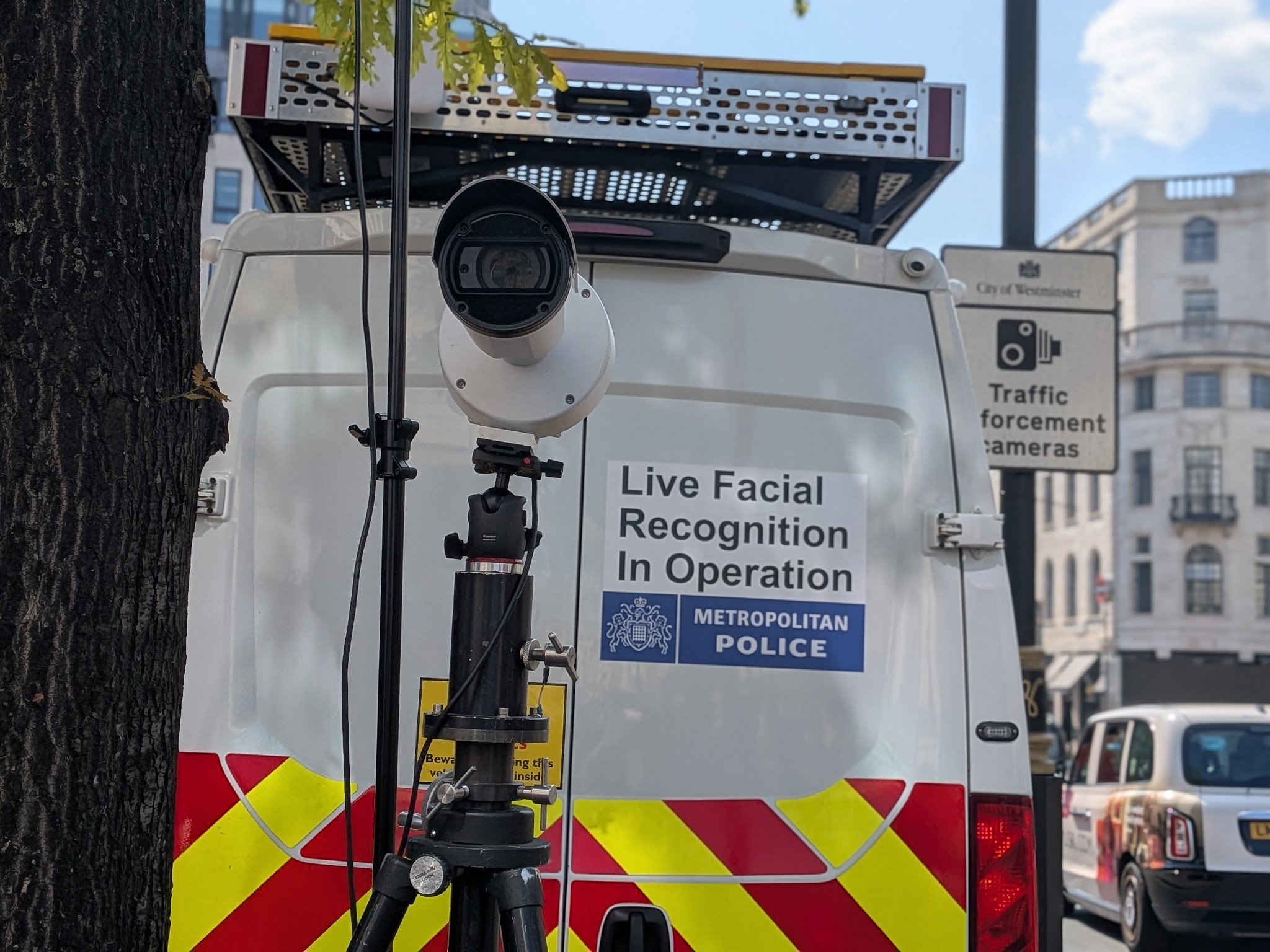
The push for live facial recognition technology
In the last six months, at least four of England’s regional police forces – Cambridgeshire, Hampshire, Norfolk and Thames Valley – used live facial recognition (LFR) technology for the first time.
This is part of an ongoing government push to provide police forces with LFR capabilities, despite there being no legislation in place to govern use of the technology.
LFR software compares an image captured of someone’s face with a watchlist or database of photos. Watchlists are compiled by the police, generally using custody photos of wanted persons.Using LFR to find those people requires scanning and checking the face of every single person in the area the technology is used.
This means scanning the faces of vast numbers of people.
“In 2024 and 2025, Essex police scanned 2.2 million faces and made 117 arrests,” The Guardian has reported. In London in the first four months of 2026, 1.7 million scans led to 44 arrests.
First use at a protest
In mid-May this year, live facial recognition was used at a protest for the first time.
Officers from London’s Metropolitan Police (the Met), equipped with LFR cameras, were deployed at the ‘Unite the Kingdom’ protest in London organised by far-right agitator Stephen Yaxley-Lennon, who goes by the name Tommy Robinson.
“This Saturday is… the first time we will be using live facial recognition as part of a protest policing operation. It will be deployed in the London borough of Camden in an area likely to be used by those attending the Unite the Kingdom event,” Deputy Assistant Commissioner James Harman said at a media briefing.
While this is the first time the police have deployed LFR at a protest, demonstrations are routinely filmed and the footage may be analysed using retrospective facial recognition software.
Police and government PR work
The Met also recently released the results of a six-month LFR pilot project in Croydon, a borough in the south of London.
The project saw cameras affixed to lampposts in the town centre, rather than being deployed on vans. They were turned on and monitored remotely, with officers deployed in the street to make stops and arrests.
The results of the Croydon pilot project were published just as police and government are seeking to legitimise more extensive use of facial recognition technology.
According to a Met press release, almost half a million people had their faces scanned in Croydon as part of the pilot project, with the system issuing “just one false alert” – that is, only one person was wrongly identified by the technology as a person on a watchlist.
The veracity of this statement is unknown, as the Met have not released the full evaluation report.
In response to a freedom of information request from Statewatch, the force said information on the project would be included in its annual report on LFR, “which will be published around October 2026.”
The numbers published by the Met indicate that as the accuracy of facial recognition technology improves, arguments opposing it on the grounds that it suffers from bias caused by inaccuracy are likely to become increasingly unconvincing.
Beyond bias, however, facial recognition systems raise much broader “ethical concerns surrounding use-justifiability,” remarked Dr David Leslie of the Alan Turing Institute in a 2020 paper.
Leslie refers to “the short- and long-term effects of these systems on individual self-development, autonomy, democratic agency, social cohesion, interpersonal intimacy and community wellbeing.”
Police increase use of facial recognition tech
The government, police and private industry seem unconcerned by these issues.
The increasing number of face-scanning operations is part of a government initiative first announced in the wake of the racist pogroms in summer 2024, when prime minister Keir Starmer announced there would be “wider deployment of facial recognition technology.”
A year later, the home secretary announced that the government would provide seven police forces with a total of 10 LFR vans.
In at least one case, a police force has shared the technology with another – Bedfordshire recently lent their LFR vans to Cambridgeshire police for use in Peterborough town centre.
In total, the following forces in England and Wales are known to have used the technology:
- Bedfordshire
- Cambridgeshire
- Essex
- Greater Manchester
- Metropolitan
- Norfolk
- North Wales
- South Wales
- Suffolk
- Surrey and Sussex
- Thames Valley and Hampshire
- West Yorkshire
In January 2026, the Home Office announced that it would pay for a further 40 LFR vans, bringing the total available to 50. This would be enough for at least one van for every police force in England and Wales.
The Home Office have said the provision of more vans is part of “a nationally coordinated LFR capability, to intercept violent and sexual offenders in high crime areas across the country.”
It is currently unknown which forces will receive the new LFR vans, or when.
The Metropolitan Police are also conducting a trial with handheld facial recognition devices, referred to as “Operator-Initiated Facial Recognition”.
National Centre for AI in Policing
The use of LFR technology by an increasing number of police forces is part of a broader push to increase police use of new digital technologies.This push coincides with major changes to the way police forces are organised, in particular through the centralisation of certain powers and functions.
A new National Centre for AI in Policing, known as “Police.AI”, will soon be established with £115 million in government funding over the first three years.
The government is also planning “a public facing registry of the AI being deployed by police forces and the steps they have taken to ensure the reliability of tools before being used for operations,” according to a white paper published earlier this year.
So far, no further details of this registry have emerged.
A similar initiative in the EU includes loopholes and exclusions that mean high-risk AI systems for law enforcement, migration control and border surveillance are exempt from many transparency requirements.
Law governing facial recognition technology on the way
As well as new funding and the centralisation of police powers and functions, new legislation is on the way.
The government has announced that a forthcoming Police Reform Bill will include provisions to govern the use of facial recognition technology.
The King’s Speech, which introduces the government’s legislative agenda, says the Police Reform Bill will include:
“…a new legal framework to underpin law enforcement use of facial recognition and similar technologies, making it clear when use of these technologies can be justified, including creation of a single, expert regulatory body to provide independent advice and oversight.”
The announcement follows a Home Office consultation to which Statewatch responded.
The response argued that use of facial recognition technology “should be prohibited in most cases and otherwise restricted to only very specific circumstances.”
Statewatch is part of the Stop Facial Recognition Coalition, led by Big Brother Watch and made up of organisations campaigning for legislation that offers meaningful protections from and control over police use of facial recognition.
A spokesperson for Big Brother Watch said:
“There is no primary legislation regulating this intrusive and discriminatory technology. That is about to change, but there is no guarantee it will be for the better. The government must tightly restrict the deployment of facial recognition technology to only the most exceptional circumstances, and we are holding them to account on this.”
Image credit: Van and camera (detailed) Police Facial Recognition checkpoint, Charing Cross Station, the Strand, Westminster, London, UK by Cory Doctorow