

“This planet is for everyone, borders are for no one. It’s all about freedom.”
– Benjamin Zephaniah
Available in PDF format:
Editorial
What’s in a word? More specifically, in the context of migration policy, what’s in the word “return”?
The academic Clara Lecadet describes it as “a euphemism for the violence inherent in expulsion,” that “erases the complexity of migration journeys in which expulsion is rarely synonymous with return.” Furthermore, “it ‘naturalises’ return as an inherent part of migration.”
Given this, we consider the word deportation – a word that encapsulates the force and violence involved in the process – more appropriate.
As one of the two analyses in this bulletin demonstrates, EU deportation policy is already synonymous with violence and harm. Unsurprisingly, official documents do not take this into account, and those examined in the analysis indicate that a forthcoming revision of the EU’s deportation law is likely to mean even stricter, harsher, and more harmful measures.
In official discourse, “return” is often supposed to be followed by “reintegration.” Through this, those who have been expelled from Europe are supposed to accept their situation, settle down, and not seek to leave their country again – at least not towards Europe.
“Reintegration” is also a political euphemism. It assumes that deported individuals were once “integrated” in a particular way – if at all – in the country to which they have been expelled.
EU reintegration policy is the subject of this edition’s other analysis. Frontex has been granted an increasing role in this area. Evidence from both the Nigeria and The Gambia indicates that this is likely to exacerbate existing problems for deportees: from inadequate “reintegration” support provided by a confusing array of agencies and providers, to questions over national sovereignty and democratic control.
Substantial sums of public money are going towards the EU’s deportation and reintegration policies: €20 million for “sustainable reintegration” of people deported to Bangladesh; the same amount for a similar project in Iraq; and in sub-Saharan Africa, €113 million for a joint EU-IOM project, and a further €180 million for another project on “sustainable reintegration.”
These figures come from one of the documents we are publishing with this bulletin on the Coordination Group on Migration (CGM), a secretive body in which the Commission and member states coordinate their spending on external migration projects.
The CGM was set up in late 2021, and aims to bring together high-level EU and member state representatives to discuss and coordinate ongoing or proposed projects around the world.
The aim is to find “complementarities and synergies” between EU and national actions. On the face of it, this may seem rather useful: it is of little use to anyone when governments waste money by duplicating each other’s activities, and collective action is usually more effective.
However, such superficial benefits are outweighed by a far more fundamental problem: the purpose of all this spending is to extend and entrench harmful migration and border control policies. Furthermore, it is development aid – vast quantities of it – that is being used for this purpose.
The projects discussed by the CGM are primarily financed by development budgets – for the EU, this means the Neighbourhood, Development and International Cooperation Instrument (NDICI).
Up to 10% of this €80 billion budget is supposed to be used for migration-related projects, subverting the purpose of development aid. Rather than being normalised, this needs to be opposed.
Opposition becomes more difficult, of course, when discussions and decisions take place in secret. The CGM is an “informal special group,” meaning it is not subject to the same transparency rules as other Commission expert and advisory groups (“informal special group” could be considered a euphemism all of its own).
This secrecy means there are vanishingly few references to the CGM in public documents, and no meaningful public information: as far as we know, we are the first organisation to publish any substantive documents it has produced or discussed.
Even these documents are somewhat limited, dating largely from 2021 and 2022. Access to more recent ones was denied on the grounds that decisions on the projects they detail have not yet been taken. Other denials and redactions were justified on the grounds of protecting “public security” and international relations.
Nevertheless, the documents should be of interest to anyone seeking to understand, investigate or challenge the further entrenchment of the EU’s external migration control agenda. They provide information on a wide number of projects, priorities and useful pointers for further investigation.
We will continue to seek access to more documents produced by the CGM and other secretive EU entities, such as MOCADEM. Likewise, we will continue to obtain and publish documents from other EU bodies. With a new Commission set to accelerate the externalisation agenda, finding ways to expose and challenge it is more important than ever.
Chris Jones, Statewatch
Thematic and regional developments
The majority of the documents published with this bulletin relate to the Coordination Group on Migration (CGM), and appear to date from 2021 or 2022. While they do not give an insight into recent developments, they offer useful information on the work of the CGM, the types of project discussed within the group, and the vast quantities of development aid being spent on projects geared, in one way or another, to externalised migration control.
We are also publishing a Frontex presentation on “Risk Analysis at Air Borders,” which makes clear how people seeking asylum are considered a “risk” in EU border policy; and another presentation by Frontex on its cooperation with non-EU states in 2023. We are awaiting responses to requests for a substantial number of other documents, and will publish those in the document archive as and when they arrive.
All the documents summarised here, and those published with previous editions of the bulletin, are contained in our document archive, which also contains sections on:
- Coordination Group on Migration
- European Council
- External Aspects of Migration Working Party (EMWP)
- Justice and Home Affairs Council
- Operational Mechanism for External Dimension of Migration (MOCADEM)
- Strategic Committee on Frontiers, Immigration and Asylum (SCIFA)
- Visa Working Party
- Working Party on Frontiers
- Working Party on Integration, Migration and Expulsion (IMEX)
Contents
Border management
- Key points
- A presentation by Frontex outlining the aims of risk analysis at air borders
- It notes that the “Air Borders Risk Analysis Network” produces weekly updates on refusals of entry, asylum applications, “illegal stay/over-stayers,” and other categories of information
- It includes numbers on how many individuals of certain nationalities applied for asylum, and at which airports in the EU, thus placing asylum-seekers as a “risk” that requires analysis and intervention
- From: Frontex
- To: Working Party on Integration, Migration and Expulsion
- Document date: 29 October 2024
- Document number: WK 13482/2024 INIT
- Key points
- Aims at “the prevention of irregular crossings by Egyptians and other nationality migrants living or transiting in Egypt”
- The project’s “stakeholders” include the Egyptian Ministry of Defence, and others whose names are censored
- From: Unknown
- To: Coordination Group on Migration
- Document date: Undated, released 30 October 2024
- Key points
- A project that aims to “strengthen law enforcement’s capacity across North Africa to effectively investigate and prosecute organized crime groups engaging in migrant smuggling and, as appropriate, trafficking in human beings”
- This will be done by increasing the ability of police forces to “manage, share, analyse, and use police information” and to “conduct cooperative targeted police operations”
- The project foresees possible cooperation with Interpol and EU justice and home affairs agencies
- From: Unknown
- To: Coordination Group on Migration
- Document date: Undated, released 30 October 2024
Project fiche: Support to Cross-Border Cooperation and Integrated Border Management in North Africa
- Key points
- A proposed project based in North Africa (no more specific location is stated) attempting to tackle “organized crime groups, including those involved in migrant smuggling and trafficking in human beings”
- The budget is censored
- The project is “part of both the Central Mediterranean migration route Team Europe Initiative and the Western Mediterranean and Atlantic migration route Team Europe Initiative”
- From: Unknown
- To: Coordination Group on Migration
- Document date: Undated, released 30 October 2024
- Key points
- Proposes €45 million for maritime rescue centres, border surveillance, and coast guard training in Libya and Tunisia, framed as a humanitarian search and rescue objective, despite political instability and the potential risk of “critical security conditions” impeding the project
- Emphasizes “prevention of departures” and increasing surveillance capabilities through technical support and training programs, with €5 million specifically allocated to complete Tunisia’s coastal surveillance system
- Would establish a Maritime Rescue Coordination Centre and Border Guard Training Academy in Libya, funding the expansion of Tunisian coastal patrol capabilities with a training academy, and maintain “complementary land border management actions”
- From/Author: Commission services
- To: Coordination Group on Migration
- Document date: 5 July 2021
Budgets and funding
- Key points
- A list of projects using development aid for achieving migration policy goals, divided up by geographical region: Americas, Asia, Sub-Saharan Africa, North Africa, Eastern Europe, Eastern Mediterranean, and “Global”
- The projects make use of the “migration marker” discussed in a separate note
- “This is a living document, destined to be progressively expanded and improved,” indicating that there may be subsequent versions
- From: European Commission
- To: Coordination Group on Migration
- Document date: Undated, released 30 October 2024
- Key points
- Guidance note establishing rules for tracking EU spending on migration-related actions in third countries, in response to the requirement that the NDICI-Global Europe funding instrument (the EU’s main development aid and external cooperation funding tool for 2021–2027) dedicate 10% of its funds towards “actions supporting management and governance of migration and forced displacement”
- Notes that development projects funded through NDICI-GE count towards “achieving the migration spending target” if they “address the root causes of irregular migration and forced displacement” but only “when they directly target specific challenges related to migration and forced displacement”
- Gives instructions on designing projects that are relevant to meeting the migration spending target; that such projects should analyse the migration situation in the country in which the action will take place, directly target migration “challenges,” and monitor and report on “migration-related results”
- From: European Commission
- To: European Commission and member state officials
- Document date: 1 August 2021
- Document number: Intpa.g.6 (2021)6244514
- Key points
- Outlines projects funded by a new €200 million “Flexible Mechanism” funding instrument under NDICI-Global Europe, intended to “maximize EU leverage” and incentivize Sub-Saharan Africa partner countries’ cooperation with the EU on migration control
- The mechanism approved funding for projects in Niger (€13M to support Nigerian police in the “fight against criminal networks linked to irregular migration”), Mauritania (€20M on vocational training, education about “migration risks” and information on local employment opportunities to “avoid secondary movement towards the EU”), Kenya (€15M to transform refugee camps into long term settlements) and Uganda (€15M to support Uganda in developing policies and providing services to influx of refugees mainly from DRC)
- Notes discussion and feedback by Member states on each project and responses; for example several Member States (FR, NL, ES) questioned whether the Uganda forced displacement project should be funded through this mechanism, rather than other instruments which are earmarked for displacement, to which the CGM replied that the stability of the region was “of strategic importance for the EU”
- From/Author: The Secretariat of the Coordination Group on Migration
- To: Coordination Group on Migration
- Document date: 13 December 2022
Deportation and readmission
- Key points
- A project aiming to “improve access to protection and economic
- and social integration for Tunisians [sic] returnees, displaced populations and host communities in Tunisia and Morocco”
- The document notes: “It is essential to create local opportunities for Tunisian youth, in order to have perspectives other than that of departure to succeed, but also at the same time to strengthen the support mechanism for the return”
- The proposed budget is censored
- From: Unknown
- To: Coordination Group on Migration
- Document date: Undated, released 30 October 2024
- Key points
- Proposes a 3-year, €60 million program beginning in 2022 to work with North Africa partner countries to return stranded or detained migrants to their countries of origin, and to support “sustainable reintegration” of North Africa region returnees from EU
- Frames the action as “supporting voluntary returns,” while acknowledging an “urgent lack of effective protection and sufficient assistance” faced by migrants in the region (particularly Libya), and the “limited channels” for legal migration
- The action intends to strengthen partner countries’ capacity to return migrants to countries of origin, and increase partner countries’ “ownership” over that process, while collecting data about the project and migration flows for future use
- The action overlaps with, and works in collaboration with, several interlocking existing reintegration programs in the region by IOM, ICMPD, civil society, EU member states, and more, and acknowledges that “shortcomings on coordination” with these programs are a problem the action hopes to solve
- From/Author: Commission services
- To: Coordination Group on Migration
- Document date: 3 December 2021
Migration partnerships
EU support to legal migration, mobility and skills partnerships with North of African countries
- Key points
- Aims to build on other projects including THAMM, but “will focus more on the human capital development sector; will foster a stronger involvement of the private sector; will set up a stronger coordination mechanisms in partner countries to strengthen national authorities’ ownership”
- The proposed budget and duration are censored
- From: Unknown
- To: Coordination Group on Migration
- Document date: Undated, released 30 October 2024
Presentation: Cooperation between Frontex and third countries in 2023
- Key points
- Gives an overview of Frontex’s work with non-EU states in 2023, noting “concrete operational results” and an increase in deportations supported by Frontex of 60% as key results
- Pre-accession countries have “utmost priority in the external dimensions”
- Nine EU Return Liaison Officers were deployed in 2023, covering 13 different non-EU states
- From: Frontex
- To: Working Party on External Aspects of Asylum and Migration (EMWP)
- Document date: 20 September 2024
- Document number: WK 11796/2024 INIT
- Classification: LIMITE
- Key points
- Proposes a €5 million action to promote EU-approved “legal migration pathways” between North African countries and EU Member States through training and mobility schemes, a continuation of previous pilots and phases (THAMM I and THAMM II)
- Discusses continued facilitation of cooperation with North African countries on labor migration and mobility schemes through support for vocational training, skills matching, and institution building that will be “mutually beneficial for both societies and labour markets in Europe”
- As with previous THAMM initiatives, no mention of relaxing EU visa policy (only a passing mention of working with consulates and supporting “legal migration management”) – the proposed activities focus is on analysing the EU’s labour market needs, setting up vocational trainings, and encouraging exchange partnerships between EU and North African institutions
- From/Author: Commission services
- To: Coordination Group on Migration
- Document date: 2 August 2021
Other
- Key points
- A project in Egypt for “basic service delivery and access to basic services, mainly health and education protection of unaccompanied minors and young adults via family reunification and child protection”
- The budget and proposed duration are both censored
- From: Unknown
- To: Coordination Group on Migration
- Document date: Undated, released 30 October 2024
- Key points
- Proposes a €55 million action carried out in Libya through grants and NGO partners to increase protection and aid to forcibly displaced people, including employment and evacuations, alongside “awareness raising” about the risks of smuggling, and protection against smuggling
- Details “dire” conditions in Libyan detention facilities, including lack of food, water, ventilation and sanitation, extreme overcrowding, absence of female guards leading to high risk of sexual violence, and limited humanitarian agency access
- Project is presented as aligning with New Pact on Migration and Asylum, focusing on protection and assistance while acknowledging Libya remains the major hub for irregular migration to Europe across the Central Mediterranean route
- From/Author: Commission services
- To: Coordination Group on Migration
- Document date: 2 August 2021
- Key points
- A founding letter & rules of procedure document that establishes the Coordination Group on Migration, an informal group between the European Commission and EU Member States to “exchange information and views to ensure coordination and coherence” on the use of NDICI – Global Europe funds to “support external migration-related actions”
- The group’s objectives are to “ensure maximum synergies between EU and Member State actions,” while avoiding duplication of effort, through information exchange on planned migration projects in third countries
- Explains that CGM meetings are intended to provide a forum for Member states to discuss implementation and coordination of future projects, and to monitor progress toward the NDICI-GE’s target of spending 10% of its external development and aid budget on migration related projects, including a means to provide updates to the European Parliament and Council on this progress
- From: General Secretariat of the Council
- To: Working Party on Development Cooperation and International Partnerships
- Document date: 21 November 2022
- Document number: WK 16046/22
- Classification: LIMITE
- Censored: Yes
- Key points
- The group is “an informal special group created by the Commission,” made up of “the relevant European Commission’s services and the EEAS, and the relevant EU Member States’ authorities”
- The purpose of the group is “to exchange information and views to ensure coordination and coherence between the use of NDICI – Global Europe funds to support external migration-related actions and Member States’ migration-related actions”
- Three types of item are considered for discussion in the group: “Exchange on the implementation orientations”; Coordination discussions in view of future projects; and Information on approved projects
- From/Author: European Commission
- To: Unknown
- Document date: 11 November 2021
- Document number: Ares(2021)6942056
- Classification: None
Frontex’s increasing role in reintegration policy and its effects in West Africa

Image: Jeff Attaway, CC BY 2.0
Introduction
European policymakers try to draw a clear line between so-called assisted voluntary return and forced removal. However, as both stem from migrants’ illegalisation, these two forms of return both amount to deportation. Deportees and their communities struggle to re-establish themselves after traumatic migration and deportation experiences.
In the few cases when European countries offer them reintegration assistance, it works as a tool to convince people to self-deport, is limited in amount and is Eurocentric in its conceptualisation. Indeed, it prioritises individualised business projects based on insufficient resources and training, without addressing the economic exploitation of and mobility injustice faced by Africans.
In 2023, Frontex’s involvement in deporting third-country nationals increased by 116% in so-called voluntary return and by 58% overall. This analysis looks at the implications of this expansion in the context of West Africa.
Frontex and West Africa
Frontex has a longstanding involvement in West Africa. Operation Hera, involving maritime and aerial patrols off the coasts of Senegal, Mauritania, Cape Verde and Morocco, started in 2006. All West African countries are part of the Africa-Frontex Intelligence Community (AFIC), and Nigeria, Niger, Togo, Ghana, Ivory Coast, Guinea, Senegal and Mauritania host Risk Analysis Cells. These are used to collect data on transnational crime and border crossings.
The agency also has working arrangements with Nigeria and Cape Verde, and had one with the EU Capacity Building Mission in Niger (EUCAP Sahel Niger) until the Nigerien government ended the mission.
This type of arrangement normally involves information exchange, capacity-building on border governance and the facilitation of readmission agreements. They do not require approval by the European Commission or European Parliament, posing questions around transparency and democracy.
Beyond working arrangements, status agreements can be agreed between the EU and other states. These allow the deployment of Frontex officials in non-EU states. They are negotiated by the Commission with the country in question, and require approval by the European Parliament.
Status agreements mean that Frontex border guards can conduct border checks and surveillance, amongst other things. In Africa, the EU previously tried to sign such an agreement with Mauritania, and a deal with Senegal may still be on the cards.
These plans and the other initiatives signal a worrying externalisation trend, pose clear sovereignty issues and have the direct consequence of hindering free movement within the Economic Community of West African States (ECOWAS).
Deportation and reintegration
EU “reintegration” policy has received somewhat less public attention than other initiatives. Since 2018, the European Union has supported reintegration through the involvement of local service providers in its European Return and Reintegration Network (ERRIN).
Frontex’s Joint Reintegration Service (JRS) took over ERRIN in 2022, renaming it the EU Reintegration Programme (EU-RP). Assigning reintegration policy to a clearly securitarian actor like Frontex further underscores the link between so-called voluntary return and forced removal outlined above.
Recent policy documents indicate an intention to extend the involvement of Frontex’s liaison officers in deportation and reintegration, and to increase their funding and deployment. The aim is for Frontex to introduce more standardisation, datafication and digitalisation in deportation and reintegration.
More specifically, Frontex will increase its involvement in “return counselling” by developing counselling trainings and dedicated curricula; increase the extraction of data on the fuzzy concept of “sustainable reintegration”; and develop return and reintegration-related digital tools.
These include the Return Case Management System (RECAMAS), the Integrated Return Management Application (IRMA 2.0), and a “return data warehouse pilot.” A Mobile App for Reintegration (RAPP) will be expanded. Additionally, return counsellors should communicate through the Reintegration Assistance Tool (RIAT), a digital interface pooling information and monitoring all phases of return and reintegration.
The next sections will discuss these developments with regard to The Gambia and Nigeria.
The increasing role of Frontex and its consequences for The Gambia and migrants
Sovereignty issues
The relationship between The Gambia and the EU on the deportation of illegalised migrants is a complicated one. In 2018, the Gambian government and the EU ratified a Good Practices Document on return procedures. It includes provisions on the support from the EU for the reintegration of deportees. In 2019, however, Gambian president Adama Barrow announced a moratorium on forced returns. This led to EU sanctions, and the Gambian government eventually reversed its decision. There are thus clearly already certain sovereignty issues in the relationship between The Gambia and the EU. EU assistance is increasingly being delegated to Frontex which, given its extensive record of human rights breaches inside and outside EU territory, further exacerbates this concern.
Deportees’ struggle for support
The extension of the mandate of the Frontex liaison officer based in Senegal means the agency is now also involved in deportation operations to The Gambia. EU-funded reintegration assistance within the context of so-called assisted voluntary return was previously given by the Gambian Catholic Development Office (CaDO, under the supervision of Caritas International Belgium, within the context of ERRIN.
As discussed above, Frontex took over the EU-RP in 2022. As a consequence, it concluded a partnership with both Caritas International Belgium and CaDo. This partnership should offer post-arrival and reintegration assistance to returnees, including temporary and long-term accommodation, start-up capital for business development, schooling and training.
Previous beneficiaries of ERRIN have lamented delays in the reception of support, inadequate follow-up and confusion with relation to the assistance offered by different partners, including the International Organization for Migration (IOM). The agency’s intervention in a landscape already saturated with humanitarian and development actors is an element of over-complexification.
As for Caritas, its willingness to work with Frontex confirms scholarly findings on the ever-growing embedding of so-called humanitarian actors in a mostly securitarian migration governance landscape.
Consequences for the civil society landscape
The standardization of digital tools and training curricula mentioned above may be beneficial for Frontex and officials working with it, but detrimental for recipients given the different cases, countries and circumstances in question. Furthermore, it poses risks for anonymity and privacy because of its focus on increased data and information extraction.
The pledge to increase funds to strengthen Frontex’s role in deportation and reintegration will have the additional consequence of boosting the agency’s stance vis-à-vis locally-embedded and long-standing civil society actors in The Gambia. This includes deportee-led organisations seeking independence from more powerful actors, such as IOM, which exploit them politically and financially under the banner of efficient migration management.
The deepening role of Frontex and its consequences for Nigeria and migrants
Sovereignty issues
Frontex’s collaboration with the Nigerian government, particularly through the Nigeria Immigration Service (NIS), raises important questions about national sovereignty. The existing working arrangement (signed in 2012) and the NIS Border Management Strategy (2019-2023) highlight a structured dialogue and cooperation that may compromise Nigeria’s autonomy in managing its migration policies. Nigerian authorities are encouraged to intensify their efforts to implement the agreement, potentially infringing on the country’s sovereignty.
The emphasis on Frontex’s role in border management and return operations suggests a shift in control that could undermine Nigeria’s ability to protect the rights of its citizens who wish to cross the border in search of protection—as many parts of the country are experiencing banditry, kidnapping and conflicts—or better economic opportunities.
Focus on deportation over reintegration
A draft EU action plan on Nigeria from September 2021 emphasised return, readmission, and reintegration, yet the focus appears to be disproportionately on facilitating deportation rather than ensuring comprehensive reintegration.
Though Frontex is involved in initiatives aimed at supporting returnees, such as the Integrated Reintegration Assistance for Returnees and Asylum Seekers (IRARA) programme, civil society organizations (CSOs) indicate that the reality often differs significantly from what is promised. Many deportees face challenges in reintegrating into their communities, leading to cycles of migration as they seek better opportunities abroad.
Non-transparent processes
The reintegration landscape in which Frontex operates in Nigeria is frequently criticised for its lack of transparency. Many deportees report confusion and a lack of information regarding the procedures affecting them. This non-transparent nature can exacerbate vulnerabilities, leaving returnees without adequate support or guidance.
As one CSO member told the authors of this article: “They [Frontex/the IRARA programme] are bringing back people… who have lost their senses. What are the arrangements down? Is there any arrangement for recuperation?” This highlights the urgent need for clearer communication and support mechanisms for returnees.
Health concerns and psychological challenges
Despite the reintegration assistance, health issues are a significant concern for many returning Nigerian migrants. Reports suggest that some returnees arrive in Nigeria with serious psychological and health challenges, having experienced trauma during their migration journey. The lack of adequate health services and psychosocial support for returnees can lead to further marginalization and mental health crises.
As emphasized by CSO representatives: “They [returnees] need further health services, health concerns. They need psychosocial services. You know some of those things must be done because there must be a recovery process that must be put in place for them.” This underscores the neeed for comprehensive health services to assist returnees in their recovery process.
Focus on Frontex’s goals over fundamental rights
CSOs in Nigeria often find themselves navigating a complex landscape where the goal of increasing deportations, with Frontex support, may not align with the EU’s ostensible values and human rights standards. The emphasis on expedited returns overshadows the fundamental rights of migrants, leading to violations. The focus on operational efficiency over humanitarian considerations raises ethical concerns about the treatment of migrants throughout the deportation process.
As one CSO member articulated:
“The kind of people they are bringing back, there is no adequate arrangement for them. They are bringing back people, somebody who has been in prison…. and the person is returned drugged. He has lost his senses. What are the arrangements down? Is there any arrangement for (the) recuperation or that these people have been brought back just to die? Because no matter the kind of support you give to such a person, it’s not going to be sustainable… some of them don’t even see it as support because they don’t know what to do with it. They have already lost their senses. That’s my concern about such a return programme with IRARA and Frontex”.
Conclusion
Recent EU discussions and legal developments seek to strengthen and expand the involvement of Frontex in deportation and reintegration. The underlying narrative points to Frontex’s potential in harmonising and standardising approaches across the EU and its member states. This, however, has severe consequences in West African countries.
In The Gambia, Frontex superimposed on an existing partnership between the Belgian and Gambian Caritas, complicating further a support landscape that returnees already find difficult to navigate.
Frontex’s emphasis on digital tools and data collection will exacerbate a securitarian trend in return and reintegration, while the pledge to increase the agency’s resources in the area will exacerbate power asymmetries vis-à-vis grassroots organisations struggling to avoid instrumentalisation and exploitation.
In Nigeria, Frontex’s emphasis on border and migration control undermines the country’s ability to protect the rights of those Nigerian citizens compelled to move. Furthermore, civil society organisations and returnees lament the lack of transparency and inadequacy of Frontex’s support to reintegration, negatively affecting the (mental) health of returnees and their communities.
Ngozi Uzomah and Rossella Marino
Deportations: when “assertiveness” and “effectiveness” entail violence and abuse
More deportations
Improving EU cooperation and coordination on deportations has been a policy objective since the 1990s. The ultimate goal is to increase the number of people deported from the EU. Over the last five years, various changes have been introduced with this aim in mind.
These include new powers for Frontex; the establishment of the post of ‘Return Coordinator’ in the European Commission; and monitoring of non-EU states’ level of cooperation with deportations, with a lack of compliance liable to spark punitive “visa sanctions”. MOCADEM regularly examines non-EU states’ deportation policies.
More recently, the issue of “return hubs” – which might better be termed deportation camps – has been put on the agenda. These proposals, currently the topic of much debate within the Brussels bubble, come alongside a range of others, revealed in documents published with this bulletin. Some of these may well find their way into a fresh proposal for a law to replace the 2008 Returns Directive.
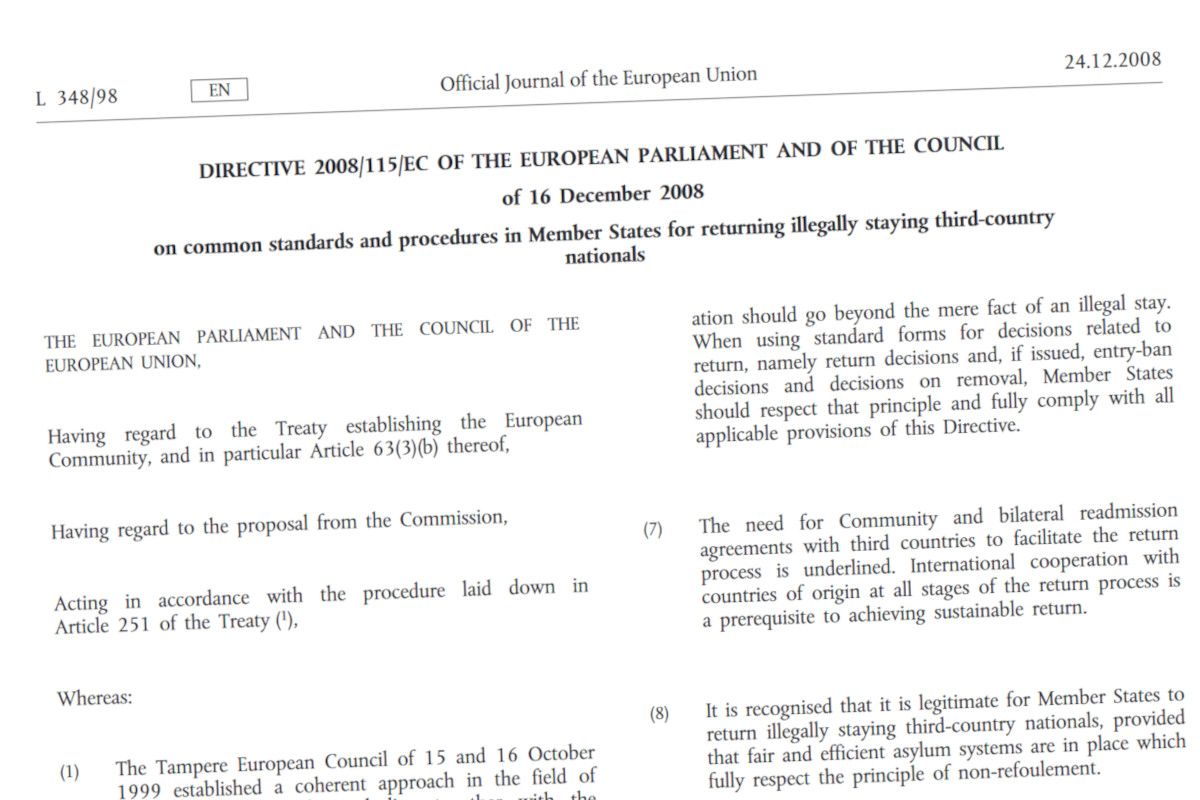
While a proposal to revise the Returns Directive was published by the European Commission in 2018, negotiations have stalled, and the Commission and the Council are now committed to a new text. Commission President, Ursula von der Leyen, has said this proposal will be “one of the immediate tasks for the Commissioner for Internal Affairs and Migration.”
Despite years of failure on its own terms, the EU looks set to make its deportation policies even harsher, causing more harm to a greater number of people. However, policy documents make no explicit mention of negative effects for individuals. Instead, documents circulated within the Council in recent months have called for “steps towards a well-functioning return system” (13 July) based on “a more assertive returns policy” (9 September) that can increase “effectiveness” (13 September).
Deportations: “a top priority”
The Hungarian Presidency took up its role on 1 July, and just over two weeks later a document for a meeting of the Council’s Integration, Migration and Expulsion (IMEX) working party looked at “steps towards a well-functioning return system.” The Presidency’s aim is for discussions within IMEX is to examine topics from “from a more operational perspective.”
The 18 July document highlights that deportation (“return”) is “a top priority and part of the Schengen cycles, including the current one (2024-2025).” The “Schengen cycle” is the process for evaluating member state compliance with laws and policies on the Schengen area.
The document also emphasises the need for “the appropriate synergy” between an “obligation to cooperate with the authorities and the guarantee of the fundamental rights of the persons.” Without this, “enforcement is jeopardised,” and there may be “an impact on our external dimension ambitions and on cooperation with third countries.”
The document also refers to the recently-adopted Regulation on a return border procedure. This provides new, swifter means for deporting people who have been refused entry at the borders. It allows the quicker deportation of people deemed a security threat, an issue that has come up at multiple Council working party meetings in recent months.
The Presidency’s July document notes that the Council’s position on the 2018 proposal for a revised Returns Directive would have made it easier to detain individuals deemed a security threat, and to deny them a period for voluntary departure. More may be to come. There is a reference to “the possibility of other derogations that could contribute to a more effective return of such third country nationals.”
The document also highlights a new legal obligation to enter expulsion orders in the EU-wide Schengen Information System database. There is also the possibility of placing a “security flag” on alerts involving people deemed to pose “a threat to public policy, public security or national security.”
It is argued that appeals against return decisions should only have a suspensive effect “when there is a risk that the third-country national concerned would be exposed to a real risk of ill-treatment in case of return.” Without such a risk, the document says, the suspensive effect should not apply – a move that would increase the likelihood of returning someone to danger.
“Out-of-box” solutions
In the document from 9 September, the Hungarian Council Presidency sets forth a number of other proposals. Initiatives that are underway, such as the reform of the Common European Asylum System, are deemed unable “to reduce the overall burden on Member States.” Thus, innovative “out-of-box” solutions must be found.
This should include progress on the recast Returns Directive, which has been stalled since 2020 and is likely to be the subject of a fresh proposal next year. The recast has been criticised as a “lock ‘em up” reform due to an increased number of grounds for detention preceding deportations. It is unlikely that the new proposal will take a softer approach. It is worth noting that a paper from March asked member state delegations for their views on whether EU legislation “should establish minimal detention capacities at EU and national levels?”
The return rate (the number of expulsion orders issued versus the number of removals carried out) is cited to demonstrate the need for “out-of-box” solutions. In 2023, 484,160 expulsion orders were issued, while 91,465 were deported, a rate of 18.9%. Whilst acknowledging that the “gap” is narrowing, the Presidency says “there is still significant room for further improvement.”
The violence and abuse that come with the deportation system go unmentioned, despite well-documented human rights violations, misuse of sedatives, deaths in detention centres and discriminatory policing to apprehend foreign nationals for removal. These are ignored in favour of instrumental and speculative claims, such as “Member States continue to face significant challenges related to asylum applications lodged solely to obstruct returns,” and “a large number of migrants arriving illegally is unlikely to be eligible and meet the conditions for receiving international protection in the EU.”
The document calls for the EU’s externalisation “toolbox” to be extended by complementing it with “readmission conditionality under the Generalised Scheme of Preferences (GSP) Regulation.” This is an attempt to use trade policy to impose EU migration priorities. There is also a call to intensify the “Team Europe” approach and “partnerships” with non-EU states. This appears to be an invitation to step up initiatives that have been criticised as blackmail, whilst activating further incentives for third countries.
Member states must “significantly improve return rates”
Similar issues come up again in a Presidency paper circulated on 13 September for a meeting of the Strategic Committee on Immigration, Frontiers and Asylum (SCIFA). The document laments the “stalling” of the legislative process on the recast Return Directive, but proposes a number of elements for the “future legal framework.”
The paper cites an increase in the return rate from 2022 to 2023 (from 15.5% to 18.9%), with partial figures for 2024 indicating a further increase. The document nevertheless reasserts “the need of Member States to significantly improve return rates.” The top nationalities of recipients of expulsion orders are Algeria, Morocco, Turkey, Afghanistan, Syria and Georgia, each of which poses its own protection and safeguarding issues.
The document refers to some of the same “innovative” proposals brought up in the Presidency’s 9 September paper, such as extraterritorial deportation camps, the removal of people deemed a security threat, and ensuring that appeals against removal decisions do not automatically have a suspensive effect.
It goes on to refer to discussions in COREPER (the Committee of Permanent Representatives) in September, that resulted in “broad agreement” on updating the legislative framework and attempting to remove operational obstacles.
These include non-cooperation by non-EU nationals facing deportation, and ways to deal with asylum applications deemed to be mere attempts to obstruct removal. Some member states support the option of empowering Frontex to support returns “from third countries to third countries.” This idea was included in the proposal for the 2019 Frontex Regulation but removed at the behest of MEPs.
The document states that “innovative solutions” for increasing deportations must be “legally, operationally and diplomatically sound.” While this requires legal compliance and coherence, it does not guarantee that existing legal safeguards will not be removed or watered down.
For example, the document describes the non-refoulement principle as “indispensable” and says it should be “taken into account and examined during the whole return procedure.” Yet it goes on to say that it is a “common challenge” that many destination countries for deportations are classified as unsafe, making removals impossible.
Efforts to overcome this include finding individual solutions, such as “encouraging and supporting voluntary returns,” considering key aspects of “sustainable return,” and gaining support from international organisations, such as UNHCR. The possibility of cooperation with “unrecognised authorities of certain third countries” is also mentioned, though this has “broader political implications” that are not further specified.
The “challenge” posed by the non-refoulement principle is raised as a problem specifically relating to the deportation of individuals deemed to pose a security threat. This is evidently a high-priority issue for EU member states. The question is whether the purported urgency of removing “threats” to the EU will be used as a wedge to undermine the principle more broadly.
Following the blueprint
The Hungarian Presidency is, unsurprisingly, following the returns policy blueprint it inherited from its predecessor, with a particular focus on expanding detention, introducing extraterritorial deportation camps, and watering down safeguards, likely with a view to making the Commission’s forthcoming proposal for a new deportation law even harsher for individuals. The documents also feature a tendency to treat people from predominantly Muslim countries (Syria and Afghanistan are mentioned specifically) as inherent security and/or public order threats, and indicate a desire to water down protections against non-refoulement and reduce scrutiny of asylum applications and appeals, based on presumptions about their supposed instrumental purpose.